Kaisariani Monastery
When the Turks besieging the Acropolis in 1826 ran out of fuse cord, the Greek defenders inside reached for the manuscripts of Kaisariani Monastery. The library had been one of the most renowned in Byzantine Greece, holding documents some scholars believed traced back to the libraries of antiquity itself. The defenders tore the parchments into strips, twisted them into slow-burning fuses, and used them to ignite the cannons firing back at the besiegers. By the time the Greek War of Independence was over, the library was gone - some manuscripts sold to English collectors as 'membranes', the rest burned. What survived is the building itself, perched on the cool, spring-fed northern slope of Mount Hymettus, and the frescoes still dim on its walls.
Aphrodite's Spring
Long before the Christians arrived, this slope was already sacred. The natural spring that gushes from the rock just above the monastery walls was, in antiquity, dedicated to Aphrodite - and according to ancient tradition, drinking its water cured infertility. Christians took the site over in the fifth or sixth century, building a basilica whose foundations still lie just west of the present church. Around 1100, during the late Byzantine flowering, monks built the church you see today - a small, dignified cross-in-square structure with half-hexagonal apses and a low octagonal dome. The water kept flowing. The monks just dedicated it to a different mother now.
Mehmed and the Key
In 1458, five years after the fall of Constantinople, Sultan Mehmed II rode south to take Athens. According to the French traveler Jacob Spon, who visited in 1675 and recorded the local tradition, Mehmed paused at Kaisariani before approaching the city. Here, in this courtyard, the keys of Athens were handed over - not at the gates, but at the monastery, by Athenian envoys who had come up the mountain to surrender to the conqueror. Whether the story is exactly true or partly legend, the monastery survived the conquest intact. It remained Greek Orthodox throughout the long centuries of Ottoman rule, never converted to a mosque, never seized by Roman Catholic clergy as so many other monasteries were after the Fourth Crusade. Its olive groves, vineyards, and beehives kept it solvent. Its position on a fertile mountain slope kept it useful.
The Frescoes of 1682
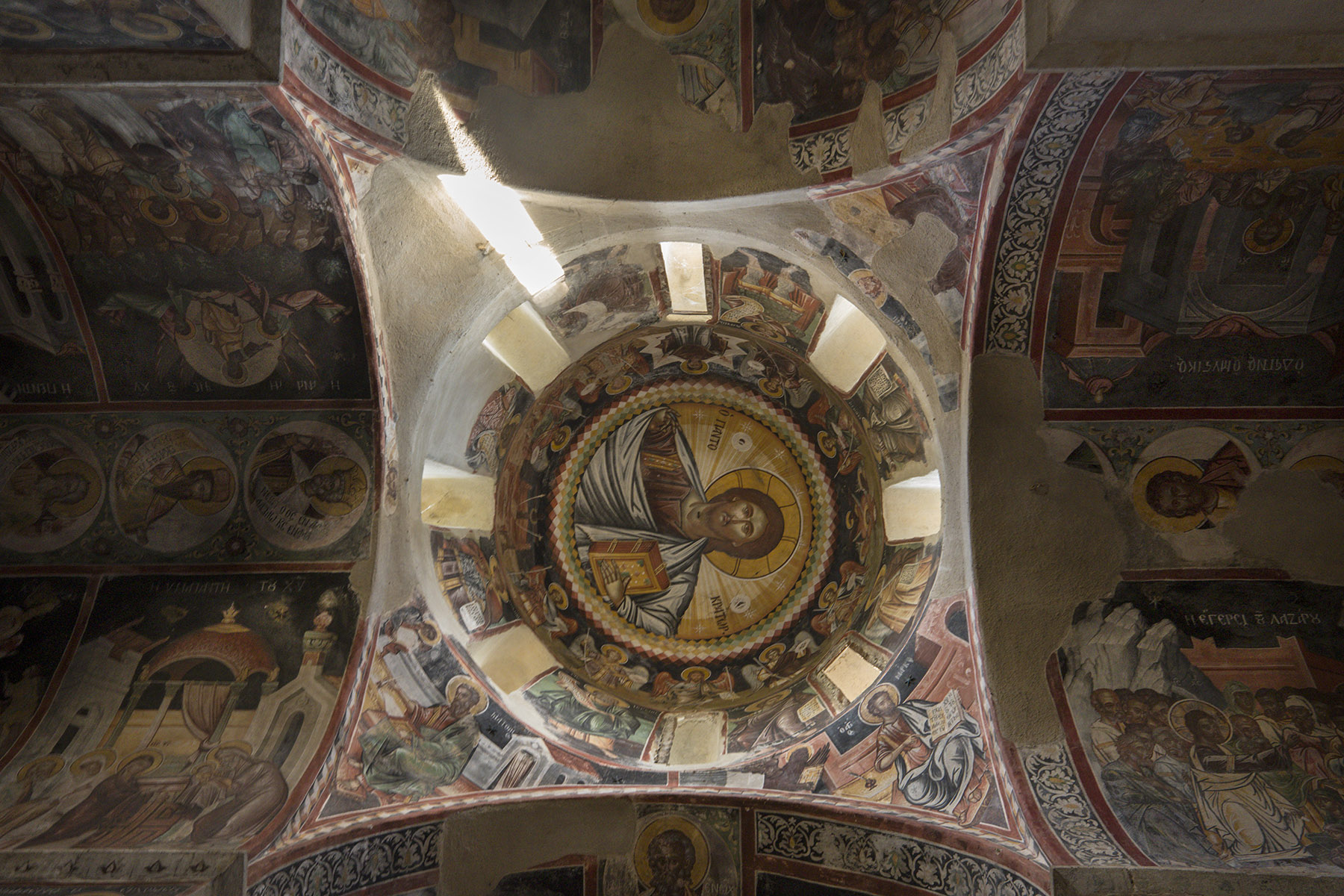
Step into the narthex and the Ottoman-era painting hits you in pieces - Christ Pantokrator filling the cupola overhead, the Virgin enthroned in a lunette, evangelists rendered in dark earth tones with gold accents almost rubbed away by three centuries of candle smoke. The wealthy Benizelos family of Athens paid for these frescoes in 1682, and the painter Ioannis Ypatos came up from the Peloponnese to execute them. He was working in a tradition descended from the great fresco workshops of Mount Athos a century earlier - more popular in style than the rigorous Byzantine painters of Constantinople, but recognizably the same visual language. An older fresco of the Theotokos, painted in the fourteenth century by some unnamed rural hand, survives on the external southern wall. Sweeping brushstrokes, half-faded. The earliest surviving image at the site.
Bath, Refectory, Cells
What is unusual at Kaisariani is how much of the monastery's working life is still legible. The eleventh-century bath house - actually contemporary with the church - sits to the south, its small dome supported on pendentives. Greek monks of this period bathed regularly, and warm water from the heated bath was used to warm the cells and refectory in winter. After the Ottoman conquest the bath was repurposed into an olive oil press, and the great clay jars used for storing oil are still there, evidence of the conversion. The refectory and kitchen sit on the western side, with a square hearth in the center and a chimney through the vaulted roof. Monks ate communally here, listening to readings from the lives of saints. Modern restoration has been hindered by earthquakes - serious damage in 1981, more in 1999, work paused for years at a time - but the bones of the place remain.
Forest, Springs, City Below
Today Kaisariani sits inside a protected pine and cypress forest, replanted after centuries of clearing for fuel. The Athens metropolitan area sprawls just below, its eastern edge lapping at the foot of Hymettus, but up here the air still smells of resin and the springs still run cool. Hikers and cyclists pass through on weekends. Athenians come up to escape the heat. The grave of the abbot Theophanis Kavallaris, who taught grammar and natural philosophy here in the 1720s, is somewhere on the grounds. The monks are gone - the monastery has been a working museum since the mid-twentieth century - but the place still has the quality monastic communities cultivate by their presence: a gathered, listening silence. The kind of silence that survives even when the city below is roaring.
From the Air
Located at 37.9607°N, 23.7981°E on the western slope of Mount Hymettus, just east of Athens. Cruising 4,000-7,000 ft offers views of the Athens basin, the Saronic Gulf, and the long ridge of Hymettus stretching south. Nearest airport: Athens International (LGAV) about 15 km east. Watch for the radio masts on Hymettus's summit. Afternoon thermals build along the eastern face.