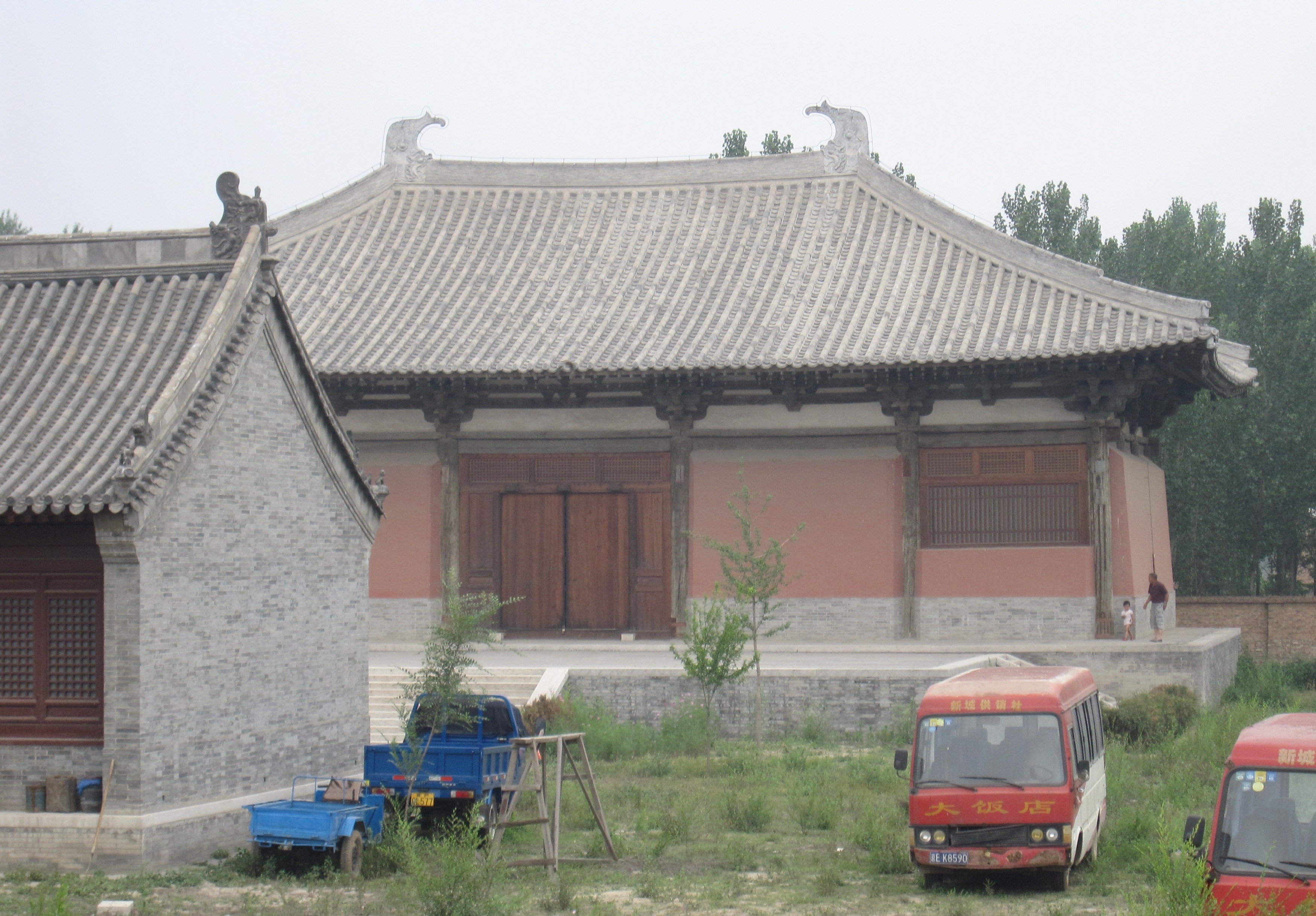
Kaishan Temple
The date is written on a beam inside the main hall: 1033 AD. Nearly a thousand years ago, during the Liao dynasty, craftsmen raised this structure in the northeast corner of a walled town called Xincheng, near what is now Gaobeidian in Hebei Province. The temple they built had already been standing for two centuries by then -- Kaishan Temple was first founded during the Tang dynasty, before Xincheng itself was established in 832 CE. Locals called it simply Dasi, the Big Temple. What survived to the present day is not the original Tang-era structure but the Liao dynasty main hall, a building that has endured by being continuously repurposed: as a place of worship, a school, a granary, and finally, after a government-funded restoration completed in 2007, something close to its original self.
A Hall That Leans Inward
The Mahavira Hall -- the Main Hall, or Daxiongbao Dian -- measures 30.4 by 18.5 meters, five bays by three, and sits on a stone platform 1.11 meters high. In front of it stretches a large yuetai, a ceremonial platform measuring 27.6 by 11.4 meters. The engineering reveals its age in fascinating ways. Columns are set into square stone bases and support massive eaves whose overhang equals 55 percent of the columns' height. Most tellingly, the back and side pillars incline slightly toward the interior of the hall, a structural feature associated exclusively with pre-Yuan dynasty Chinese architecture. This inward lean is not a sign of settling or damage; it is intentional, a technique that distributes the weight of the heavy tiled roof more effectively. Buildings this old that still demonstrate this feature are extraordinarily rare.
From Buddha to Blackboard
Before 1928, the hall's central devotional image was likely Guanyin, the bodhisattva of compassion, flanked by four esoteric bodhisattvas on each side and luohans -- enlightened disciples -- along the walls. Then the temple was converted into a school, and the religious imagery gave way to desks and lessons. Later it served as a granary, its sacred space filled with grain storage. During the Cultural Revolution, houses were built directly on the temple grounds, encroaching on and damaging the surroundings. Through all of these transformations, the main hall's structure held. The beams that bore the date 1033 continued to bear weight, indifferent to whatever purpose the humans below assigned to the space they supported.
The Long Restoration
In 2001, the Chinese government initiated a restoration project with the explicit goal of returning Kaishan Temple to its historical state. The work, funded by the government and guided by conservation principles documented by scholar Liu Zhimin, took six years to complete. The restoration finished in 2007, and the temple was prepared for public access. The challenge was significant: restoring a Liao dynasty structure requires understanding construction techniques that have been obsolete for centuries, reading the building itself as a document of practices that no living craftsman was trained in. Nancy Shatzman Steinhardt's scholarship on Liao architecture, published by the University of Hawaii Press, has been instrumental in placing buildings like Kaishan Temple's main hall within the broader context of northern Chinese architectural history.
Quiet Survival
Kaishan Temple does not command the fame of China's great Buddhist complexes. It sits in a village near a small city, surrounded by the ordinary landscape of Hebei Province. But its survival is itself remarkable. The Tang dynasty founding, the Liao dynasty hall, the centuries of use and misuse, the Cultural Revolution damage, the careful restoration -- each layer adds to a story of a building that persisted not because anyone set out to preserve it as a monument, but because it kept being useful enough to maintain. There is something humble and powerful in that persistence, a reminder that the most enduring structures are often not the grandest ones but the ones that people simply could not bring themselves to tear down.
From the Air
Located at 39.25°N, 115.98°E near Gaobeidian, Hebei Province, approximately 120 km south-southwest of Beijing. The temple is in a village setting and not distinguishable from altitude. Nearest major airport is Beijing Daxing International (ZBAD), roughly 100 km to the northeast. Recommend lower altitudes of 2,000-4,000 ft to appreciate the flat agricultural landscape and scattered village settlements typical of this part of the North China Plain.