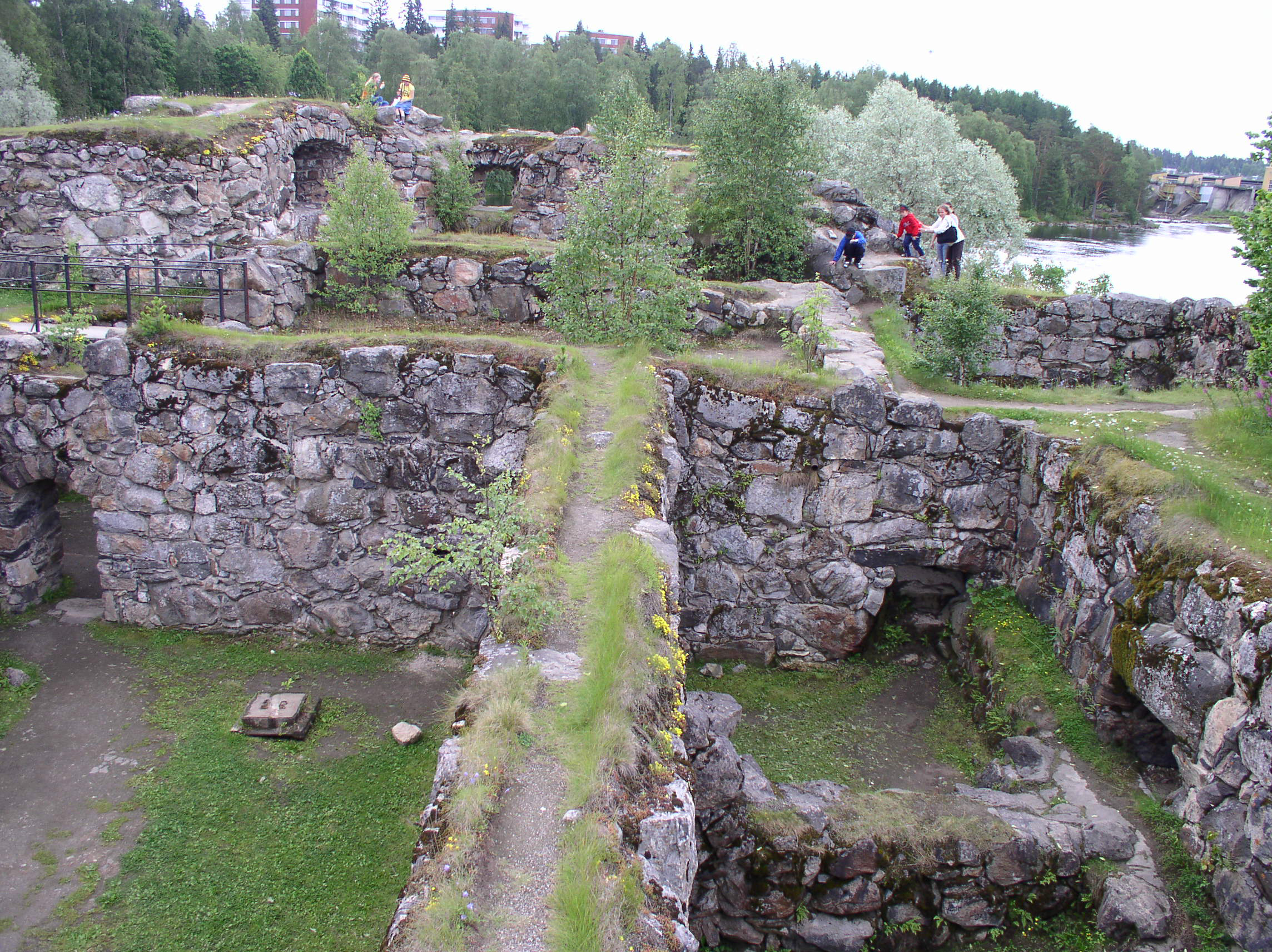
Kajaani Castle
The island was too small. Everyone knew it. When King Charles IX of Sweden ordered a castle built on the islet between the Ammakoski and Koivukoski rapids of the Kajaani River in 1604, the foundation had to be enlarged with piling and embankment before a single stone could be laid. Yet from this improbable perch in the Kainuu wilderness, the last medieval-style stone castle ever constructed in Sweden would rise -- and upon completion become the northernmost stone castle in all of Europe. Its walls climbed directly from the churning rapids, as if the river itself held the fortress aloft.
A Prison Before It Was Finished
Construction began under the master builder Clemens Eriksson, though the castle was barely habitable when it received its first inmates. Before the walls were complete, Kajaani Castle was pressed into service as a prison -- and not for common criminals. Johannes Messenius, a professor at Uppsala University, was sentenced to confinement there for his contacts with the Jesuits and the Pope. He endured the castle's harsh conditions from 1616 to 1635, nineteen years in a half-finished fortress at the edge of the known world. The poet-adventurer Lars Wivallius also spent years within these walls. Centuries later, the Finland-Swedish poet Lars Hulden would imagine their inner lives in his 2010 collection Kajaneborg 1636, giving voice to men whom the Swedish crown had tried to silence through geography and granite.
The Count's Brief Golden Age
The castle found its stride when Count Per Brahe the Younger took charge of the region in the 1650s. Under Brahe's tenure, the town of Kajaani was formally founded in 1651, growing up beside the fortress like a village around a church. Plans emerged to transform the austere military structure into a proper noble residence. Stone replaced wood inside the walls; a great hall was added to the eastern tower in 1669. The chancellery building rose to two stories, its rooms whitewashed with limestone, the commander's quarters floored in brick. Double houses lined the interior, each with a shared porch between paired residences -- an architectural intimacy unusual for a frontier fortress. But this golden age ended abruptly in 1681, when the Great Reduction abolished the fief. Kajaani Castle reverted to a simple administrative post for Sweden's northernmost territories, its dreams of grandeur quietly shelved.
Siege, Explosion, and Silence
During the Great Northern War, Russian forces laid siege to the castle. The garrison held out, but in 1716 the attackers destroyed it with explosives. The blast that ended Kajaani Castle was, in a sense, redundant -- the fortress had already outlived its strategic purpose in a world where warfare had moved beyond medieval walls. After 1809, when Finland passed from Swedish to Russian control, the island of Linnasaari remained important only as a river crossing. The roofless ruins stood largely forgotten until the 1930s, when construction of a new concrete bridge turned up old artifacts and awakened archaeological interest. Restoration campaigns followed in the 1890s and again from 2001 to 2008, when the Finnish Heritage Agency repaired the walls and the city built a pedestrian bridge to the island.
Granite Memory on the Rapids
Today the outer wall's surviving section -- originally about 39 meters long, 9.6 meters high, and 3.6 meters thick -- still anchors the island between the two rapids. Traces of white lime mortar cling to the stonework, and the window embrasures retain hints of their original red coloring. The poet Eino Leino, who would become one of Finland's most celebrated writers, published his very first printed poem about the siege of Kajaani Castle in 1890, describing the desperate situation of women and children who had sought refuge within its walls. In 2014, the site passed to the care of Metsahallitus, Finland's forestry agency, joining 28 other nationally significant cultural heritage sites. The castle that was too large for its island, too remote for its prisoners, and too medieval for its wars persists as ruin -- which, in Finland, is simply another word for endurance.
From the Air
Located at 64.23N, 27.73E on an island in the Kajaani River, between the Ammakoski and Koivukoski rapids. The ruins are visible from low altitude as stone walls on a small river island in central Kajaani. Nearest airport is Kajaani (EFKI), less than 10 km to the northwest. The castle sits east of Lake Oulujarvi in the Kainuu region. The surrounding terrain is flat boreal forest and lake country, with the city of Kajaani visible along the riverbanks.