Kakamega Forest
Nine orchid species grow in Kakamega Forest that grow nowhere else. This fact alone would make the place remarkable, but it barely hints at what this 238-square-kilometre patch of green represents. Kakamega is Kenya's only tropical rainforest -- the easternmost surviving fragment of the vast Guineo-Congolian forest that once stretched unbroken from the Atlantic coast to the shores of Lake Victoria. What took millions of years to establish now clings to the hills of western Kenya, surrounded on all sides by one of the most densely populated rural landscapes on the continent.
A Forest Out of Place
Kakamega sits where you would not expect a rainforest. At elevations between 1,500 and 1,600 metres, on undulating terrain between the Nandi Escarpment and Lake Victoria, it receives between 1,200 and 1,700 millimetres of rain annually. The long rains arrive in April and May, followed by a drier June, then a second peak in August and September. Temperatures hold remarkably steady year-round, between 20 and 30 degrees Celsius -- a consequence of sitting almost exactly on the equator. The Isiukhu and Yala rivers originate on the escarpment to the east, flow westward through the forest canopy, and eventually empty into Lake Victoria. Throughout the forest, a patchwork of grassy glades punctuates the tree cover. Some are clearly recent clearings, but others predate any recorded history. They may be the legacy of elephants and buffalo that once roamed here -- both now locally extinct -- or of cattle-grazing communities whose names have been forgotten.
The Inventory of Life
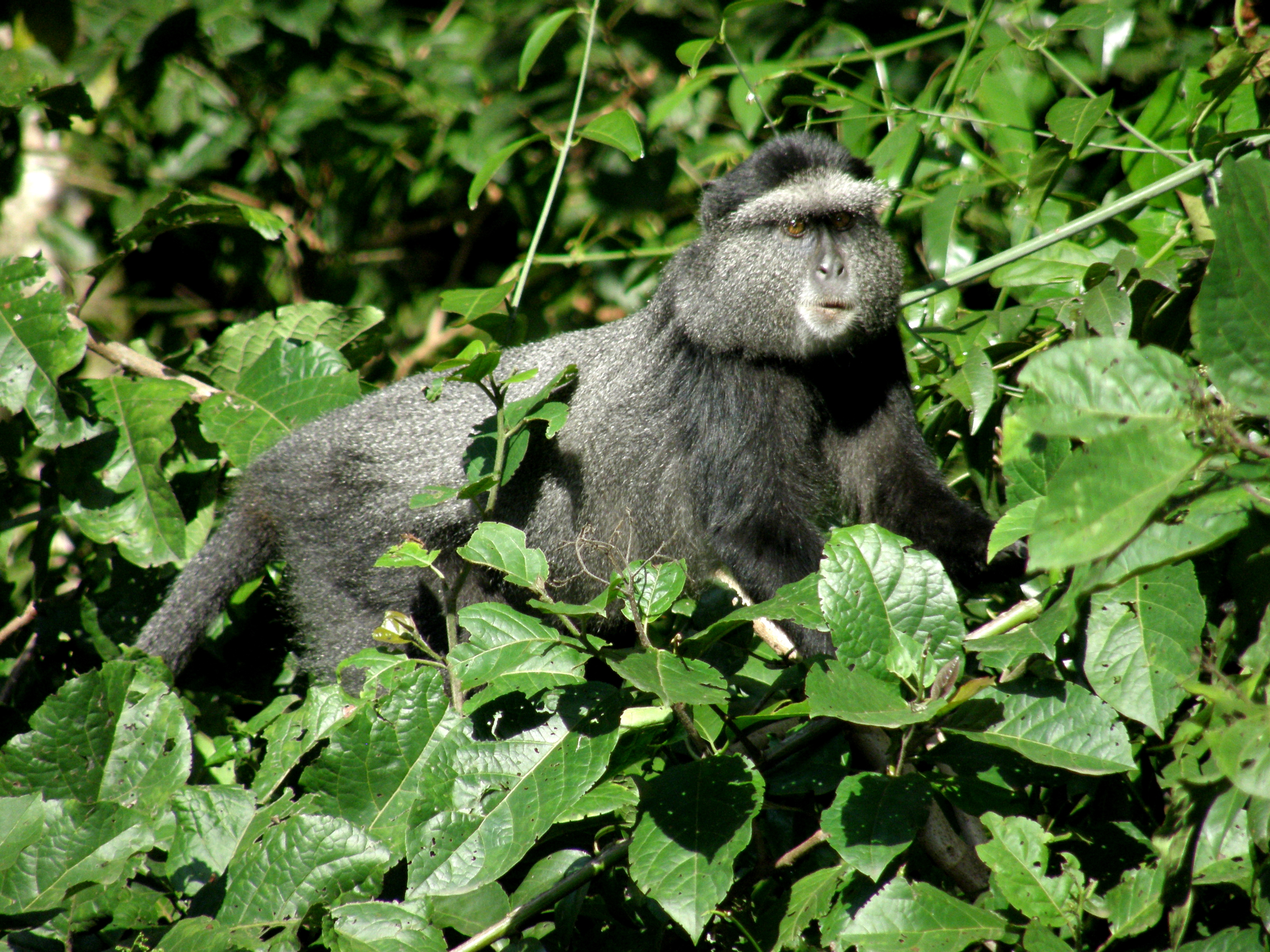
The biodiversity numbers are staggering for a forest this size. Botanists have recorded 380 plant species: 60 species of ferns, 150 trees and shrubs, and 170 flowering plants including those nine endemic orchids. The canopy holds some of Africa's most prized hardwoods -- Elgon teak, red stinkwood, and the towering Aningeria altissima. Beneath the canopy, 367 bird species have been documented. The great blue turaco, a West African species that has no business being in Kenya by any conventional biogeographic logic, lives here. So does the black-and-white-casqued hornbill. At least nine bird species are found nowhere else. The mammal list includes blue monkeys, red-tailed monkeys, De Brazza's monkeys, pottos, tree pangolins, and bush pigs. Leopards were last officially sighted in 1991. And then there are the insects: 489 butterfly species, Goliath beetles the size of a child's fist, and pink-and-green flower mantises that look like evolutionary art projects.
The Shrinking Canopy
Kakamega Forest Reserve was designated in 1933, but protection has not halted the pressure. Less than half of the 238-square-kilometre reserve area remains as indigenous forest today. The Kakamega National Reserve, covering 44.7 square kilometres in the northern portion, received official status only in 1985. In 1967, the Isecheno and Yala nature reserves were carved out within the larger forest reserve. The surrounding region is among the most densely populated rural areas on Earth, and the forest provides firewood, building poles, and traditional medicines to communities that have relied on it for generations. Cattle graze in some of the glades. From 2001 to 2010, the German-funded BIOTA East project worked to create inventories of the forest's species and develop strategies for sustainable use. The fundamental tension remains: the forest is irreplaceable, but the people who live around it have needs that are immediate and non-negotiable.
Walking the Green Cathedral
The most accessible entry point is the Isecheno Forest Station in the southern section, managed by the Kenya Forest Service. Here stands the Mama Mtere tree, a massive specimen that has become the most photographed tree in Kakamega -- a local landmark that anchors countless visitors' memories. Strangler figs wrap their roots around host trees in slow, centuries-long embraces. Hiking trails thread through the forest floor, and the best birdwatching comes at the edges of the day: dawn walks between 6:30 and 8:30 in the morning, or evening excursions from 4:30 to 6:30, when the canopy comes alive with calls. The Kakamega Rainforest Tour Guides can arrange visits to the Crying Stone at Ilesi along the Kakamega-Kisumu road, or trips to the Kisere Forest Reserve in the north to spot De Brazza's monkeys. What strikes most visitors is the sound. Away from the trails, the forest hums with insect life, punctuated by bird calls that carry through the canopy in ways that open savanna never allows.
From the Air
Located at 0.29N, 34.86E on the equator in western Kenya. From the air, the forest appears as a dense green patch contrasting sharply with surrounding agricultural land and settlements. Elevation 1,500-1,600m. Nearest major airport is Kisumu International Airport (HKKI), approximately 60 km to the south. Eldoret International Airport (HKEL) lies about 80 km to the northeast. Best viewed at 3,000-5,000 ft AGL for canopy detail and the contrast between forest and farmland.