Kakegawa Castle
The bill came to one billion yen, and the citizens of Kakegawa paid it themselves. In April 1994, a wooden keep rose again on the hilltop at the center of their city -- the first castle tower reconstructed using traditional methods in postwar Japan. No steel frames hiding inside plastered walls, no concrete poured behind a historical facade. Kakegawa Castle's tenshukaku was built the way Yamauchi Kazutoyo's builders would have recognized four centuries earlier, assembled from timber using surviving diagrams of the original structure. The result stands today above the old Tokaido highway as both a monument to feudal engineering and a statement of civic pride.
Crossroads of Power
Kakegawa's strategic importance was written into the landscape long before any castle stood here. The city controlled a vital stretch of the Tokaido, the great highway connecting Kyoto with eastern Japan, and had served as an important post station since the Heian period. Whoever held Kakegawa held the eastern half of Totomi Province. The first fortification appeared between 1469 and 1487, built by Asahina Yasuhiro for warlord Imagawa Yoshitada. For generations, the Asahina clan held the castle as Imagawa retainers. Then came the Battle of Okehazama in 1560, where the Imagawa were shattered. Their territories fell to two of Japan's most famous rivals: Takeda Shingen of Kai Province and Tokugawa Ieyasu of Mikawa. In 1568, after a grueling five-month siege, Asahina Yasutomo surrendered Kakegawa to Tokugawa forces. The castle would remain in Tokugawa hands for decades.
The Builder and His Legacy
The castle that visitors see today owes its form to Yamauchi Kazutoyo, a retainer of Toyotomi Hideyoshi. After the Battle of Odawara in 1590, Hideyoshi forced Tokugawa Ieyasu to trade his Tokai domains for the Kanto region. Kakegawa passed to Yamauchi as the center of a 51,000 koku domain -- later expanded to 59,000 koku. Yamauchi completely rebuilt the castle to contemporary standards, laying out the stone walls, moats, and baileys that define the site to this day. When the Tokugawa shogunate consolidated power, they reclaimed their old territories and shuffled Yamauchi off to Kochi in distant Shikoku. Kakegawa rotated through a procession of fudai daimyo -- trusted hereditary lords -- ending with seven generations of the Ota clan. The keep Yamauchi had built was destroyed by an earthquake in 1604 and reconstructed in 1621.
Earthquakes and Endurance
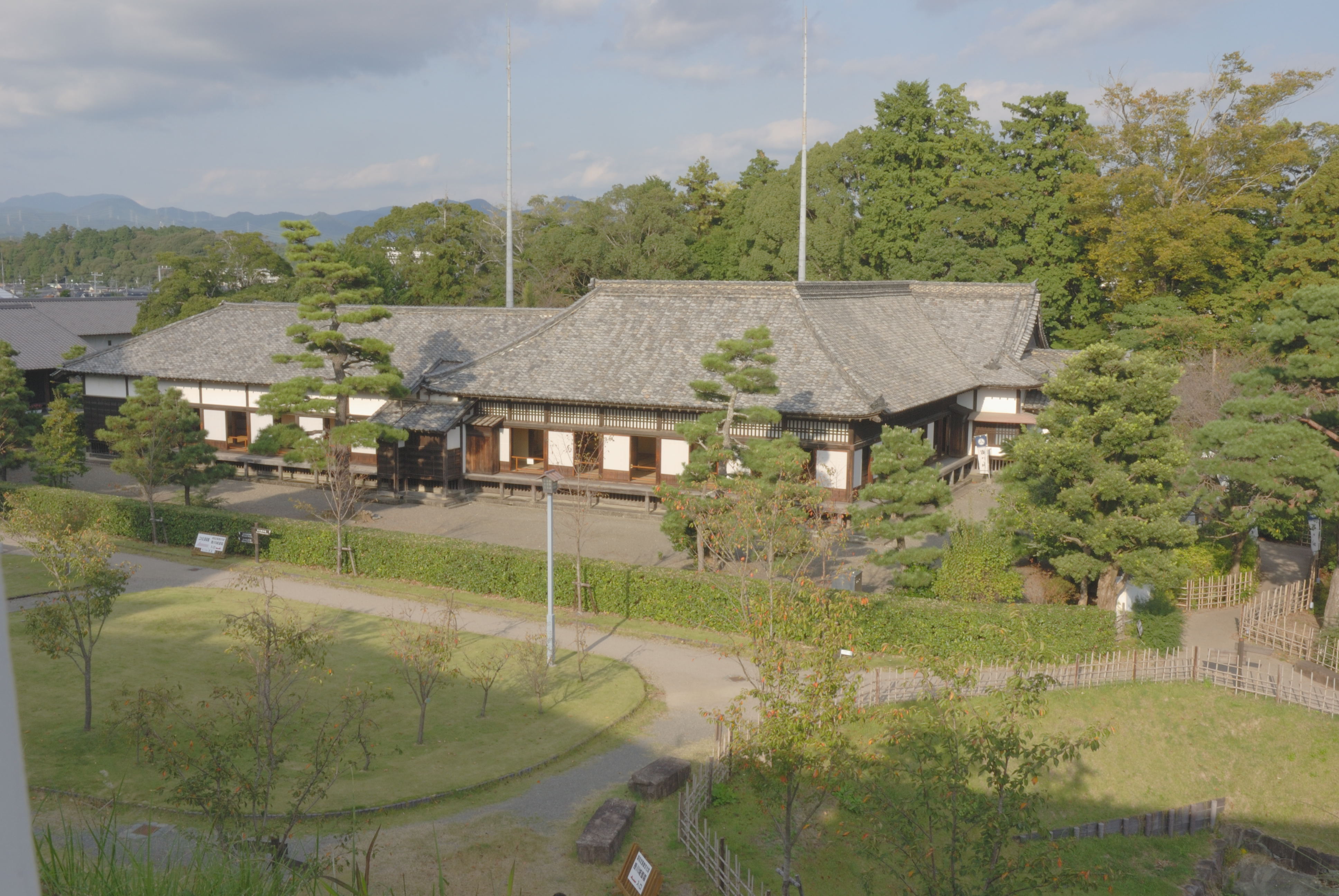
If any theme runs through Kakegawa Castle's story, it is resilience against seismic violence. The 1604 earthquake toppled the original keep. Two and a half centuries later, the devastating Ansei Tokai earthquake of 1854 inflicted extensive damage across the entire complex. Most structures were painstakingly rebuilt by 1861 and pressed into service as local government offices after the Meiji Restoration -- but the keep itself was left in ruins. It would remain a gap in the skyline for 140 years. What survived earned recognition: the daimyo's mansion, rebuilt after the 1854 quake by Ota Sukekatsu, was registered as an Important Cultural Property in 1980. A gate from the main bailey, dating to 1659, was given to the Buddhist temple of Yusan-ji in nearby Fukuroi, where it still serves as the main entrance.
Rebuilt by Hand
The 1994 reconstruction was an act of deliberate authenticity. Engineers worked from a handful of surviving diagrams to recreate the tenshukaku in wood, using the same joinery techniques that castle builders had employed in the Edo period. Along with the keep, sections of the innermost bailey, walls, and a yagura watchtower were rebuilt. The entire project was funded largely through public donations, reflecting a city-wide commitment to preserving its feudal heritage. In 2006, the Japan Castle Foundation recognized Kakegawa as one of the 100 Fine Castles of Japan, citing its historical significance. Today the castle grounds include the original stone walls and moats, the surviving guardhouse and drum house, and the reconstructed keep commanding views across the surrounding tea plantations and the distant ridgeline of the Tokaido mountains.
From the Air
Located at 34.78°N, 138.01°E atop a small hill in central Kakegawa. The reconstructed wooden keep and surrounding stone walls are visible from low altitude against the urban grid of the city. The nearest major airport is Mt. Fuji Shizuoka Airport (RJNS), approximately 15 km to the southwest. Hamamatsu Air Base (RJNH) lies about 40 km to the west. Best viewed at 2,000-4,000 feet, where the castle hilltop stands out against the flat city center and the Tokaido Shinkansen line running nearby provides a useful orientation reference.