Kalijodo Park
The name means "river of soulmates." In the 1950s, young men floated down the Angke River on boats during the Peh Cun festival, tossing bean cakes to the women who caught their eye. If a woman accepted, she threw one back. It was matchmaking by confection, gentle and public, part of a Chinese Indonesian holiday that celebrated the hundredth day of the lunar calendar. Then the celebrations were banned, the river went foul, and the neighborhood became synonymous with something else entirely. For decades, Kalijodo was Jakarta's most infamous red-light district - a place controlled by gangs, fueled by alcohol, and avoided by families. Today, on that same ground, children ride BMX bikes around concrete ramps while ten of Indonesia's best street artists stare back from a 23-meter mural wall. The transformation happened fast, and not without controversy, but the park that stands here now is among the most remarkable urban reclamations in Southeast Asia.
Bean Cakes and Soulmates
Kalijodo was once a Chinese Indonesian neighborhood where the Angke River ran clean and green. The name itself is a compound: kali, Indonesian for river, and jodoh, meaning mate or soulmate. The etymology traces back to the Peh Cun water festival, during which young people would float side by side in boats, and a man who fancied a woman would toss her a bean cake as an overture. Acceptance was signaled by a return toss. The tradition vanished in 1958 when Jakarta Mayor Sudiro, who served from 1953 to 1960, banned Chinese cultural celebrations across the city. Without the festival, the riverbank lost its romantic associations. By 1963, prostitution had taken root along its banks, though some accounts trace the area's role in the sex trade much further back - to the 1600s, when fugitives from Manchuria docked in Batavia and sought temporary companions among local women who sang Chinese classical songs from boats on the river.
Decades in the Shadows
For more than half a century, Kalijodo occupied an uneasy place in Jakarta's geography - everyone knew what it was, but no administration could muster the political will to confront the entrenched gangs that controlled the area. The red-light district sprawled across the border of North and West Jakarta, a maze of narrow lanes and makeshift bars. Prostitution is ostensibly illegal in Indonesia, yet Kalijodo operated in plain sight. The city government talked about cleanup for as long as anyone could remember. What finally broke the paralysis was a drunk driver. On 9 February 2016, a 24-year-old who had consumed ten alcoholic beverages sped through the area at 100 kilometers per hour, killing four people. The incident galvanized the Jakarta city administration into swift action. Bulldozers arrived shortly afterward, and the demolition began.
The Human Cost of Clearance
The demolition was fast and forceful, and human rights organizations pushed back almost immediately. The rapid eviction violated principles of involuntary resettlement outlined in the UN's International Covenant on Economic, Social and Cultural Rights, which Indonesia had ratified in 2005. The covenant mandates consultation with affected residents and protections to ensure no one is left homeless or vulnerable - neither of which were adequately observed in the rush to raze Kalijodo. The Indonesian National Commission on Violence Against Women raised particular concern about the welfare of the sex workers who had lived and worked there. Many of these women had few options and fewer resources. The demolition removed the visible problem but did little to address the underlying economic desperation that had sustained it. Whatever Kalijodo became next, the people who had inhabited it were largely left to fend for themselves.
Concrete Ramps Where Bars Once Stood
What rose from the rubble was ambitious. The 3.4-hectare park, funded through corporate social responsibility contributions from private companies, opened on 22 February 2017 with a concept its designers called a semi-natural green park. The centerpiece is an international-standard skate park - one of the largest in the region - surrounded by a bicycle track and anchored by concrete ramps, iron railings, and stair-sets that draw riders from across Jakarta. An amphitheater sits beside an open-air function hall, its translucent roof punctured by a central void where trees grow, letting the tropical breeze thread through. The 23-meter wall surrounding the amphitheater became a canvas for ten of Indonesia's leading mural artists and graffiti writers, turning bare concrete into a gallery. On the north side, a brick-and-steel monument called Sumur - a well - commemorates the old matchmaking days, built on the Sanskrit philosophy of lingam-yoni as a symbol of sacred fertility.
A Fragment of Another Wall
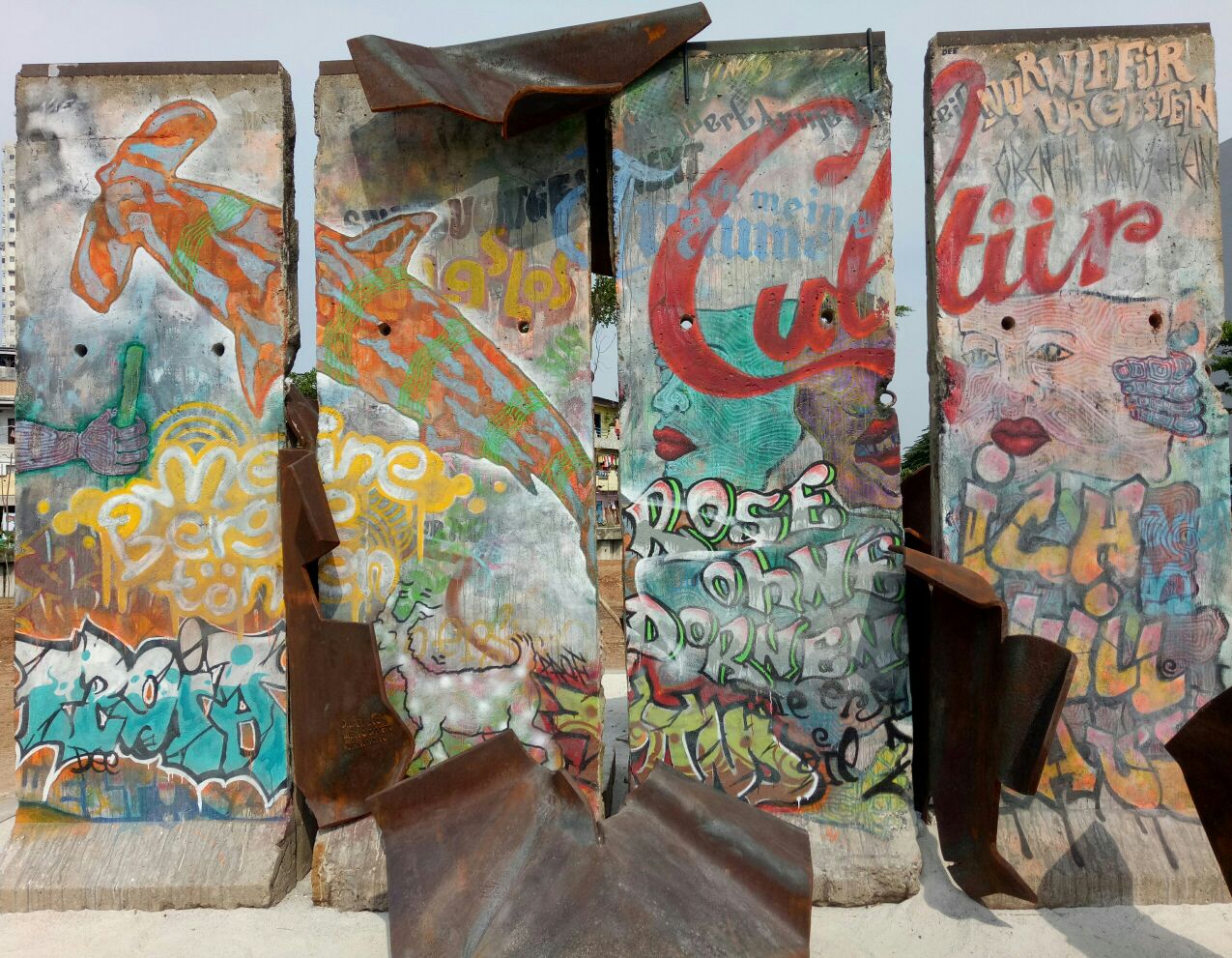
Among the park's more surprising features is a section of the Berlin Wall - a concrete slab from the barrier that divided East and West Germany until 1989, now standing in the tropical heat of North Jakarta. It is an improbable artifact for a park built on a demolished red-light district, yet the symbolism is hard to miss: walls come down, and what replaces them defines a city's character. Kalijodo Park also houses a child-friendly integrated public space known locally as RPTRA, a Betawi-style mosque, a food court, and a futsal court. The park is occasionally used as a concert venue. Families come on weekends, skaters come in the evenings, and the Angke River flows alongside, cleaner than it has been in decades but still a long way from the days when bean cakes sailed across it.
From the Air
Located at 6.14S, 106.79E in Penjaringan, North Jakarta, along the Krendang River near its junction with the Angke River. The park's skate ramps and open green space are visible from lower altitudes against the dense urban fabric of northern Jakarta. Nearest major airport is Soekarno-Hatta International (WIII), approximately 18 km northwest. Halim Perdanakusuma Airport (WIHH) lies about 20 km southeast. The area sits near the coast of the Java Sea, with the old port of Sunda Kelapa visible to the northeast.