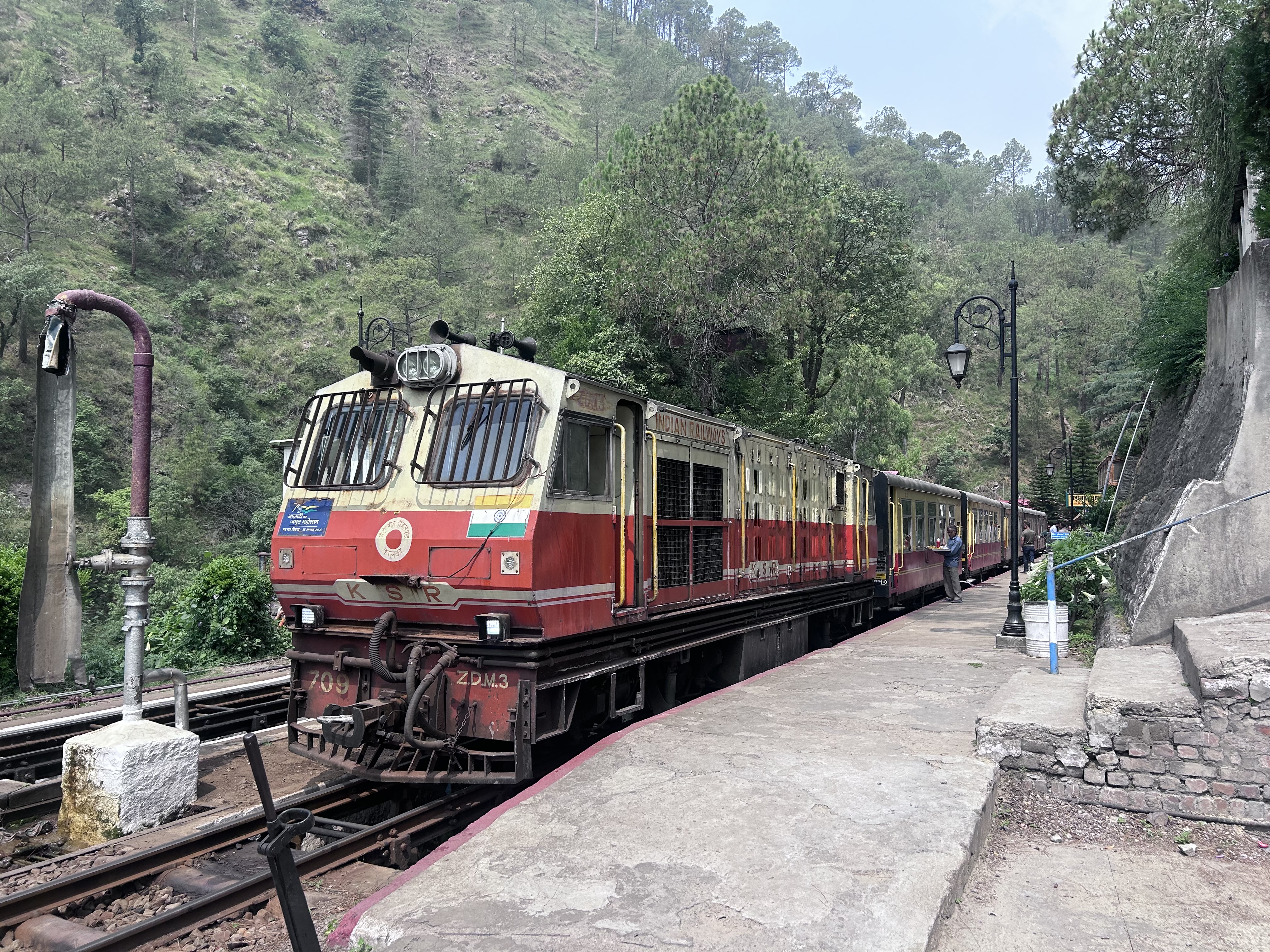
Kalka-Shimla Railway
Twice a year, the entire British colonial government of India packed up and moved. Calcutta's heat was unbearable, and Shimla -- perched at 7,116 feet in the Himalayan foothills -- was the designated escape. Before 1903, that meant an agonizing journey by horse and ox-drawn cart up switchback mountain roads. Then Herbert Septimus Harington built a railway that made the impossible routine: a narrow-gauge line that climbs from the plains at Kalka through 103 tunnels, across 969 bridges, around 912 curves, and up a relentless 1:33 gradient to deliver passengers into the pine-scented air of what was then the summer capital of the British Raj.
An Imperial Escalator
The idea surfaced as early as 1847, when a correspondent to the Delhi Gazette suggested connecting Shimla by rail. But surveys did not begin until 1884 and 1885, and the project report did not reach the government of British India until 1887. Construction finally started in 1898 under Harington's direction. The line opened for traffic on November 9, 1903, and was extended to Shimla Goods station on June 27, 1909, bringing the total length to 96.6 kilometers. The engineering was remarkable for its era, but the economics were brutal. By 1904 the company had spent over 16.5 million rupees with no prospect of profitability. The government purchased the railway on January 1, 1906, for just over 17.1 million rupees -- essentially a bailout justified by the line's strategic importance to a capital city that happened to sit on a mountainside.
Steam, Steel, and Aluminium
The railway's early locomotives came from Sharp, Stewart and Company, but the line's workhorse engines were thirty 2-6-2T tank locomotives built by the Hunslet Engine Company and North British Locomotive Company between 1904 and 1910. Weighing about 35 long tons each, they handled most traffic during the steam era. In a clever 1908 innovation, the coach stock was rebuilt with steel frames and aluminium roofs -- an early use of aluminium in rail construction that reduced tare weight enough to let each locomotive haul six bogie coaches instead of four. Diesel locomotives arrived in 1955, and diesel-hydraulic power followed in 1970. A pair of massive Kitson-Meyer articulated locomotives, delivered in 1928, proved a failure: it took all day to assemble enough freight to justify running one. Shippers increasingly turned to road transport, and the heavy engines were transferred to the Kangra Valley Railway.
Through the Mountain's Bones
The track's statistics read like a feat of stubbornness. Twenty stations mark the climb, each at a different altitude. The longest tunnel -- 1,143 meters at Barog -- plunges through the mountain just before Barog station. The sharpest curve bends at a radius of just 38 meters, tight enough that passengers on longer trains can see the locomotive from the rear coach. The original 42 lb/yd rail has since been replaced with heavier 60 lb/yd track, but the alignment remains essentially unchanged from Harington's design. At Koti station, workers excavating for the railway discovered a 20-million-year-old plant fossil from the Miocene era, evidence that these mountains once bordered the Tethys Ocean. The Birbal Sahni Institute of Palaeosciences is studying the find, and there are efforts to designate the site as a Geo Heritage Site.
Heritage on a Precarious Ledge
On July 8, 2008, UNESCO inscribed the Kalka-Shimla Railway as part of the Mountain Railways of India World Heritage Site, joining the Darjeeling Himalayan Railway and Nilgiri Mountain Railway. The recognition was hard-won -- a UNESCO inspection team spent a week on the line in September 2007 before recommending it. Television followed: the BBC documentary series Indian Hill Railways won a Royal Television Society award in 2010, and the KSR appeared on CNN's Anthony Bourdain: Parts Unknown and BBC Two's Great Indian Railway Journeys. But heritage status has not made the line invulnerable. During the 2023 North India floods, landslides washed out several sections of track, leaving the 114-year-old heritage line suspended in air above collapsed hillsides. The railway has been rebuilt before and will be again, but each monsoon season tests whether this mountain infrastructure -- conceived for a colonial summer capital -- can endure a climate that is growing less predictable.
From the Air
The Kalka-Shimla Railway runs from Kalka (30.84N, 76.94E, elevation ~656m) to Shimla (31.10N, 77.17E, elevation ~2,170m) in Himachal Pradesh. The 96.6 km route is visible as a thin thread of track winding through the Himalayan foothills with 103 tunnels and 969 bridges. Recommended viewing at 6,000-8,000 ft AGL to see the switchbacks. Nearest airports: Shimla (VISM) and Chandigarh (VICG), approximately 23 km and 85 km respectively. Mountain terrain with variable weather; morning visibility is typically best.