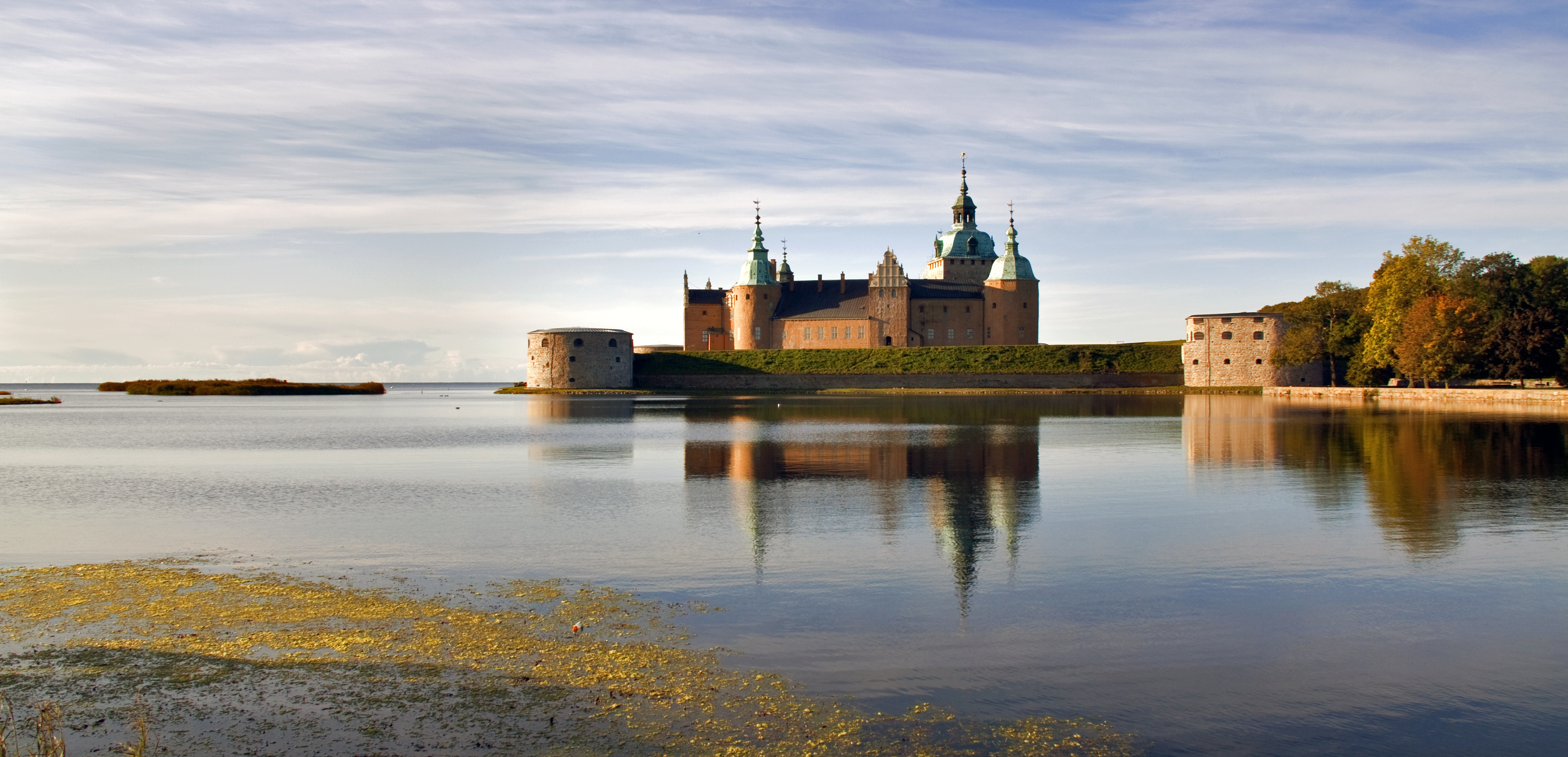
Kalmar Castle
The dinner invitation arrived in 1397 with the weight of continental politics behind it. Queen Margaret I of Denmark had chosen Kalmar Castle as the setting for one of history's most ambitious experiments in unity: the merger of Denmark, Norway, and Sweden into a single realm. The stone walls that had begun as a simple defensive tower in the twelfth century would bear witness to this moment of Scandinavian consolidation, and to the centuries of intrigue, rebellion, and bloodshed that followed.
From Watchtower to Kingmaker
The castle's origins lie in a round defensive tower built during the twelfth century overlooking Kalmarsund, the strait separating mainland Sweden from the island of Oland. King Magnus Ladulas expanded this modest fortification at the end of the thirteenth century, surrounding the original tower with curtain walls, round corner towers, and two square gatehouses. The location proved strategically vital, commanding the waters that connected the Baltic world. When Margaret I assembled the nobles of three kingdoms here in 1397 to forge the Kalmar Union, she chose wisely. The fortress projected power while its position at the crossroads of Scandinavian trade routes made it accessible to all parties. For over a century, this union would hold together an empire stretching from Greenland to Finland.
A Woman Holds the Walls
The castle's most remarkable defender may be Anna Eriksdotter Bielke, who took command in 1520 during Sweden's rebellion against Danish rule. When her husband Johan Mansson Natt och Dag died in the midst of the uprising, Anna did not retreat. She assumed control of his fiefs and defended Kalmar against Denmark, a woman commanding a strategic fortress in an age when such authority rarely fell to her sex. The castle changed hands repeatedly during these tumultuous years, its thick walls scarred by the ambitions of rival crowns.
Renaissance Transformation
The medieval fortress gave way to Renaissance splendor under King Johan III, who began an extensive reconstruction almost immediately after his coronation. In 1574, architect Domenicus Pahr commenced the transformation. Towers were leveled to uniform heights and capped with lead roofs. Windows became squares rather than defensive slits. The king ordered the facade painted white and the roof red, colors that would define the castle's appearance for centuries. Inside, the renovation that began in 1587 created spaces fit for royalty: the Nya kungamaket, or new throne hall, received 2,200 gold-painted leaves as decorative elements, transforming a fortress into a palace.
The Second Bloodbath
Loyalty exacted a terrible price at Kalmar in 1599. The garrison had remained faithful to King Sigismund during Duke Charles's rebellion, holding firm even after Sigismund's decisive defeat at the Battle of Stangebro. When the Duke's forces besieged the castle in March, the defenders held out for two months before surrendering on May 12th. The victors showed no mercy. Three commanders and nineteen garrison members were executed in a mass killing that history remembers as the Second Kalmar Bloodbath, echoing an earlier massacre at the same site. The castle's walls had sheltered defiance, but could not protect against the vengeance of victory.
Decay and Rebirth
The Kalmar War of 1611-1613 left the castle badly damaged, and a fire in 1642 inflicted further wounds. By the late seventeenth century, the once-proud fortress had been abandoned to decay. Restoration began in 1856 under architect Fredrik Wilhelm Scholander, continued by his pupil Helgo Zettervall in the 1880s. The work that concluded in 1891 gave the castle the silhouette visitors see today. Further restoration under Professor Martin Olsson from 1919 to 1941 returned water to the moat, completing the transformation from ruin to one of Sweden's best-preserved Renaissance castles, now open to the public as a living monument to Scandinavian history.
From the Air
Located at 56.658N, 16.355E on Sweden's southeastern coast at the Kalmarsund strait. The castle sits on a small peninsula jutting into the water, making it highly visible from altitude. Best approached from the east over the Baltic for dramatic water-to-land views. Nearest airport is Kalmar Airport (ESMQ), approximately 4 nautical miles west. The island of Oland lies just across the strait to the east. Optimal viewing altitude 2,000-4,000 feet for castle detail while maintaining context of the strategic waterway position.