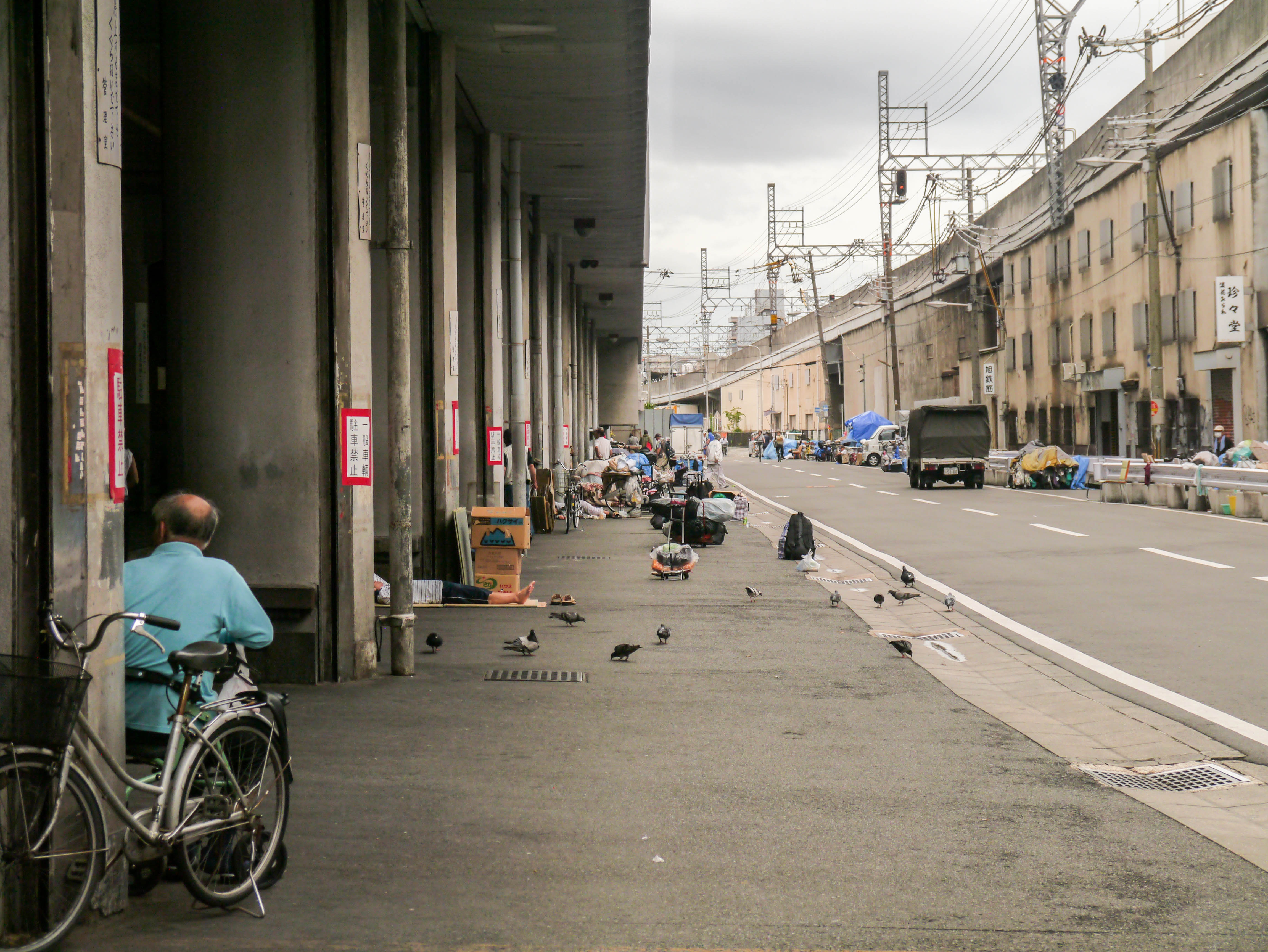
Kamagasaki: The Neighborhood That Doesn't Officially Exist
You will not find Kamagasaki on any official map of Osaka. The city government does not allow the name to appear and discourages its use in the media. Yet walk a few blocks south from the neon carnival of Shinsekai, past the retro tower of Tsutenkaku, and the landscape shifts so abruptly it feels like crossing a border between countries. The tourist sheen evaporates. Rows of doya -- bare-bones lodging houses originally built for day laborers -- line narrow streets. An estimated 30,000 people live within a two-kilometer radius of this area in Nishinari-ku, many of them without permanent addresses, uncounted even in the national census. Kamagasaki is a place that Japan's second-largest city would prefer did not exist, and that stubborn existence is precisely what makes it one of the most important neighborhoods in the country.
A Name Erased, A Place Enduring
Kamagasaki has been a place name since 1922, but in May 1966, the area was officially renamed Airin -- a gentler label that the government hoped would soften the district's reputation. The original name never went away. Locals, journalists, and activists continued using Kamagasaki, and the name persists as an act of defiance against the erasure. The neighborhood itself is not a single administrative district but a patchwork of sections from four or five different officially designated towns, collectively known by the name that does not appear on maps. Property values are noticeably lower than in surrounding areas. Just blocks away, the upscale shopping districts of Nipponbashi and the tourist magnets of Shinsekai attract visitors who may never realize what lies around the corner.
The Day Laborers' District
Kamagasaki became Japan's largest concentration of day laborers through decades of economic gravity. Workers without permanent employment gathered here because the doya hotels offered cheap nightly rooms, the labor exchanges provided daily job assignments, and the density of similarly situated men created a community of mutual survival. The Airin Labor and Welfare Center, which opened in 1970, became the physical symbol of this economy -- a hulking building where men lined up before dawn hoping to be selected for construction, dock, or factory work. Non-profit and religious organizations set up food distribution points, and the long lines in public parks became a daily feature of neighborhood life. The welfare rate in Nishinari-ku is the highest in Japan: 176 people per 1,000 receive Life Protection benefits, compared to 42 per 1,000 across Osaka City as a whole and just 17 per 1,000 in Tokyo.
Riots, Film, and the Fight to Be Seen
Kamagasaki has a history of eruption. The neighborhood has experienced over two dozen riots since the 1960s, flare-ups born of frustration with police treatment, working conditions, and the indignity of being both essential to the city's economy and invisible in its official narrative. The 24th Kamagasaki Riot in 2008 brought images of burning barricades and running battles that the media were quick to broadcast. Photographer Seiryu Inoue documented daily life here in the 1950s, winning the 1961 Newcomer's Prize from the Japan Photography Critics' Society for his series "One Hundred Faces of Kamagasaki." Decades later, when director Ota made a film called "Fragile" that was partially financed by the city and set in the neighborhood, it was pulled from the 2013-2014 Osaka Asian Film Festival after he refused to cut scenes identifying the community and its culture. The pattern repeats: Kamagasaki generates attention that Osaka would rather redirect elsewhere.
Expo Pressure and an Uncertain Future
The approach of World Expo 2025 intensified the pressure on Kamagasaki. As part of broader slum clearance efforts in preparation for the international event, the government ordered the closure of the Airin Labor and Welfare Center -- the building that had anchored the day labor economy since 1970. The closure was framed as modernization, but residents and advocates saw it as another attempt to sanitize the neighborhood out of existence. Meanwhile, the cheap doya hotels have found an unexpected second life: backpackers from outside Japan discovered them as affordable lodging near major rail connections, and some have been rebranded as budget hostels. Shin-Imamiya Station, served by the JR Osaka Loop Line, Nankai Railway, and multiple subway lines, sits at the neighborhood's edge, making Kamagasaki one of the best-connected places in Osaka -- and one of the most deliberately overlooked.
Triangle Park After Dark
The heart of Kamagasaki is a small triangular park wedged between streets, officially unnamed on maps but known to everyone as Triangle Park. It is where community events happen -- the Kamagasaki Summer Festival in August, the May Day gatherings, the Twilight Concerts, the Evening Variety Shows. It is where food is distributed and where people sleep when the doya rooms are full. In a neighborhood that the city would prefer to forget, Triangle Park functions as a town square, a gathering place that insists on the visibility and dignity of people who have been pushed to the margins. That insistence -- quiet, stubborn, daily -- is the real story of Kamagasaki.
From the Air
Located at 34.648N, 135.502E in Nishinari-ku, south-central Osaka. The neighborhood is not visually distinct from the air but can be located relative to prominent landmarks: it sits immediately south of the Tsutenkaku Tower and Shinsekai entertainment district, and adjacent to Shin-Imamiya Station, a major rail junction visible from altitude. Tennoji Park is approximately 500 meters to the east. Osaka International Airport at Itami (RJOO) is approximately 9 nautical miles to the north-northwest. Kansai International Airport (RJBB) is approximately 26 nautical miles to the south-southwest. The dense, low-rise urban grid of Nishinari-ku contrasts with the taller buildings of Tennoji and Abeno-ku to the east, where the 300-meter Abeno Harukas tower is a dominant visual reference.