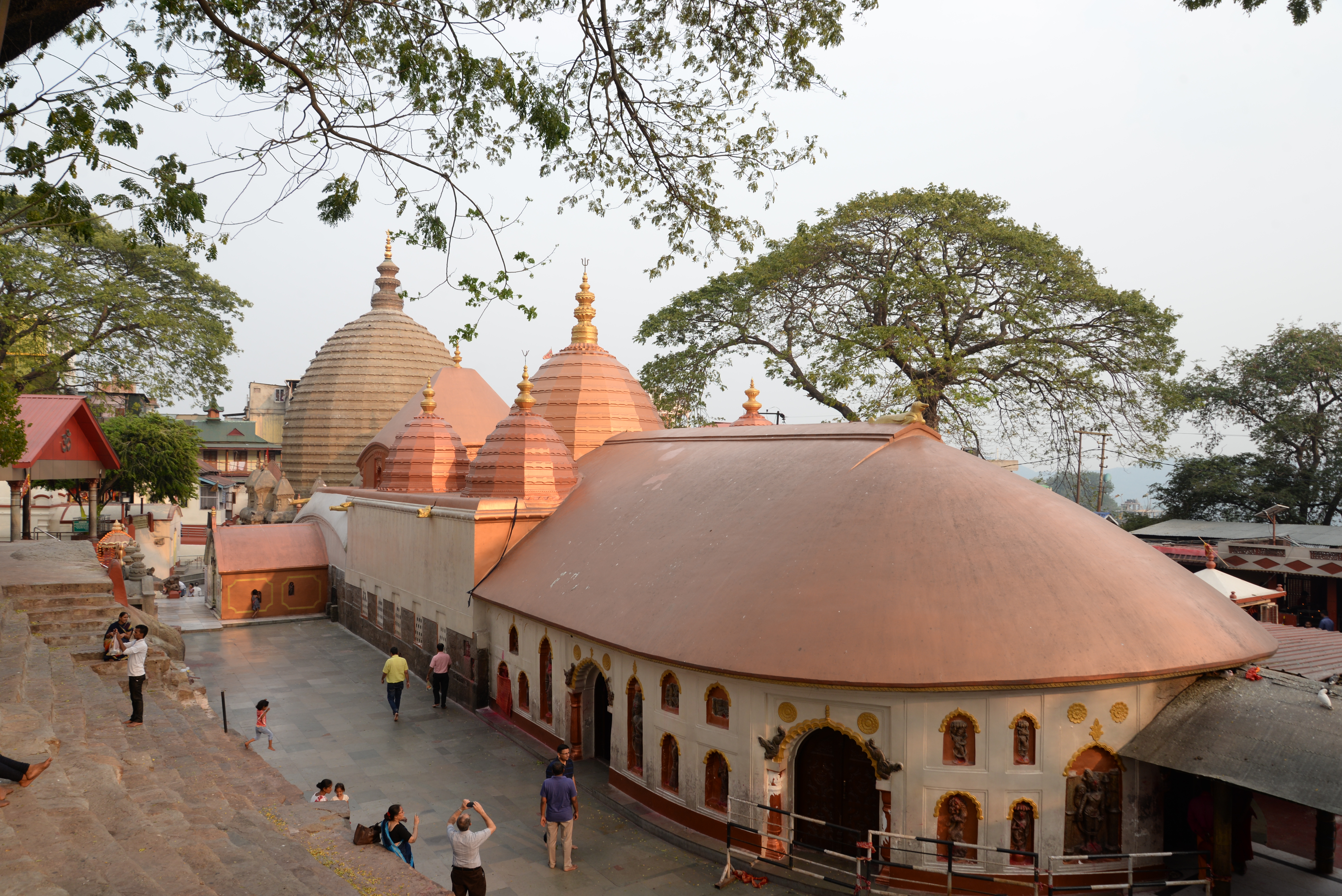
Kamakhya Temple
There is no idol in the inner sanctum of Kamakhya Temple. Below ground level, in a cave-like chamber carved into the bedrock of Nilachal Hill, the object of worship is a natural rock fissure in the shape of a yoni, the Hindu symbol of feminine creative power. A natural spring keeps the stone perpetually moist. During the Ambubachi Mela each June, the temple closes for three days to honor the annual menstruation of the goddess, after which the doors reopen and red-stained cloth from the sanctum is distributed to thousands of waiting devotees. This is not a temple that has softened its symbolism for modern sensibilities. Kamakhya is, and has been for well over a thousand years, the most important center of Tantric worship in India, a place where the boundaries between the sacred and the visceral do not merely blur but dissolve entirely.
Before the Brahmins Arrived
The worship at Kamakhya predates the formal Hindu traditions that later claimed it. The Kalika Purana and the Yogini Tantra both record that the goddess is of Kirata origin, referring to the indigenous peoples of the northeast who venerated the site long before Brahminical Hinduism reached the Brahmaputra Valley. The Varman dynasty, which ruled the ancient kingdom of Kamarupa from roughly 350 to 650 CE, makes no mention of Kamakhya, suggesting the worship remained outside the mainstream religious establishment. The first epigraphic reference to the goddess appears in ninth-century copper plates of the Mlechchha dynasty, whose patronage either established or significantly rebuilt the temple. Scholars have traced three phases of worship: yoni veneration under the Mlechchhas, yogini practices under the Pala dynasty, and the Mahavidya tradition introduced by the Koch dynasty. Each layer built upon the last without erasing it.
Destroyed and Reborn in Brick
The temple's current form is itself a story of destruction and adaptation. Tradition long credited the sixteenth-century iconoclast Kalapahar with demolishing the original stone structure, but since the reconstruction date of 1565 precedes the period when Kalapahar was active, historians now believe the temple was actually destroyed during Alauddin Husain Shah's invasion of the Kamata kingdom in 1498. The ruins lay dormant until Vishwasingha, founder of the Koch dynasty, rediscovered the site around 1515. His son Nara Narayan oversaw the reconstruction, completed in 1565 under the supervision of the military commander Chilarai. When two attempts to rebuild the original stone shikhara failed, a Koch artisan named Meghamukdam turned to brick. Trained in the Islamic architectural traditions of Bengal, he created the distinctive bulbous hemispherical dome that crowns the temple today, ringed by minaret-inspired turrets. The result is a hybrid structure unlike any other in India: an ancient Tantric shrine capped by an Islamic-influenced dome, built by Hindu rulers.
Ten Goddesses on One Hill
Kamakhya is not a single temple but a complex. Surrounding the main shrine are individual temples dedicated to the ten Mahavidyas, the Tantric manifestations of the supreme goddess: Kali, Tara, Tripura Sundari, Bhuvaneshwari, Bhairavi, Chhinnamasta, Dhumavati, Bagalamukhi, Matangi, and Kamalatmika. Three of these goddesses reside within the main temple itself, while the remaining seven occupy their own structures across the hilltop. Such a complete grouping of Mahavidya temples in one complex is exceptionally rare. The worship practices here follow both the vamachara, or left-hand path, and the dakshinachara, or right-hand path, of Tantra. Offerings range from flowers to animal sacrifices. Female animals are generally exempt, a rule relaxed only during mass ceremonies. The Koch Bihar royal family, according to legend, is forbidden from visiting due to an ancient curse by the goddess herself.
Power and Pilgrimage
Every dynasty that controlled the Brahmaputra Valley recognized Kamakhya as a source of political legitimacy. The Kalika Purana connected Naraka, the mythological progenitor of Kamarupa's kings, directly to the goddess, binding royal authority to her blessing. The Ahom kingdom, which gained control after the Battle of Itakhuli in 1681, continued rebuilding and expanding the complex. Inscriptions from kings Rajeswar Singha in 1759 and Gaurinath Singha in 1782 document ongoing royal patronage. The natamandira, the temple's outermost hall, was built in the distinctive Ahom style with its ridged roof modeled after the Ranghar. For much of its history, Kamakhya was actually an obscure pilgrimage site, known primarily to local practitioners. Its transformation into a major destination came during British colonial rule in the nineteenth century, when Bengali devotees began traveling to Assam in large numbers. Today the Ambubachi Mela draws hundreds of thousands, and the temple remains the beating heart of Tantric practice in India.
From the Air
Located at 26.17N, 91.71E atop Nilachal Hill on the western edge of Guwahati, Assam. The hill rises prominently above the south bank of the Brahmaputra River. Nearest airport is Lokpriya Gopinath Bordoloi International Airport (VEGT), approximately 20 km east. The temple complex is visible as a cluster of structures on the wooded hilltop. Best viewed at 5,000-8,000 feet. The Brahmaputra's broad channel provides an excellent visual reference for navigation.