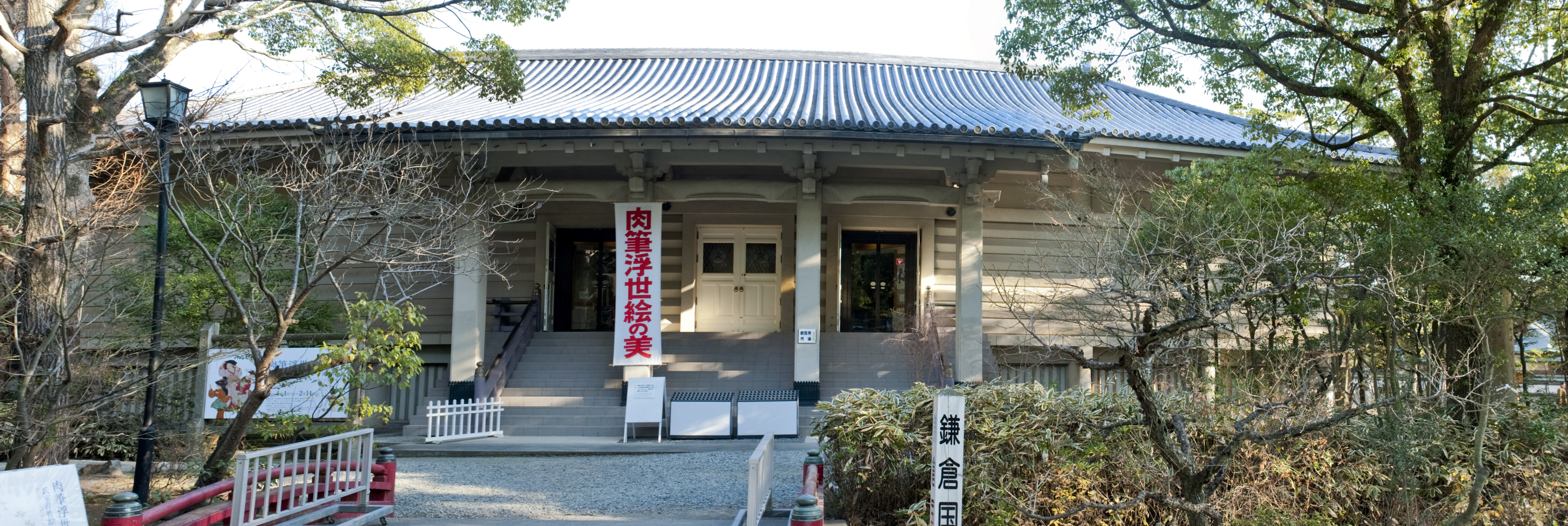
Kamakura Museum of National Treasures
The 1923 Great Kanto Earthquake killed over 100,000 people and flattened much of the Tokyo-Yokohama corridor. In Kamakura, temples that had stood since the shogunate crumbled in ninety seconds. Irreplaceable scrolls, lacquerware, and sculptures -- some eight centuries old -- lay exposed in rubble, vulnerable to rain, fire, and looters. Five years later, the city's answer rose on the grounds of Tsurugaoka Hachimangu, Kamakura's most important Shinto shrine: a concrete building deliberately styled to look like something ancient, designed to ensure that what the earthquake nearly destroyed would never be lost again.
A Treasure House Disguised as a Relic
Architect Shinichiro Okada modeled the 1928 building on the Shosoin, the eighth-century treasure house at Todai-ji in Nara -- Japan's original purpose-built storehouse for imperial artifacts. The exterior replicates the Shosoin's distinctive azekura log-cabin style, with its interlocking triangular timbers and elevated floor, but the resemblance is deliberate illusion. Underneath the traditional facade, the structure is reinforced concrete, engineered to withstand exactly the kind of seismic violence that had prompted its creation. The interior draws from Kamakura-period temple construction techniques, making the museum feel less like a modern institution and more like walking into a medieval storehouse that somehow survived eight centuries.
Five Centuries Under One Roof
The collection spans roughly 4,800 objects, most originating from the Kamakura period (1185-1333) and Muromachi period (1336-1573). These are not reproductions or secondary pieces. A hanging scroll from 1271, lent by Kencho-ji temple, depicts the Chinese Chan master Lanxi Daolong seated in meditation, with an inscription in Lanxi's own hand brushed across the upper portion. A lacquer box decorated with maki-e gold-dust patterns was a gift from Emperor Go-Shirakawa to Minamoto no Yoritomo, the first shogun of the Kamakura government. Thirty-five items of armor, weaponry, and regalia from the Kamakura period -- including swords with missing guards and a quiver short one arrow shaft -- arrive on loan from Tsurugaoka Hachimangu itself, carrying the wear of actual use rather than ceremonial display.
Evacuated, Closed, Reopened
The museum weathered a second crisis during World War II. In June 1945, as American firebombing campaigns devastated Japanese cities, curators evacuated the most vulnerable pieces to a location in Tsukui District, in the mountainous northwestern reaches of Kanagawa Prefecture. The museum closed its doors between August and October 1945, spanning the period of Japan's surrender. The evacuated objects returned safely in May 1946. In October 1952, the museum came under the jurisdiction of the newly formed Kamakura City Board of Education, and in 1955 it joined a national consortium of museums. A research center was established within the building in 1974, deepening its role from mere repository to active scholarly institution.
Sacred Ground, Secular Purpose
The museum sits within the sprawling precincts of Tsurugaoka Hachimangu, a shrine founded in 1063 and expanded by Yoritomo in 1180 when he established Kamakura as his seat of power. Visitors walking the long, tree-lined approach to the shrine often pass the museum without realizing what it holds. The building's modest scale belies its significance: the term "National Treasure" in its name refers to the pre-1950 classification system, when all state-designated cultural properties bore that title. After the Law for the Protection of Cultural Properties took effect on August 29, 1950, the old national treasures were reclassified as Important Cultural Properties, with only the finest re-designated as National Treasures under the new, more selective criteria. The museum holds objects in both categories -- a quiet distinction that makes it one of the densest concentrations of protected art in all of Kamakura.
From the Air
Located at 35.325N, 139.557E on the grounds of Tsurugaoka Hachimangu shrine in central Kamakura. The shrine complex is identifiable from the air by its long, straight approach road (Wakamiya Oji) running south to the coast, one of the most distinctive urban features in Kamakura. The museum building itself is small and sits among trees on the eastern side of the shrine grounds. Nearest airports: Tokyo Haneda (RJTT) approximately 30nm northeast, Atsugi Naval Air Facility (RJTA) approximately 15nm northwest. Sagami Bay coastline provides visual orientation to the south. The forested hills encircling Kamakura on three sides are clearly visible from above.