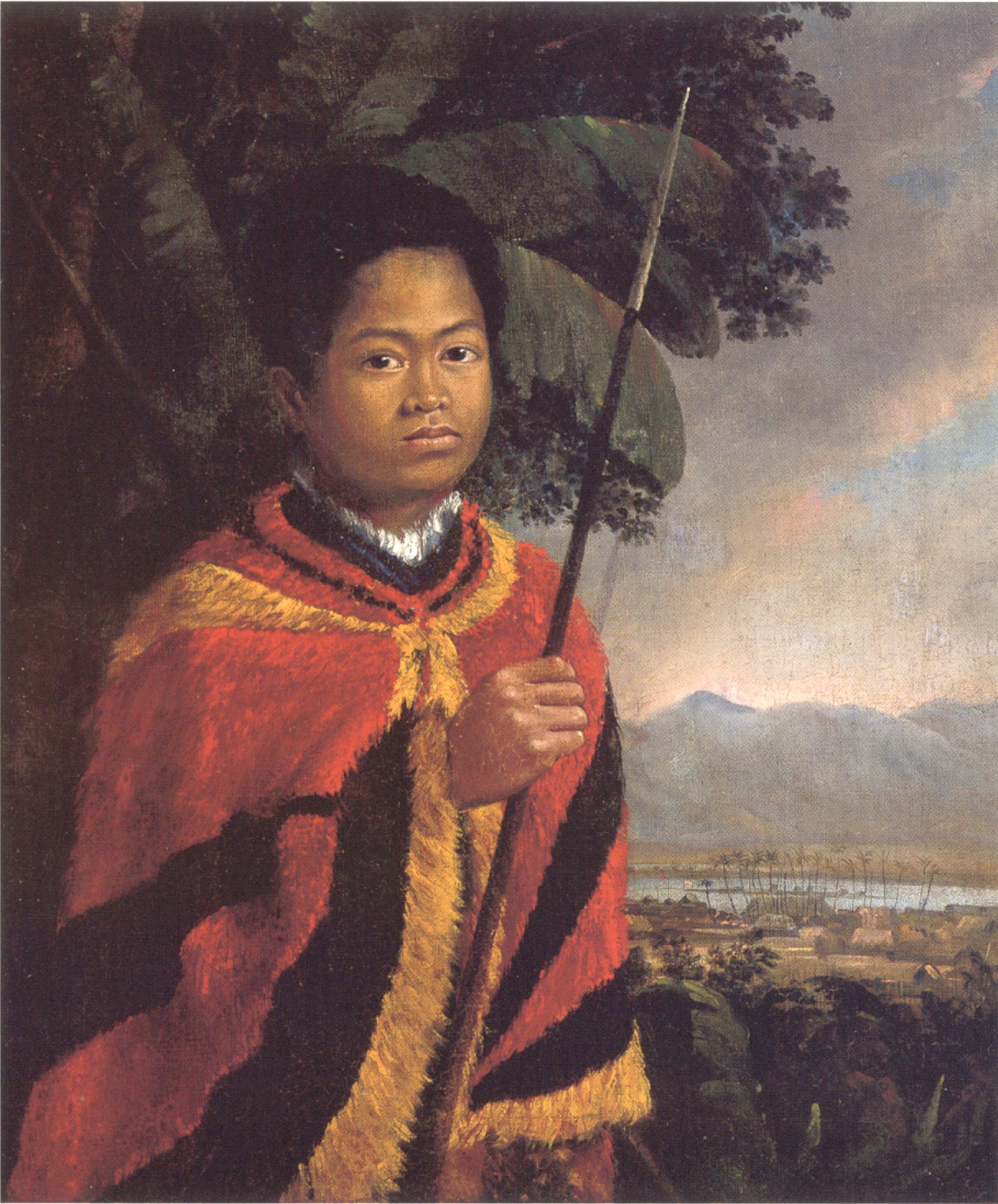
Kamehameha III
The baby was not breathing. Laid on a rock at Keauhou Bay, cleansed and fanned while a prophet named Kapihe prayed to Kaonohiokala, the infant Kauikeaouli finally drew breath. That rock still stands at the bay as a monument, marking the spot where the future Kamehameha III entered the world on March 17, 1814 -- a king who would reign longer than any other Hawaiian monarch and reshape his kingdom from the inside out.
A Prince Between Two Worlds
Kauikeaouli was the second son of Kamehameha the Great and his highest-ranking wife, Queen Keopuolani. His name meant "placed in the dark clouds," and the description fit his childhood. His stepmother Kaahumanu, serving as regent, imposed strict Puritan Christian rules on the kingdom, while the young prince felt the pull of older Hawaiian traditions. Under the influence of Oahu's governor Boki and a Hawaiian-Tahitian former priest named Kaomi, he rebelled against his partial Christian upbringing. When he ascended the throne in 1825 at roughly eleven years old, the native population already stood at about 150,000 -- less than a third of what it had been when Captain Cook arrived in 1778. During his 29-year reign, epidemics would halve that number again. Kauikeaouli inherited not just a kingdom but a crisis: how to modernize fast enough to survive without losing everything that made Hawaii Hawaiian.
The Foundation of Law
In 1838, senior advisor Hoapili convinced former missionary William Richards to leave the church and become a political advisor. Richards -- who had no legal training himself -- began teaching the king and his councilors Western ideas about rule of law and economics. Their first product was a declaration of human rights in 1839. The 1840 Constitution followed, the first written in the Hawaiian language, transforming Hawaii from an absolute monarchy into a constitutional one. Then came the Great Mahele of 1848, which redistributed land among government, king, nobles, and commoners, and for the first time allowed foreigners to own land in fee simple. The reforms were revolutionary but uneven. Many commoners, unaware of the program, never claimed their share. The king's cabinet was dominated by Americans, which discouraged his own people. Kamehameha III was building a modern nation, but the tools he used carried costs he could not fully control.
Five Months Under a Foreign Flag
In February 1843, British Captain Lord George Paulet pressured Kamehameha III into surrendering the Hawaiian Kingdom to the British crown. It was a rogue action -- Paulet had no authorization from London -- but the king had little choice against warships in his harbor. Rather than submit quietly, Kamehameha III alerted London directly. Less than five months later, British Admiral Richard Thomas rejected Paulet's seizure, and on July 31 the kingdom was restored. At the ceremony, the king spoke words that would become the state motto: "Ua Mau ke Ea o ka Aina i ka Pono" -- the sovereignty of the land is perpetuated in righteousness. July 31 became Sovereignty Restoration Day. By November, both Britain and France officially recognized Hawaiian independence, and that date became Independence Day. The Paulet affair proved that Kamehameha III could play the diplomatic game on its own terms, using international law rather than force.
The Annexation Question
By the early 1850s, Hawaii attracted a new kind of visitor: frustrated Gold Rush prospectors, some rumored to be filibusters hoping to profit from rebellion. In 1849, French Admiral Louis Tromelin had already invaded and sacked Honolulu after the king refused his demands. Petitions for annexation to the United States circulated by the end of 1853. Kamehameha III's advisors Robert Crichton Wyllie and William Little Lee convinced him to insist that any annexation must grant Hawaii full statehood -- not territorial status. A treaty was negotiated with U.S. Commissioner David L. Gregg by August 1854, but it was never signed. It would take 105 more years before Hawaii finally became a state. Kamehameha III died suddenly on December 15, 1854, possibly from a stroke, succeeded by his nephew Alexander Liholiho as Kamehameha IV.
The Impress of a Mild Disposition
His successor offered a eulogy that still resonates: "The age of Kamehameha III was that of progress and of liberty -- of schools and of civilization. He gave us a Constitution and fixed laws; he secured the people in the title to their lands, and removed the last chain of oppression." On July 31, 2018, a 12-foot bronze statue of the king was unveiled at Thomas Square in Honolulu, commemorating the 175th anniversary of sovereignty restoration. Created by Oregon artist Thomas Jay Warren, the statue stands with a flagpole flying the Hawaiian flag -- a fitting tribute to the monarch who spent his life trying to keep that flag flying. His body rests at Mauna Ala, the Royal Mausoleum, but his legacy lives in the legal and constitutional framework he built for a nation caught between old ways and new pressures.
From the Air
Keauhou Bay, the birthplace of Kamehameha III, sits at 19.57°N, 155.96°W on the Kona Coast of the Big Island of Hawaii. The bay is visible from the air along the western shoreline, south of Kailua-Kona. Nearest major airport is Ellison Onizuka Kona International Airport (PHKO). The area is best viewed at 3,000-5,000 ft AGL, with the lava fields and green upland coffee country providing strong visual contrast.