Kamigamo Shrine: Thunder God on the Kamo River
Before Kyoto was Kyoto -- before Emperor Kanmu moved the imperial capital here in 794 -- the Kamo clan already worshipped at this bend in the river. Kamigamo Shrine was founded in 678, making it older than the city by more than a century. The sanctuary sits where the northern hills meet the Kamo River's upper banks, surrounded by vestiges of the primeval forest called Tadasu no Mori. Descendants of the original Kamo clan still live in the neighborhood around the shrine, an unbroken human thread connecting the seventh century to the present. The deity enshrined here is Kamo Wake-ikazuchi, the kami of thunder -- and the shrine's purpose, across nearly fourteen centuries, has been to protect Kyoto from malign influences that might drift down from the mountains or seep up from the earth.
Guardians Before the Capital
The Kamo shrines -- Kamigamo in the north and its paired sanctuary Shimogamo downstream -- existed before Kyoto became the seat of imperial power. When Emperor Kanmu established the capital of Heian-kyo in 794, he visited Kamigamo as part of a grand progress through the region, recognizing a spiritual authority that predated his political one. The twin shrines were designated the guardians of the new capital, charged with defending Heian-kyo from spiritual harm. This was not ceremonial lip service. Imperial records from the reign of Emperor Heizei, who ruled from 806 to 809, show that Kamigamo was granted a divine seal for use on official documents -- an administrative privilege that placed it among an elite tier of religious institutions. By 965, Emperor Murakami had formalized the practice of sending imperial messengers to report important national events to the shrine's thunder deity, treating Kamo Wake-ikazuchi as one of Japan's guardian kami.
Rank and Imperial Favor
Kamigamo and Shimogamo were jointly designated as the ichinomiya -- chief Shinto shrines -- of Yamashiro Province, the administrative territory that encompassed Kyoto. This rank made the Kamo shrines the spiritual center of the province and guaranteed them resources, patronage, and political protection across successive imperial reigns. The shrine's relationship with the throne was occasionally more practical than spiritual. In 1711, when the imperial palace became uninhabitable, Emperor Nakamikado took refuge in the Hosodono hall at Kamigamo -- the emperor sheltering in the thunder god's house while his own was repaired. From 1871 through 1946, under the modern system of state Shinto, Kamigamo held the highest government ranking, standing in the first tier of state-supported shrines. That formal designation ended with the postwar separation of religion and state, but the shrine's prestige endured.
Forests, Streams, and Sacred Sand
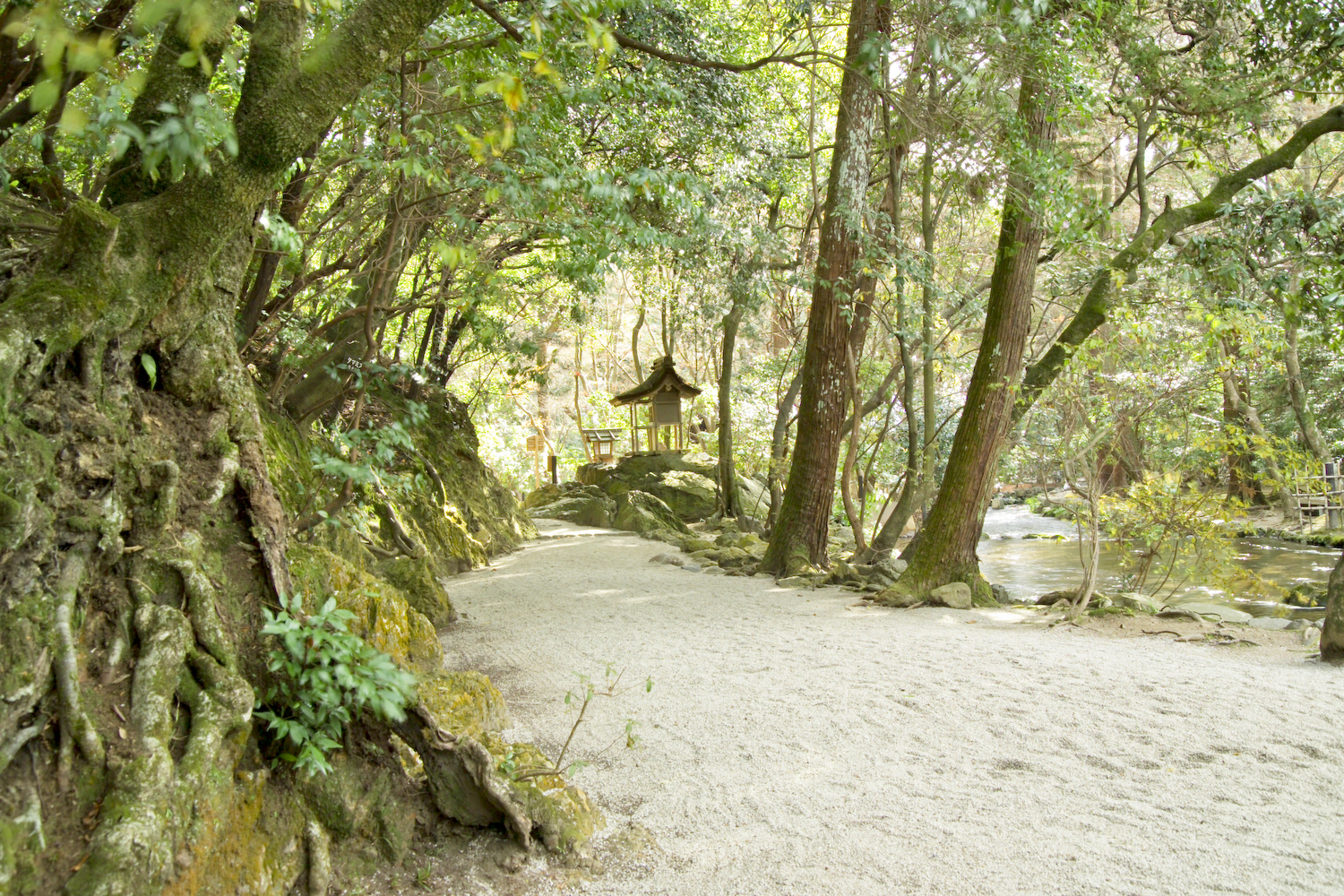
The shrine grounds are as much landscape as architecture. Tadasu no Mori, the grove that borders the compound, preserves fragments of the primeval forest that once covered this part of the Kamo River valley. The name itself is debated -- some scholars connect it to a word meaning "to correct" or "to verify," suggesting the forest was a place where truth was tested. Within the shrine precinct, the Nara-no-ogawa stream runs through carefully arranged gravel beds, its sound a constant companion to visitors walking between buildings. The tatesuna -- a pair of cone-shaped sand mounds -- stand before the main worship hall, their form echoing the sacred mountains. The haiden, or worship hall, was rebuilt during the Kan'ei era in 1628 to 1629, and its clean cedar lines reflect the Shinto architectural principle that buildings should be periodically renewed rather than preserved in amber. Several priests' residences remain on the grounds, and the Nishimura House is open to visitors.
A Living Tradition
Kamigamo Shrine is one of seventeen Historic Monuments of Ancient Kyoto inscribed on the UNESCO World Heritage List, a designation that recognizes both its architectural significance and its unbroken cultural continuity. The shrine hosts annual festivals that have been observed for centuries, including the Aoi Matsuri, one of Kyoto's three great festivals, which dates to the sixth century. The karasu-zumo, or "crow sumo" -- a ritual wrestling ceremony held at the shrine -- connects to ancient myths about the crow messengers of the gods. What distinguishes Kamigamo from Kyoto's many other historic shrines is the living presence of the Kamo clan descendants in the surrounding neighborhood. This is not a museum or a relic. It is a place where the same families who served the thunder god in the seventh century still live within sight of the shrine, where the same stream still flows through the same gravel, and where Kyoto's oldest spiritual guardian continues to watch over the city from its post on the northern river bank.
From the Air
Located at 35.060°N, 135.753°E on the northern bank of the Kamo River in Kyoto, Japan. The shrine complex is identifiable by its large forested compound (Tadasu no Mori) along the river, contrasting with the dense urban grid surrounding it. Shimogamo Shrine, its paired sanctuary, lies approximately 2.5 km downstream to the south. The Kyoto Imperial Palace is approximately 3.5 km to the south. Nearest airports: Osaka Itami (RJOO) approximately 20 nm southwest, Kansai International (RJBB) approximately 45 nm south. Best viewed at 2,000-3,000 feet AGL to see the relationship between the shrine's forested grounds and the Kamo River.