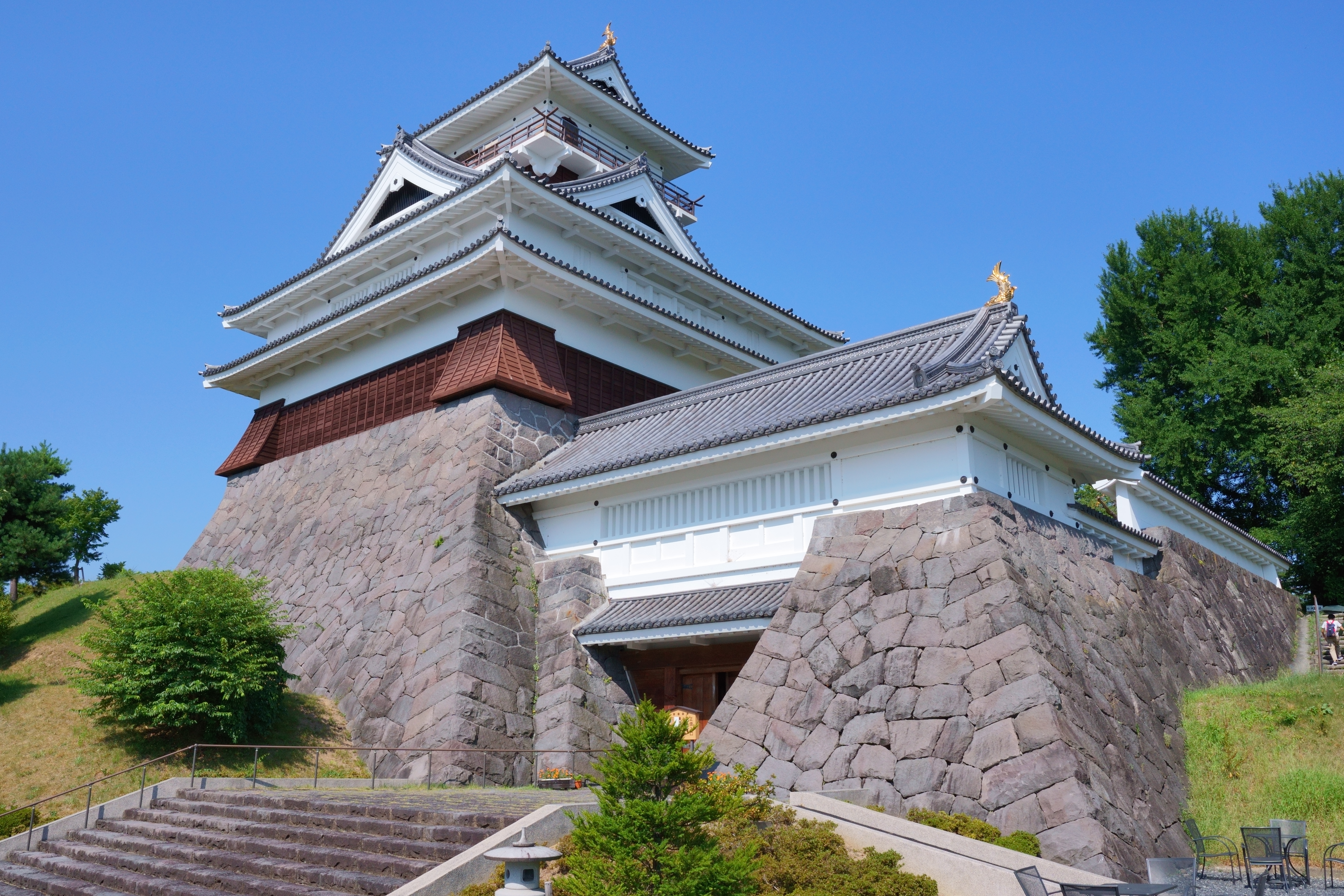
Kaminoyama Castle: Where Samurai Soaked Away the Cold
In 1458, a traveling monk named Gesshu noticed a crane dipping its wounded leg into a marshy hot spring and flying away healed. That legend gave birth to Kaminoyama Onsen, the hot spring town that would grow up around a castle perched on a hill in eastern Yamagata Prefecture. The castle and the springs became inseparable -- warriors built fortifications on the high ground while healing waters bubbled from the low ground below. Today, five free public footbaths still steam in the shadow of a reconstructed tower, and visitors soak their feet while gazing up at Kaminoyama Castle and the snow-capped Zao mountains beyond.
A Castle Nobody Could Keep
The first fortification at Kaminoyama dates to the early Muromachi period, when the Tendo clan controlled these lands in Yamagata's interior. But the site was too valuable to stay in one family's hands for long. The Mogami clan and the Date clan fought over it repeatedly, and the castle changed allegiance several times before Takenaga Yoshitada, a retainer of the Mogami, laid the present foundations in 1535. When the Tokugawa shogunate consolidated power after 1600, the Mogami were stripped of their holdings, and a new 40,000-koku domain was carved out at Kaminoyama. What followed was a revolving door of feudal lords -- clan after clan was assigned the castle, often ruling for only a generation or two before being transferred elsewhere. The Toki clan built a donjon during their tenure, only to see it destroyed when they were moved in 1692.
The Matsudaira Settle In
Stability finally arrived in 1697 when the Fujii branch of the Matsudaira clan took control. The Matsudaira would prove to be Kaminoyama's last feudal lords, governing the domain through the remainder of the Edo period until the Meiji Restoration ended the samurai age entirely. Under their watch, Kaminoyama developed into more than a military outpost. The town became a prosperous post station on the road to Edo, bustling with travelers and feudal lords making the mandatory sankin-kotai journeys to the shogun's capital. The hot springs drew samurai seeking relief from the punishing Tohoku winters, and the castle town took on the dual character it holds to this day: part fortress, part refuge.
From Domain to Park to Concrete Tower
The abolition of the han system in 1871 dissolved Kaminoyama Domain into Kaminoyama Prefecture, and by 1872 the castle grounds had been sold to the government and converted into a public park. The original structures were gone, the donjon a memory. For over a century, the hilltop was simply a pleasant green space. Then in 1982, the city built a new tower on the site of the second bailey -- not a faithful recreation of the lost original, but a concrete reconstruction of a typical Edo-period castle keep, designed to serve as a tourist attraction and local history museum. The building sits slightly lower on the hillside than the original castle tower stood, a deliberate choice that preserved the archaeological remains of the upper fortifications.
Steam and Stone at Zao's Feet
Kaminoyama today is a town still defined by the relationship between its castle and its waters. The Tsukioka Shrine sits within the castle grounds, lending a sacred dimension to the hilltop. Below, the onsen district spreads through narrow streets where ryokan and bathhouses have operated for centuries. Five free public footbaths dot the town, each offering views of the castle tower and the Zao mountain range that rises dramatically to the south. The Yamagata Shinkansen stops at Kaminoyama Onsen Station, connecting this small mountain hot spring town directly to Tokyo. For a castle that nobody could hold for long, Kaminoyama has found a lasting identity: the place where the water runs hot and the mountains stand close.
From the Air
Located at 38.16°N, 140.28°E in the Yamagata basin, with the Zao mountain range rising sharply to the south. The concrete castle tower sits on a small hill in the center of the city and is visible from moderate altitude. From 3,000-5,000 feet AGL, the compact onsen town is distinguishable from the surrounding rice paddies. Yamagata Airport (RJSC) is approximately 15 nautical miles to the north. The Yamagata Shinkansen line runs through the valley floor. Mount Zao's volcanic crater lake (Okama) is visible to the southeast in clear weather.