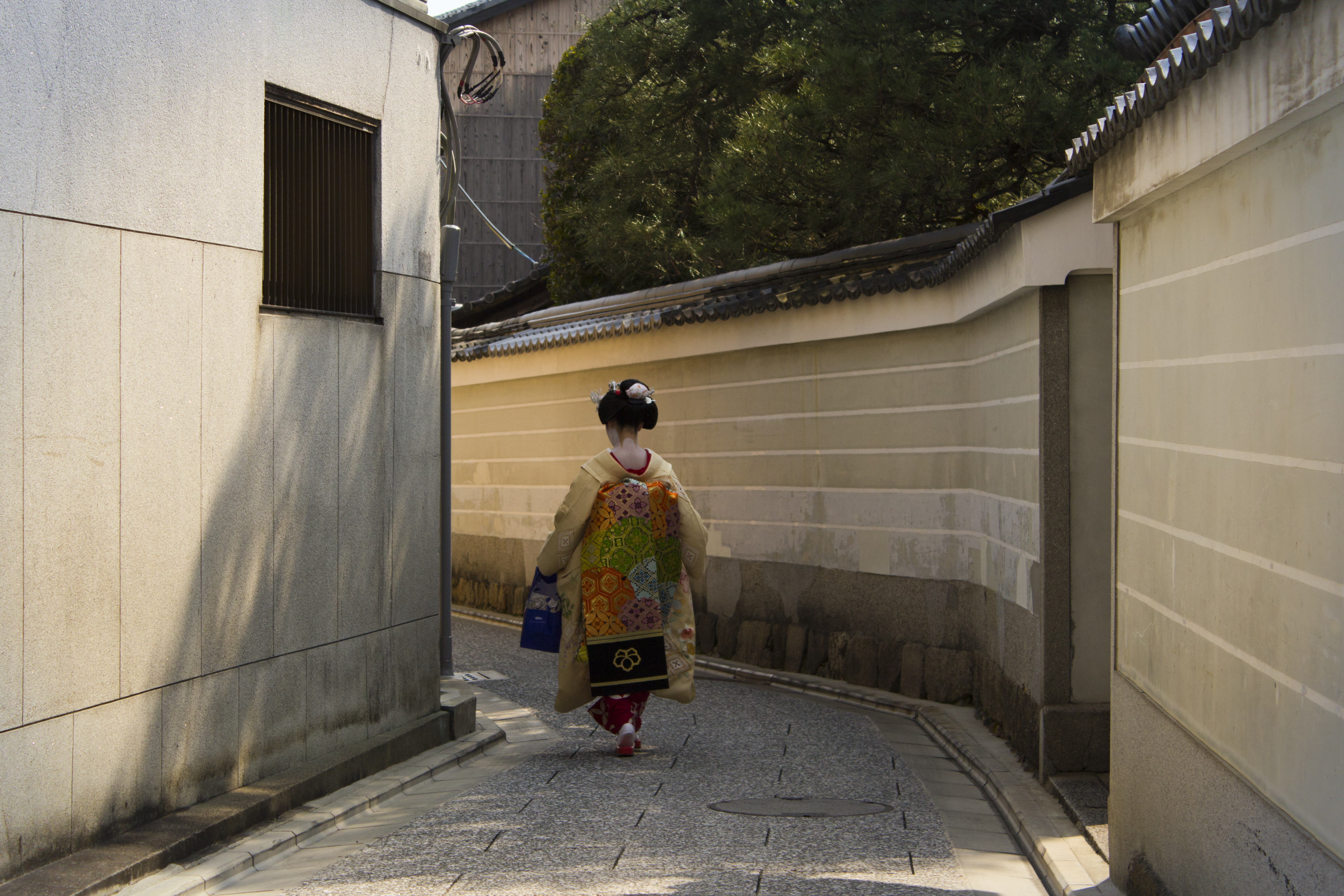
Kamishichiken: The Seven Upper Houses
The name tells you exactly how it began. Kamishichiken -- "Seven Upper Houses" -- refers to seven teahouses assembled from materials left over when Kitano Tenmangu shrine was rebuilt during the Muromachi era, sometime between 1333 and 1573. While Gion draws the crowds and Pontocho lines the Kamo River with lantern light, Kamishichiken sits apart in Kyoto's northwest, tucked against the textile-weaving neighborhood of Nishijin and the plum groves of Kitano shrine. It is the oldest hanamachi -- geisha district -- in a city famous for them, and its quietness is the point. Fewer tourists wander these narrow streets of dark wooden ochaya and okiya. The geisha here are known for being subtle and demure, accomplished in dance and music but resistant to spectacle. There are roughly 25 of them, along with 11 working teahouses -- numbers small enough that everyone knows everyone.
Built from Scraps, Steeped in Centuries
The origin story of Kamishichiken is inseparable from Kitano Tenmangu, the great Shinto shrine dedicated to Sugawara no Michizane, the deified patron of scholarship. When the shrine was reconstructed during the Muromachi period, surplus building materials were used to erect seven teahouses nearby. These modest structures became the nucleus of a geisha quarter that would outlast the political era that produced it. The district sits in Kamigyo-ku, within the broader Nishijin area -- a neighborhood that has been synonymous with hand-woven textiles for centuries. The two traditions coexisted and reinforced each other: the geisha of Kamishichiken wore Nishijin silk, and the weavers found some of their most discerning customers among the teahouse patrons. The district's crest is a ring of skewered dango -- sweet rice dumplings -- displayed on lanterns as red circles on white paper, the inverse of Gion's white-on-red design. Even the emblem marks a distinction.
Plum Blossoms and Open-Air Tea
Every February 25, the Plum Blossom Festival transforms the grounds of Kitano Tenmangu and spills into Kamishichiken. The festival centers on an open-air tea ceremony where geisha and maiko -- apprentice geisha -- serve tea and traditional wagashi sweets to approximately 3,000 guests. The event draws on a tradition of tea culture that links the shrine, the district, and the seasonal rhythm of Kyoto's calendar. Plum trees bloom earlier than the more famous cherry blossoms, and the February festival carries a different mood: quieter, colder, the blossoms appearing against bare branches and gray sky rather than spring warmth. For Kamishichiken's geisha, the Plum Blossom Festival is one of the year's most visible public appearances, a chance to represent the district beyond its private teahouse world.
Kitano Odori and Summer Nights
In April, the district stages its annual dance performance, the Kitano Odori, at the Kamishichiken Kaburenjo Theatre. The dances are performed in a distinctive style sometimes called Kitano Kabuki, reflecting the district's independent artistic identity. Each of Kyoto's geisha districts has its own annual dance -- Gion's Miyako Odori is the most famous -- but the Kitano Odori draws a more intimate audience to match its smaller scale. When summer arrives, the Kaburenjo Theatre opens its doors for something unexpected: a beer garden. From July 1 through August 31, visitors can sit in the open air and be served by geisha and maiko from six in the evening until ten at night. Traditional dances are performed during the evening. The beer garden began as a way to attract visitors during warm months and has become one of Kamishichiken's most distinctive offerings -- a place where the formality of the geisha world relaxes without dissolving entirely.
The Quiet District
Kamishichiken's distance from Kyoto's city center -- it sits northwest, away from the Gion-Pontocho corridor along the Kamo River -- has shaped its character. Fewer tourists means fewer compromises. The district has not developed the shops selling geisha-themed souvenirs that line Gion's Hanamikoji street, nor does it contend with the crowds of visitors hoping to photograph maiko on their way to appointments. The dark wooden facades of the ochaya and okiya remain largely unchanged, their latticed windows and noren curtains facing narrow streets that empty out after dark. The roughly 25 geisha and maiko who work here represent a fraction of Kyoto's total geisha population, but each is highly trained in the traditional arts of dance, music, and conversation that define the profession. Kamishichiken endures not by growing but by holding steady -- the same few dozen practitioners in the same quiet streets, maintaining a tradition that started with seven houses built from a shrine's leftovers.
From the Air
Located at 35.030°N, 135.737°E in the Kamigyo ward of northwest Kyoto, Japan. The district occupies a small cluster of blocks immediately east of Kitano Tenmangu shrine, which is identifiable from the air by its large forested compound and distinctive approach road. The Nishijin textile district surrounds Kamishichiken to the east and south. The Kamo River lies approximately 1.5 km to the east. Nearest airports: Osaka Itami (RJOO) approximately 20 nm southwest, Kansai International (RJBB) approximately 45 nm south. Best viewed at 1,500-2,500 feet AGL to distinguish the district's traditional wooden architecture from surrounding modern development.