Kamo Aquarium: The Jellyfish That Saved Everything
A Nobel Prize-winning chemist picks up the phone and dials a struggling aquarium in rural Yamagata Prefecture. He has advice: mix coelenterazine into the jellyfish food, and they will glow again within two weeks. This actually happened. On October 24, 2008, Osamu Shimomura -- days after winning the Nobel Prize in Chemistry for his work on green fluorescent protein -- called Kamo Aquarium directly to solve a problem the staff had been puzzling over: their captive-bred crystal jellyfish had lost the ability to bioluminesce. The call was quintessentially Kamo -- a place where world-class science meets small-town resourcefulness, where near-bankruptcy became a Guinness World Record, and where jellyfish ramen is on the lunch menu.
From the Edge of Oblivion
By the late 1990s, Kamo Aquarium in Tsuruoka was dying. The municipal facility on the Sea of Japan coast had no marquee exhibits, no money for renovations, and dwindling attendance. Bankruptcy loomed. Director Tatsuo Murakami made a decision that would have seemed absurd at the time: he would bet everything on jellyfish. At that point, no aquarium in the world had developed reliable methods for breeding jellyfish in captivity. The creatures are notoriously difficult to raise -- fragile, sensitive to water conditions, with complex life cycles that move through multiple stages. Murakami and his small staff began experimenting, developing techniques from scratch. Slowly, species by species, they built a collection that no other institution could match. By 2005, Kamo surpassed California's Monterey Bay Aquarium in the number of jellyfish species on display. In 2012, the Guinness World Records made it official.
The Nobel Connection
The aquarium's trajectory shifted again in 2008 when Osamu Shimomura, along with Martin Chalfie and Roger Tsien, won the Nobel Prize in Chemistry for their discovery and development of green fluorescent protein -- a molecule derived from the crystal jellyfish, Aequorea victoria. Shimomura had conducted his foundational research using specimens from one of the few institutions in the world that displayed the species: Kamo Aquarium. When the Nobel announcement came, media attention turned to the small aquarium in Tsuruoka. Visitor numbers surged to 1.5 to 2 times their normal levels. But Kamo's staff had noticed something troubling: while wild-caught adult Aequorea victoria glowed, the generations bred in captivity did not. When Shimomura heard about this, he called the aquarium directly and explained that adding coelenterazine -- the light-emitting compound -- to the jellyfish diet would restore bioluminescence. Researchers from institutions worldwide, including the Paris Aquarium, have since traveled to Kamo to study its breeding methods.
The Kuranetarium
The centerpiece of Kamo Aquarium is the Kuranetarium -- a coined word blending kurage (Japanese for jellyfish) and planetarium. The main exhibit hall houses the Jellyfish Dream Theater, a five-meter-diameter circular tank holding roughly 10,000 moon jellyfish that pulse and drift in hypnotic synchrony. The tank, weighing approximately 40 tons when filled, is itself a Guinness-certified record holder as the largest jellyfish display tank in the world. Beyond this spectacle, the aquarium exhibits over 60 species of jellyfish at any given time, from the massive lion's mane jellyfish to the immortal jellyfish, Turritopsis dohrnii, known for its ability to revert to its juvenile polyp stage. Flower hat jellies trail fluorescent yellow and pink tentacles. Nomura's jellyfish, which can grow to nearly two meters across, float in tanks proportioned to their enormous size. An educational wing includes a lecture hall and exhibits on jellyfish growth and development.
Naomi the Elephant Seal and Jellyfish Ramen
Kamo is not exclusively jellyfish. Sea lions perform daily, spotted seals lounge in outdoor pools, and octopuses occupy their own display. The aquarium's most unexpected resident arrived on October 16, 2017, when a three-year-old female northern elephant seal washed ashore on nearby Sanze Beach, weakened and injured. She weighed 273 kilograms. The staff nursed her back to health with antibiotics, and by March 2018 she had grown to over 400 kilograms. A public vote named her Naomi, after tennis star Naomi Osaka. She has been a permanent exhibit ever since. Then there is the restaurant. Kamo's cafeteria serves jellyfish ramen -- noodles made with ground cannonball jellyfish -- along with jellyfish sashimi and jellyfish ice cream. The menu is both a novelty and a statement: at Kamo, jellyfish are not just beautiful. They are everything.
From the Air
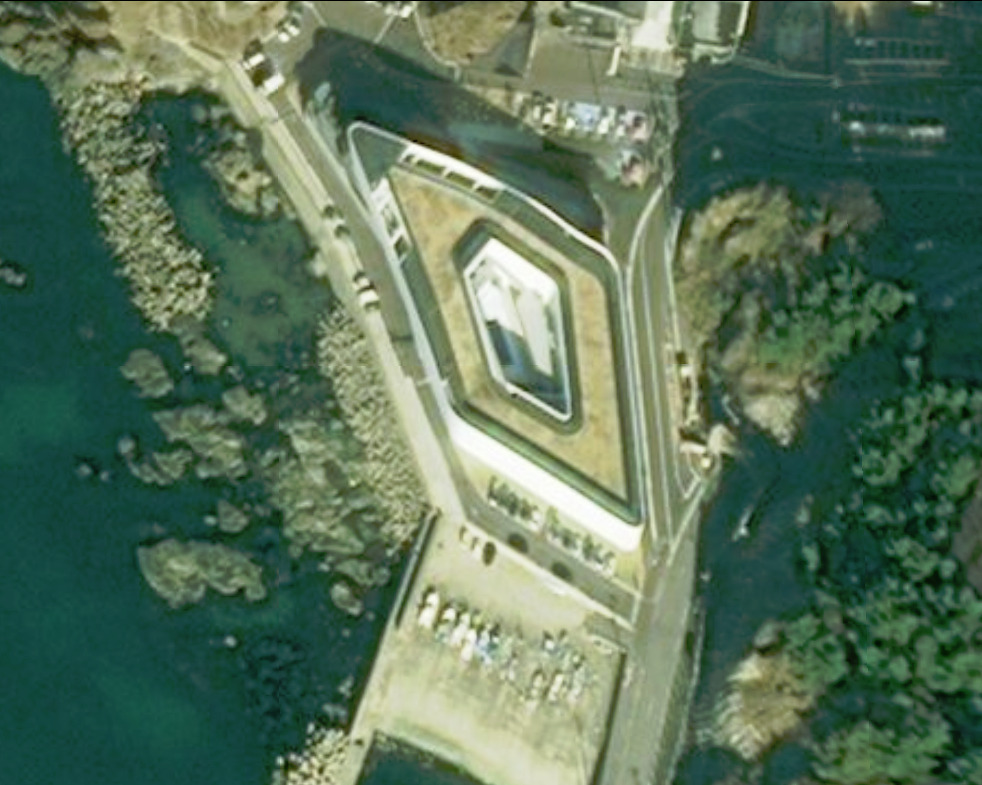
Located at 38.76°N, 139.72°E on the Sea of Japan coast in Tsuruoka, Yamagata Prefecture. The aquarium sits along the shoreline near Yunohama Onsen. From altitude, the coastal settlement and beach are visible where the flat Shonai Plain meets the sea. Shonai Airport (RJSY) is approximately 8 nautical miles to the north along the coast. Yamagata Airport (RJSC) lies roughly 55 nautical miles to the southeast, inland beyond the Dewa Mountains. The Sea of Japan coastline provides a clear visual navigation reference, with the Gassan and Chokai mountain ranges visible to the east and north respectively.