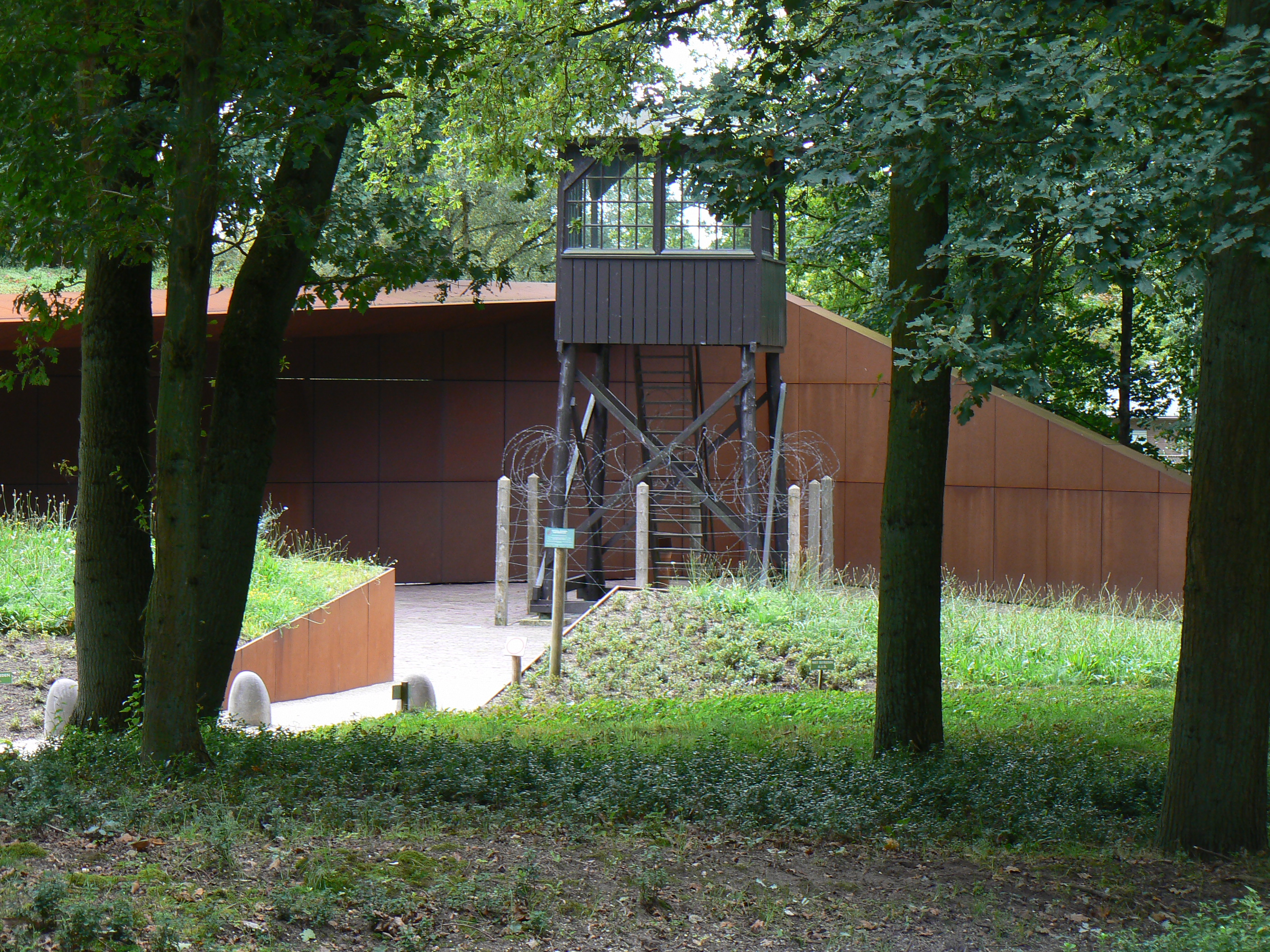
Kamp Amersfoort National Monument
The roll call clock still hangs where it always did. Five trees that lived through the war years still stand on the grounds. Walk past the original watchtower at the entrance of National Monument Kamp Amersfoort and you are walking through a place where, between 1941 and 1945, forty-seven thousand people were stripped of their names and counted only by number. Six hundred and fifty-two of them died here. Most of the rest were put on trains east. The museum is unflinching about what that meant, and quiet about how to grieve it.
The Longest-Running Camp
Kamp Amersfoort, the Polizeiliches Durchgangslager whose museum now occupies this leafy patch of Leusden, was the longest-operating concentration camp in the German-occupied Netherlands. It was, in the language of the SS, a transit and police camp - which meant it was a way station as much as a prison. Jewish families, political prisoners, members of the Dutch resistance, hostages snatched in retaliation for partisan attacks, Soviet prisoners of war, Jehovah's Witnesses, ordinary people caught on the wrong side of a checkpoint - all of them came through these gates. The exhibitions inside the underground museum, expanded in 2021, do not soften the system that produced their suffering. Hunger, forced labour, beatings, transports, executions: each is laid out plainly, in objects and documents and faces. The prisoners were people first. The museum holds onto that.
The Shooting Range and the Rose Garden
Beyond the museum entrance, the ground opens into a clearing the prisoners dug by hand. The Schietbaan, the shooting range, was carved into the soil with shovels under guard, and then used for the very thing its diggers feared. Hundreds of men were killed there - Dutch resistance fighters, Soviet POWs, hostages. Near it once stood the punishment ground the SS called, with the particular cruelty of euphemism, the rozentuin - the rose garden. Prisoners were forced to stand for hours in stress positions there, in any weather. After the war, when the foundation that runs the monument adopted its logo, it chose a rose wound in barbed wire, taken from drawings by former prisoner Jacques Kopinsky. It does not reclaim the word so much as refuse to let the SS keep it.
11 October 1944
On that single autumn morning, 1,438 men were marched from the camp to the railway station and loaded onto a train bound for Neuengamme, the concentration camp near Hamburg. Eighty-two percent of them never came home. The annual commemoration on 11 October retraces their route on foot - the Tocht van Vrees en Hoop, the Journey of Fear and Hope - and it is hard, walking it, not to feel the weight of every name on the list. The largest single transport in the camp's history, it was one of many. On 4 May each year the dead are remembered: the 652 who died inside the wire from execution, exhaustion, or beating, and the fifteen percent of transported men who did not survive the camps to the east. Of those killed on site, the cause is often simply listed as 'starvation'. That word does a great deal of work.
What Was Built After
After liberation, the Dutch state did with the site what states often do with painful ground - it reused it. The Ministry of Defence took over the buildings. The training institute for the national police moved in. The wooden barracks where prisoners had slept were torn down. For more than fifty years the place where so much had happened lived behind a perimeter fence, half-forgotten. It took a former prisoner, Gerrit Kleinveld, and the son of another, Cees Biezeveld, to insist that this could not be the end. In 2000 they founded the National Monument Foundation. A small memorial centre opened in 2004. The underground museum that now anchors the site opened to the public in 2021. Ten paid staff and 140 volunteers keep the doors open today; director Micha Bruinvels leads them. The Stone Man, sculptor Frits Sieger's 1953 statue of a prisoner facing a firing squad, still stands watch.
How to Visit
The monument sits in a clearing in the woods on the southern edge of Amersfoort, in the municipality of Leusden. The watchtower comes into view first, then the path that leads down into the museum. The recommended route walks visitors through the indoor exhibition and then out across the camp grounds to the shooting range, where small stones and flowers are usually waiting near the memorial. The annual commemoration on 19 April marks the day in 1945 that management of the camp was transferred to the Red Cross. Smaller observances are held on 20 March at the Appelweg roll call square and on 16 October in Woudenberg, where a Dutch police battalion is also remembered. The museum produces the podcast The Disappeared SS'er and a digital magazine, In Beeld. Both refuse the easy comforts.
From the Air
Coordinates: 52.1328°N, 5.3658°E. Located in Leusden on the southern edge of Amersfoort. Visible from low altitude as a wooded clearing south of central Amersfoort, just east of the A28 motorway. Nearest airports: Schiphol (EHAM) about 50 km west, and Lelystad (EHLE) about 40 km north. Best appreciated on the ground; the surrounding wooded heath of the Utrechtse Heuvelrug regional park is visible from cruise altitude in clear conditions.