Kamphaeng Phet Historical Park
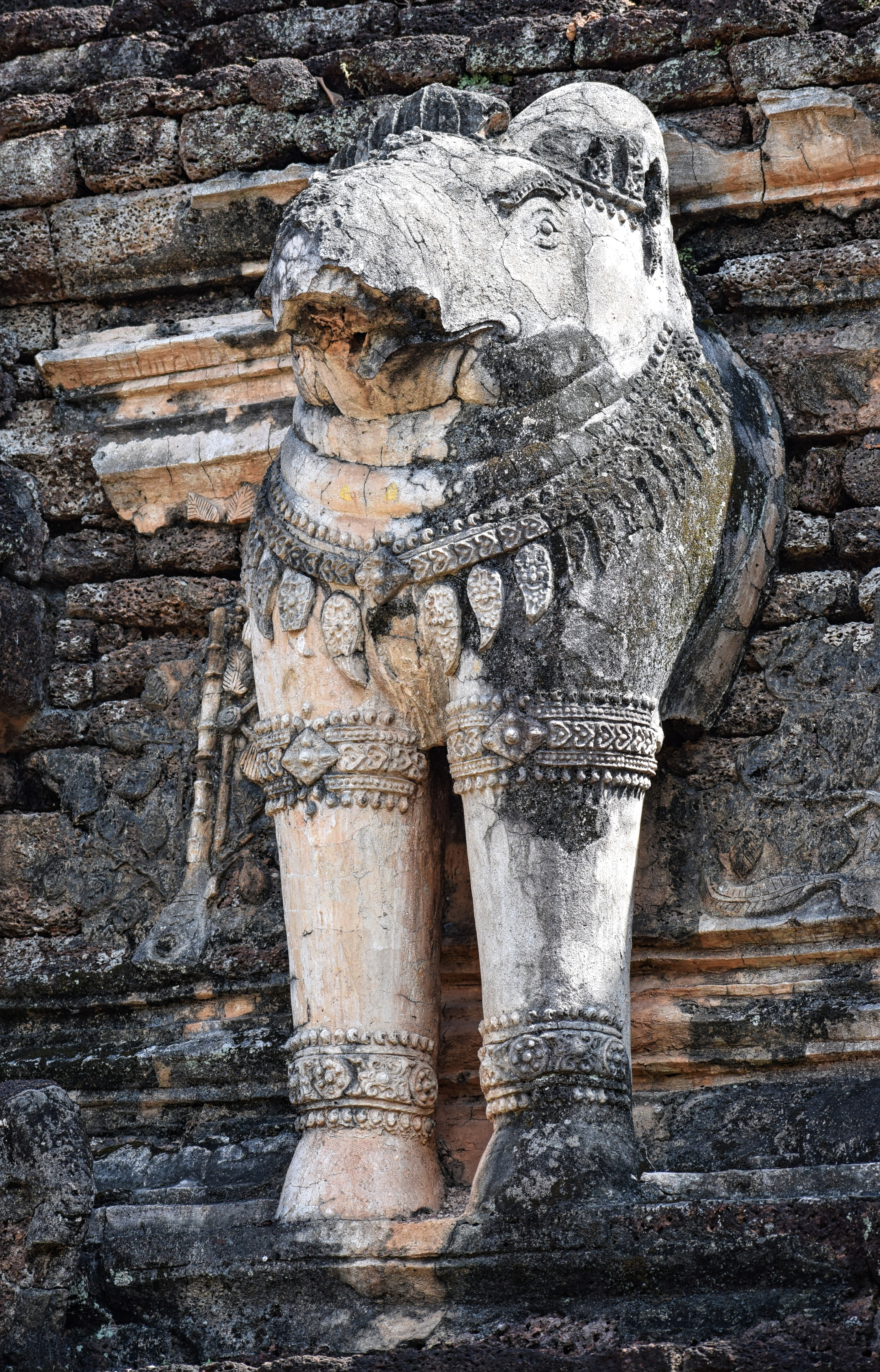
Sixty-eight half-elephants circle the base of Wat Chang Rop's great chedi, their stone bodies emerging from the laterite as though wading through solid earth. Between them, faded Bodhi-leaf carvings and traces of demons and dancers are still visible, worn by centuries of monsoon rain but not yet surrendered to it. This is Kamphaeng Phet, the "Diamond Wall," a frontier fortress of the Sukhothai Kingdom whose ruins preserve a style of Buddhist architecture found nowhere else in Thailand.
The Diamond Wall on the Ping
Kamphaeng Phet's ancient city, known as Chakangrao, occupies the east bank of the Ping River. Its builders followed the same urban planning principles as Sukhothai and Si Satchanalai: religious sites divided into zones within and outside the town walls, with the most sacred temples clustered near the presumed palace grounds. But the building material sets Kamphaeng Phet apart. Where other Sukhothai cities used brick, Chakangrao's architects favored laterite, the iron-rich clay stone that hardens when exposed to air. The result is a landscape of rust-red ruins, their rough surfaces catching the light differently than the smooth brick of their sister cities. City walls and fortifications mark the boundary of the rectangular town, measuring 300 to 700 meters wide and stretching 2,200 meters long.
Temples of the Inner City
Wat Phra Kaeo, the largest royal temple, sits near the center of the old town where a palace once stood. Reserved for important civic ceremonies rather than monastic life, it held no resident monks. Its principal chedi rests on a base adorned with lions, while a nearby round chedi features elephants at its base, their forms carved from the same laterite that defines the entire site. Smaller chapels and secondary chedis fill the compound, all bounded by laterite walls. Just south, Wat Phra That anchors its principal chedi on a 15-meter-wide square base built from a mixture of laterite and brick, its proportions distinctive enough to be classified as Kamphaeng Phet style. To the north, the palace site at Sa Mon survives only as earthen walls and moats surrounding a central pond, every standing structure long since vanished.
Buddhas in Four Postures
Among the park's most remarkable sites is Wat Phra Si Iriyabot, where a mondop structure once displayed Buddha statues in all four canonical postures: walking, sitting, standing, and reclining, each rendered in the fluid Sukhothai artistic style. Time has claimed most of the four. The standing Buddha survives best, its graceful form rising from the laterite enclosure as a reminder of a complete theological program that few other temples attempted; the outline of the walking Buddha is still discernible, though the sitting and reclining figures are largely gone. Nearby, Wat Phra Non once housed a massive reclining Buddha in a great viharn that has since crumbled entirely. What does survive is a monumental laterite column at the temple's entrance, cut from a single block of stone measuring 1.1 meters on each side and standing 6.4 meters tall. It is the largest such monolithic column in the country.
The Elephant Temple
Wat Chang Rop crowns a high hill on the edge of the park, its Ceylonese-style chedi broken at the top but magnificent at the base. The sixty-eight elephant figures that ring the foundation are more than decoration: they represent the cosmological relationship between the Buddha's teachings and the natural world, a motif borrowed from Sri Lankan Buddhist architecture and adapted to Thai sensibility. Between the elephants, the Bodhi-leaf designs reference enlightenment itself. Faint traces of demons and celestial dancers survive in the weathered stone, suggesting the base was once covered with elaborate relief carvings that told a complete narrative now mostly lost to erosion.
A World Heritage Companion
Kamphaeng Phet is one of three sites that compose the UNESCO World Heritage designation "Historic Town of Sukhothai and Associated Historic Towns," alongside Sukhothai Historical Park and Si Satchanalai Historical Park. On the west bank of the Ping River, the settlement of Nakhon Chum offers a different character: smaller brick structures that contrast with Chakangrao's massive laterite construction. Farther southwest, the satellite site of Mueang Trai Trueng extends the ancient city's footprint another 18 kilometers. Together, these sites map the full extent of a frontier town that guarded the Sukhothai Kingdom's southern approaches, a role reflected in its very name: the wall of diamond, impenetrable and enduring.
From the Air
Kamphaeng Phet Historical Park is located at 16.48°N, 99.52°E in Kamphaeng Phet province, central Thailand. The park sits along the east bank of the Ping River. Nearest airports include Phitsanulok Airport (VTPP) approximately 116 km to the northeast and Sukhothai Airport (VTPO) about 121 km to the north. Best viewed at 2,000-4,000 ft AGL to see the rectangular city walls and temple ruins along the river. The terrain is flat agricultural lowland with the Ping River clearly visible as a navigation reference.