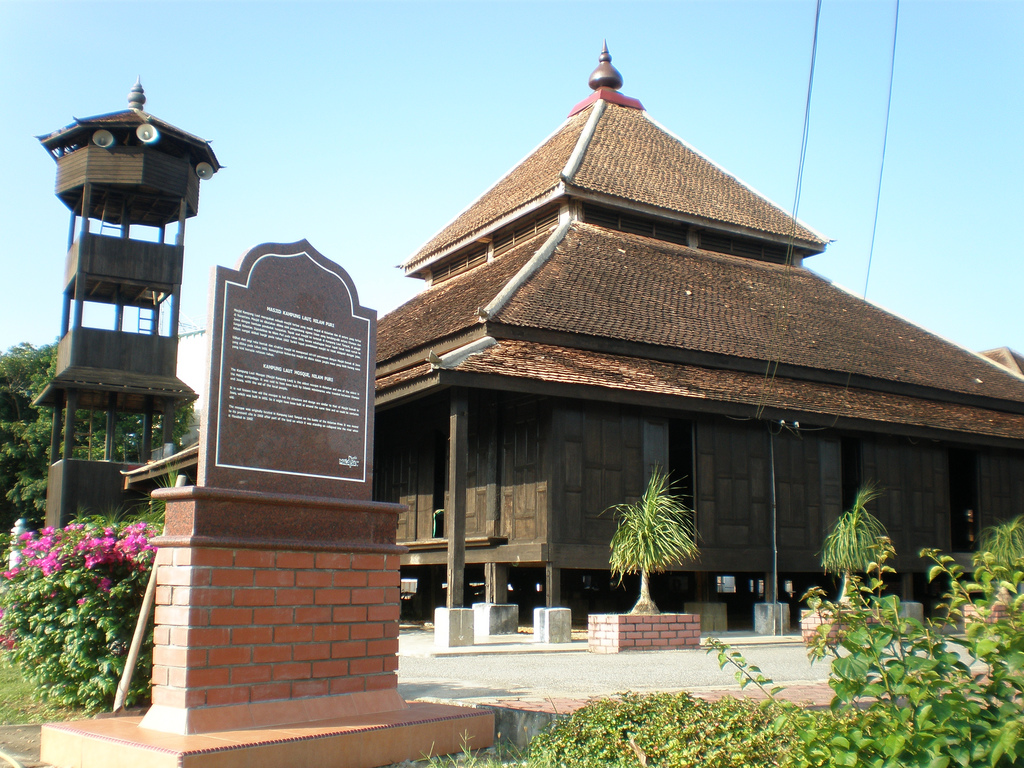
Kampung Laut Mosque
Four wooden pillars and a roof of palm fronds. That was the beginning -- a mosque so simple it could have been mistaken for a village shelter, built on the banks of a river in Kelantan by people who had sailed from the Kingdom of Champa, a maritime civilization centered in what is now central Vietnam. The Kampung Laut Mosque, located in Tumpat District, is one of the oldest mosques in Malaysia, though no one can say with certainty when it was built. Estimates range from the 15th century to the 18th, a gap wide enough to span the rise and fall of empires. What is certain is that the mosque has stood in some form for centuries, surviving floods, colonial eras, and the slow drift of time that has erased most structures of its age.
A Champa Legacy on Malay Soil
The mosque's origin story connects two distant corners of Southeast Asia. The Kingdom of Champa, a Hindu-Buddhist and later Muslim polity, ruled stretches of the Vietnamese coast for over a thousand years before its gradual absorption by the Vietnamese Dai Viet kingdom. Cham seafarers and traders ranged widely across the South China Sea and the Gulf of Thailand. According to local tradition, a group of Cham government transporters built the original mosque in Kampung Laut, bringing with them architectural sensibilities that blended southern Indian Hindu influences with the practical demands of the Malay climate. The result was a structure that looked much like the traditional Malay houses around it -- raised, timber-framed, and ventilated for tropical heat. That resemblance was not accidental; it reflected the way Islam in Southeast Asia adapted to local forms rather than imposing foreign ones.
Sultans and Sacred Ground
During the reign of the Kelantan Sultanate between 1859 and 1900, the mosque grew in importance and in size. What had been a four-pillar prayer shelter was expanded to twenty pillars. A three-tiered roof replaced the palm fronds -- a design common to traditional Malay mosques, where each tier symbolizes a different aspect of faith. A tower was added for the muezzin's call to prayer. An attic and a water tank were built, and the flooring was laid with quality timber. The mosque became more than a place of worship; it served as a meeting point for sultans and religious leaders, and as a trading post where commerce and piety intersected. Kampung Laut itself had been a gathering place for far longer than the mosque had existed -- local tradition holds that people had congregated at this site for thousands of years, drawn by the river and the natural crossing point it provided.
Tested by Water
Kelantan is one of Malaysia's most flood-prone states, and the Kampung Laut Mosque sits near the river that gives the village its name -- Kampung Laut means "sea village." The mosque has survived two catastrophic floods. The first, in 1926, was known locally as Bah Air Merah, the Red Water Flood. The mosque endured. The second, in 1966, was worse. Floodwaters swept away parts of the structure closest to the river, severely damaging a building that had stood for centuries. Repairs followed, and the mosque was rebuilt using what remained of the original timbers and structure. In May 1970, the mosque was formally handed over to the Kelantan state government under the administration of Menteri Besar Datuk Asri Muda, placing it under official protection for the first time in its long history.
Architecture as Memory
What makes the Kampung Laut Mosque architecturally significant is not grandeur but continuity. Its design -- timber-framed, raised above ground, with a tiered pyramidal roof -- represents the traditional Malay mosque form before the arrival of Middle Eastern and Mughal-influenced domes and minarets that dominate modern Malaysian mosques. The style is climate-appropriate, built for ventilation and flood resistance, and it carries within it the traces of the cultural layers that produced it: southern Indian Hindu temple architecture, Cham maritime traditions, and Malay vernacular building practice. The mosque stands as evidence that Islam in Southeast Asia was not a wholesale import but a conversation between arriving faith and existing culture. In a country where gleaming new mosques with marble floors and air conditioning are the norm, the Kampung Laut Mosque is a quiet reminder of how it all started -- with wood, water, and the devotion of travelers far from home.
From the Air
Located at approximately 6.03N, 102.24E in Tumpat District, Kelantan, near the northeastern tip of Peninsular Malaysia close to the Thai border. The mosque is in a low-lying riverine area prone to seasonal flooding. Nearest airport: Sultan Ismail Petra Airport, Kota Bharu (WMKC), approximately 20 km to the south. The Kelantan River and its tributaries are visible landmarks from the air. Flat coastal terrain; no significant obstacles.