Kanaganahalli
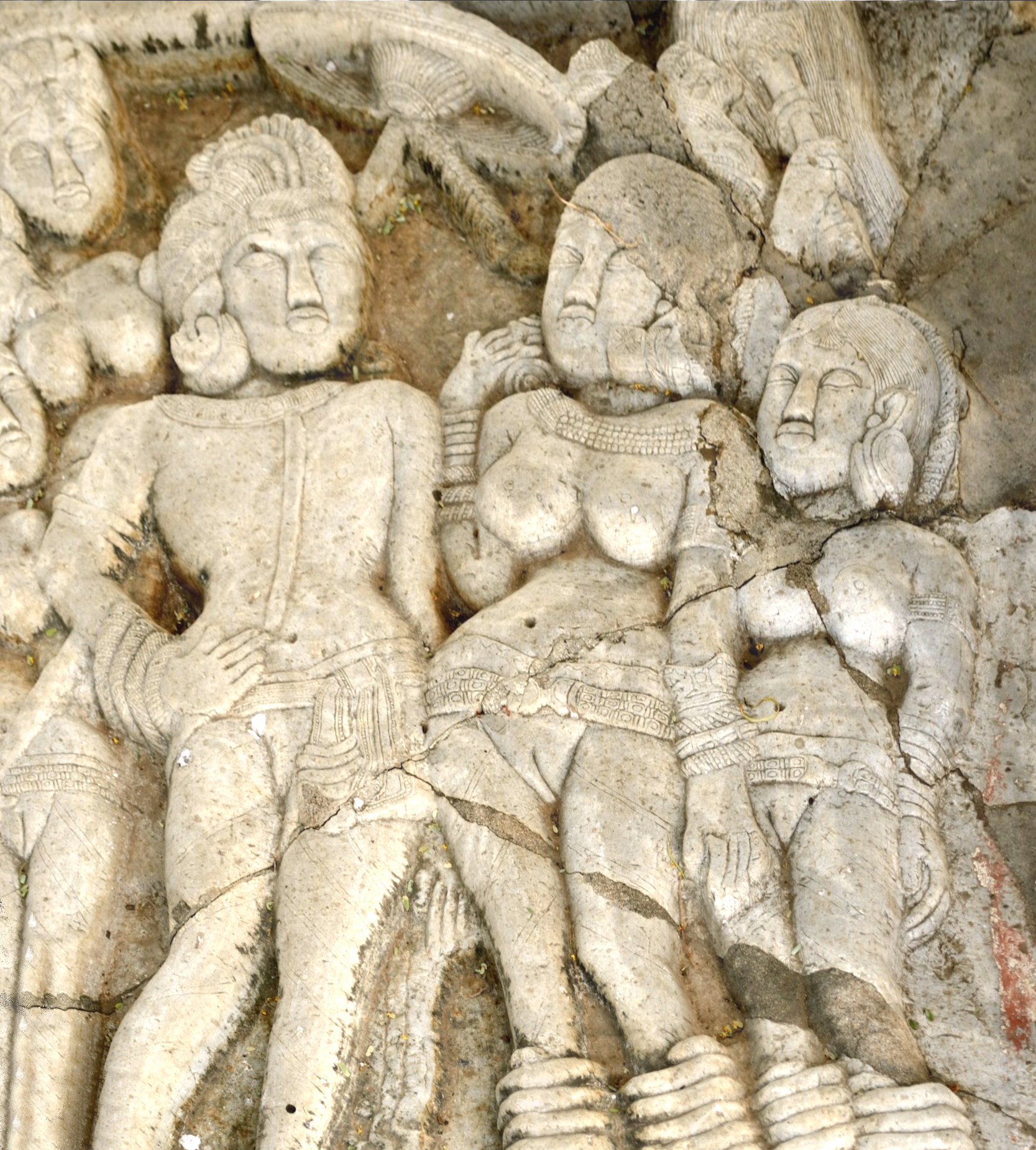
Two words in Brahmi script changed what we know about ancient India. "Raya Asoko" -- King Ashoka -- read the inscription beside a carved relief on a limestone slab, pulled from the earth near a village in Karnataka's Kalaburagi district between 1994 and 2002. Until that moment, no confirmed portrait of the Mauryan emperor who unified much of the subcontinent and championed Buddhism had ever been found. The relief at Kanaganahalli showed him with his queen, a domestic scene rendered in stone some two thousand years ago. It was buried beneath farmland three kilometers from the town of Sannati, on the left bank of the Bhima River, waiting for archaeologists to uncover what centuries of silt and forgetting had hidden.
The Stupa Beneath the Fields
What the Archaeological Survey of India unearthed at Kanaganahalli between 1994 and 2002 was nothing short of extraordinary: the remains of a massive stupa -- referred to in inscriptions as the Hama Chaitya -- along with brick chaitya-griha structures, memorial stupas, and the architectural fragments of a monastic complex. The main stupa's anda, or dome, was partially intact, though most of its elaborately carved veneer slabs, railings, pillars, and capitals had been displaced from their original positions over the centuries. Among the recovered artifacts were stone footprints of the Buddha, four Buddha images, and sculpted yakshas -- protective nature spirits standing guard over a site that had lain forgotten. The stupa dates to the 1st century BCE, built during the era of the Satavahana dynasty, and the site remained active through the 3rd and 4th centuries CE under Mahayana Buddhist patronage.
Portraits of Kings in Stone
Beyond the Ashoka relief, Kanaganahalli yielded 145 short inscriptions and one long inscription, dating from the 1st century BCE to the 1st century CE. Portraits of Satavahana kings Simuka and Vasishthiputra Pulumavi appear among the sculptured panels, making this one of the rare sites where ancient Indian rulers are depicted alongside inscriptions that identify them by name. The oldest Satavahana inscription found here, on a slab of the upper drum of the stupa, mentions "year 16" of Vasisthiputra Sri Chimuka Satavahana's reign -- datable to approximately 110 BCE. Lead coins bearing the names of Satavahana kings Satakarni, Pulumavi, and Yajnasri were also discovered during the 2000-2002 excavations, along with the remnants of brick structures connected by paved and sheltered passages that suggest a substantial monastic settlement.
Where Amaravati Met the Deccan
The artistry at Kanaganahalli represents a fascinating transitional moment in Indian Buddhist art. The Amaravati School, which flourished during the Satavahana period, left a deep imprint on the site's sculptural and architectural forms. Yet Kanaganahalli's carvings are not mere copies of Amaravati originals. They exhibit an indigenous character -- geometric patterns, distinctive floral motifs, local dress and ornamentation -- while using a stacked composition technique in the large panels that creates a flat illusion of depth quite different from the more elaborately modeled reliefs at Nagarjunakonda. The sculptured panels of the medhi, the circular terrace surrounding the stupa's dome, depict various Jataka tales illustrating episodes from the Buddha's previous lives. Scholars describe the artistic achievement here as a period of "great artistic efflorescence" that gave the maha chaitya a form "unsurpassed" in the history of stupa architecture in southern India.
Rescue and Recognition
For decades after the initial excavations, the Kanaganahalli site languished. Carved panels sat exposed to weather. Conservation efforts stalled. It was not until 2022 that restoration work restarted in earnest. The Government of Karnataka and the Archaeological Survey of India have announced plans to develop Kanaganahalli and nearby Sannati as an International Buddhist Centre, a recognition of the site's significance that has been slow in coming. A senior IAS official was appointed as special officer for the project. The ambition is substantial: to place Kanaganahalli on the Buddhist pilgrimage circuit alongside better-known sites. Whether the plans will match the site's historical importance remains to be seen, but the carved stones themselves make an eloquent case. Over a thousand photographs documenting the stupa have been compiled by the scholar C. Luczanits, preserving in digital form what took two millennia to surface from the Karnataka earth.
From the Air
Kanaganahalli (17.12N, 77.08E) is located on the left bank of the Bhima River in Chitapur taluk, Kalaburagi district, Karnataka. The site is approximately 3 km from Sannati. Nearest railway station is Nalwar, about 19 km away. The nearest major airport is Kalaburagi Airport (VAKS). The area is flat Deccan Plateau terrain with agricultural fields. From altitude, look for the Bhima River as a navigation landmark. The archaeological site itself is small and not easily visible from cruising altitude, but the river valley and surrounding village patterns provide orientation. Best viewed at 2,000-4,000 ft AGL.