Kanayama Castle: The Fortress a 71-Year-Old Woman Defended
When the Hojo clan's armies appeared below Mount Kanayama in 1584, they expected a quick surrender. The castle's lords -- brothers Yura Kunishige and Nagao Akinaga -- had already been seized through an act of treachery during a visit to Odawara Castle. With its leaders captured, the fortress should have fallen without a fight. Instead, the defenders turned to the brothers' mother. Akai Teruko was 71 years old. She took command of the garrison's 3,000 remaining soldiers, organized the defenses, and held the mountaintop castle for over fifteen months. She surrendered only after securing the condition that her captured sons would be returned. Her stand at the Battle of Kanayama Castle became one of the most remarkable episodes of the Sengoku period -- an age already defined by extraordinary acts of defiance.
A Hilltop Between Two Rivers
Kanayama Castle sits on Mount Kanayama, a hill on the northern edge of the Kanto Plain in what is now the city of Ota, Gunma Prefecture. Two large rivers -- the Tone and the Watarase -- flow on either side, making the hilltop a natural fortress commanding the corridor between the eastern provinces and the northwest Kanto region. The Iwamatsu clan, local warlords, built the original castle in 1469 to exploit this strategic position. In 1528, a retainer named Yokose Narishige overthrew his Iwamatsu overlord and seized the fortress. His family later changed their name to Yura and rapidly expanded their influence across Kozuke Province, capturing Kiryu Castle, Ashikaga Castle, and Tatebayashi Castle. They rebuilt Kanayama on a grand scale, creating a yamashiro-style mountain fortress with multiple enclosures, clay ramparts, dry moats, and an unusually extensive network of stone walls.
Caught Between Giants
The Yura clan's ambitions outpaced their power. To the north loomed the Uesugi clan; to the south, the formidable Hojo. The Yura initially pledged fealty to Uesugi Kenshin, one of the era's greatest military commanders. In 1566, they switched their allegiance to the Hojo -- a betrayal that enraged Kenshin. He ordered the Satake clan to attack Kanayama in 1574 and participated in the siege personally. The castle held. Takeda Katsuyori tried again in 1580. The castle held. Satake Yoshishige attacked in 1583. The castle held again. Kanayama's hilltop position, its stone walls, and its network of fortified enclosures made it one of the most defensible positions in the Kanto region. Three of the Sengoku period's most powerful warlords failed to take it by force, which made the Hojo's decision to capture it through deception all the more calculated.
Teruko's Stand
In 1584, the Hojo invited Yura Kunishige and his brother Nagao Akinaga to Odawara Castle under the guise of paying respects. Once the brothers arrived, they were seized. Simultaneously, Hojo armies launched a surprise attack against Kanayama. It was a coordinated act of treachery designed to decapitate the Yura clan's leadership and take the castle in a single stroke. The plan succeeded in its first objective but failed spectacularly in its second. Akai Teruko, mother of the captured lords, rallied the garrison. At 71, she organized the defense of a castle that had already proven itself siege-proof against some of Japan's greatest generals. For over fifteen months, her 3,000 soldiers held the walls, the gates, and the stone-reinforced enclosures of Mount Kanayama. When she finally agreed to surrender, it was on her own terms: her sons would be returned. The Hojo held the castle for only a few years before Maeda Toshiie captured it in 1590 as part of Toyotomi Hideyoshi's destruction of the Hojo clan. After that, Kanayama was never garrisoned again.
Stone Walls and a Round Pond
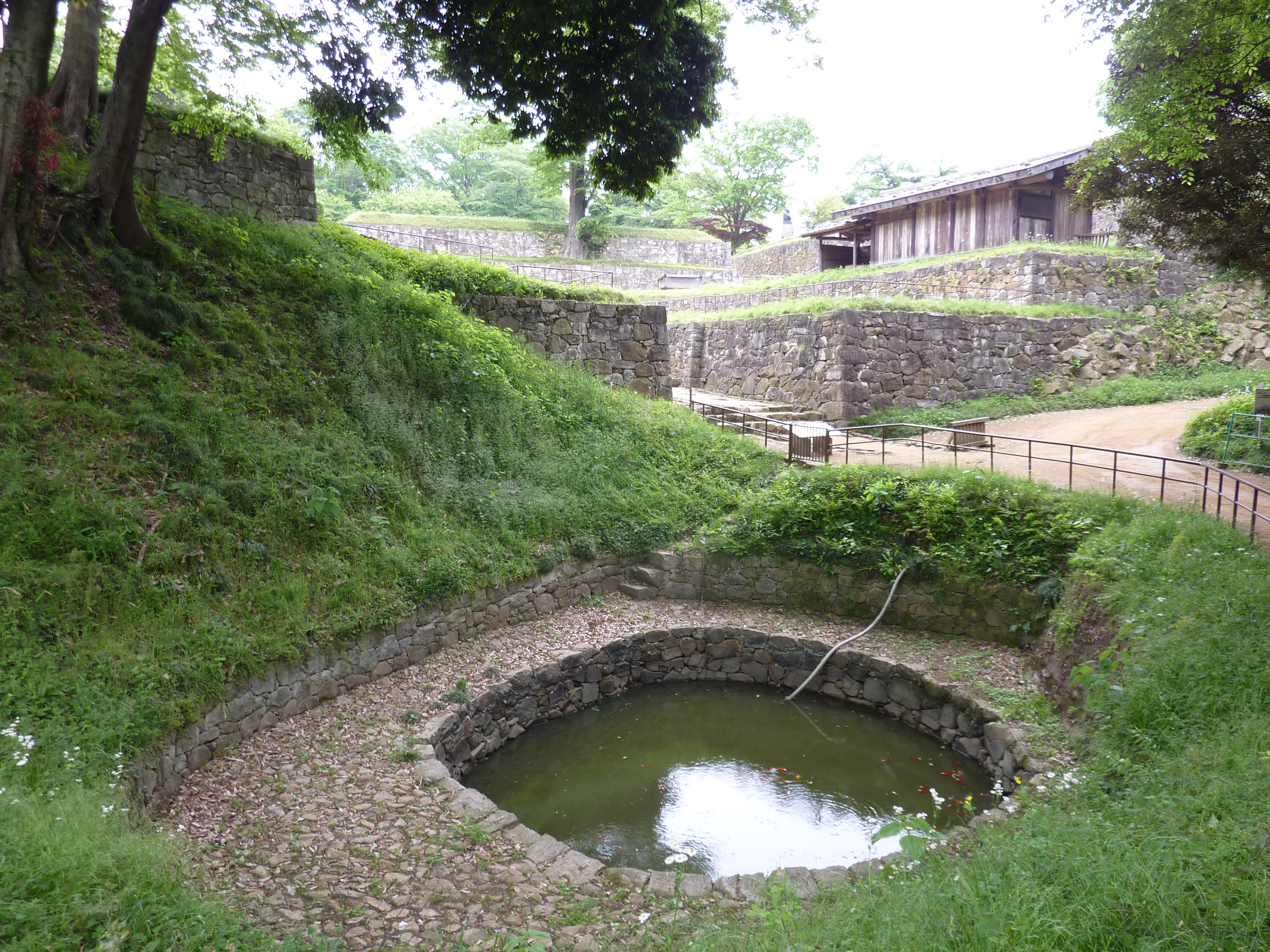
The castle's design was unusual for its era and region. Most Sengoku-period fortifications in the Kanto relied on earthworks -- clay ramparts and dry moats. Kanayama used extensive stone walls, particularly around the main gate area in a small valley below the inner bailey. The main fortified area stretched roughly one kilometer in length, with secondary fortifications covering approximately three square kilometers of the hilltop. A round pond still visible today is a surviving remnant of a Japanese garden that once graced the primary residence of the Yura lords. For years, a popular theory held that the castle's keep had been physically relocated to Inuyama Castle by Ishikawa Mitsuyoshi in 1559. Archaeological examinations during restoration work between 1961 and 1965, which involved dismantling the Inuyama Castle keep, disproved this legend entirely. In 2006, the Japan Castle Foundation named Kanayama one of Japan's Top 100 Castles, and the ruins -- protected as a National Historic Site since 1990 -- are maintained by the city of Ota, with a local museum on the grounds.
From the Air
Located at 36.3178°N, 139.3775°E on Mount Kanayama, north of central Ota in Gunma Prefecture. From the air, the castle ruins appear as cleared hilltop enclosures with visible stone wall remnants and earthwork terracing on a forested hill flanked by the Tone River to the west and the Watarase River to the east. The hill rises from the flat northern edge of the Kanto Plain, making it a prominent visual landmark at low altitude. The nearest major airport is Ibaraki Airport (RJAH), approximately 100 km east. Tokyo Haneda (RJTT) is roughly 130 km south. Best viewed at 2,000-3,000 feet AGL to appreciate the hilltop fortification layout and river positions.