Kanayama Kofun
From above, it looks like a figure eight pressed into the rice paddies at the foot of Mount Katsuragi. The Kanayama Kofun is not your typical burial mound. Most kofun in Japan take the keyhole shape that defines the era -- circular rear mound, triangular front extension. This one did something different. Two circular tumuli, one larger than the other, were joined side by side along a northwest-southeast axis, creating an extremely rare dumbbell form that has puzzled archaeologists since its first excavation in 1946. Encircled by a double-ring moat and surrounded by paddy fields that sit one step lower than the land around them, the Kanayama Kofun occupies its corner of southeastern Osaka Prefecture like a punctuation mark at the end of a sentence nobody fully understands.
Two Mounds, One Mystery
The numbers tell the structural story. The north tumulus is a two-tiered construction with a diameter of 38.6 meters and a height of 6.8 meters. The south tumulus is larger and more elaborate -- a three-tiered mound 55.4 meters across and 9.4 meters tall. Together, they stretch 85.8 meters in total length. A double-circular moat with an average depth of 1.4 meters surrounds both, giving the entire complex a footprint of 104 meters including the water. Fukiishi -- cobblestones arranged on the surface as a decorative and structural element -- have been found on both tumuli, though only on the west side of the narrow constriction where they join. No haniwa, the distinctive clay figures that typically adorn kofun exteriors, have been recovered. Stone rows line the third tier of the southern mound. The construction style dates the complex to the latter half of the 6th century, the twilight of the Kofun period.
House-Shaped Coffins in Stone
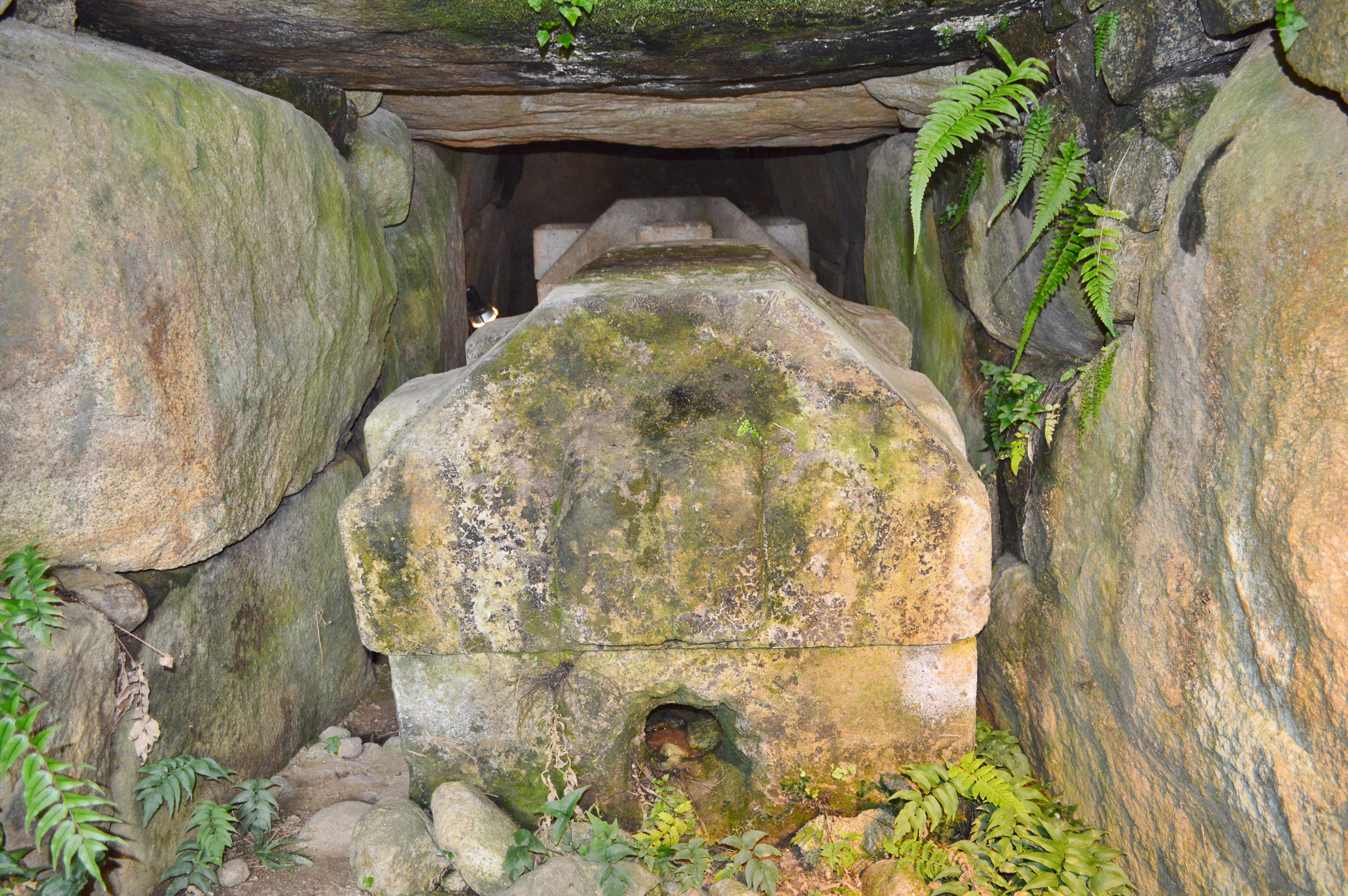
The north tumulus holds the more fully explored burial chamber -- a large stone room stretching 10.6 meters in total length. Inside, excavators found two house-shaped sarcophagi carved from tuff, one placed in the main chamber and a second in the entrance vestibule. The stone coffins mimicked the ridged rooflines of actual buildings, a funerary tradition reserved for individuals of considerable status. Grave robbers reached the chamber first -- likely in the early 7th century, barely a generation after the burial -- but they left traces behind. Archaeologists recovered glass balls, silver rings, horse harnesses, iron swords, and earthenware scattered among the disturbed remains. The southern tumulus also appears to contain a horizontal stone chamber, but it has never been fully excavated, preserving whatever secrets it holds for future generations.
A Prince's Resting Place?
Local legend assigns one of the two tumuli to Prince Saegusa, said to be a son of Prince Shotoku, the near-mythical regent who championed Buddhism and centralized governance in 7th-century Japan. The archaeological timeline makes the connection strained -- the mound likely predates Prince Shotoku's lifetime by at least a few decades -- but the persistence of the legend suggests that whoever lay in these house-shaped coffins was remembered long enough for their identity to become entangled with the most famous prince in Japanese history. The dumbbell shape itself invites speculation: were these two individuals buried simultaneously as part of a shared ruling arrangement, or was the second mound added later to honor a successor? The sealed southern chamber keeps its counsel.
A Kofun Park Among the Paddies
Archaeological excavations in 1946 provided the first systematic look at the site, followed by more thorough campaigns in 1993 and 1994. Since 1995, the Kanayama Kofun has been maintained as a public park in the town of Kanan, on the Kanan Plateau at the western foot of Mount Katsuragi. The surrounding paddy fields, sitting lower than the ancient moat perimeter, frame the twin mounds in a patchwork of green and brown that shifts with the seasons. Designated a National Historic Site of Japan in 1991, the kofun is accessible via a three-minute walk from the Seryutani bus stop on the Kongo Bus line from Tondabayashi Station. Standing on the park grounds, with the forested slopes of Katsuragi rising to the east and the Osaka plain stretching westward, the dual mounds feel less like an archaeological curiosity and more like a deliberate statement -- two circles fused together, holding their dead close across fourteen centuries.
From the Air
Located at 34.47N, 135.63E on the Kanan Plateau in southeastern Osaka Prefecture, at the western foot of Mount Katsuragi (Mount Yamato Katsuragi). The dumbbell-shaped twin tumuli are distinctive from the air, surrounded by paddy fields and the faint trace of the double-ring moat. Osaka Itami Airport (RJOO) lies approximately 30nm to the north-northwest; Kansai International Airport (RJBB) is roughly 25nm to the southwest. Best viewed at 2,000-4,000 feet AGL to appreciate the unusual twin-mound shape. The Kongo mountain range provides a dramatic backdrop to the east. The Kintetsu Nagano Line railway corridor is a useful visual reference running through nearby Tondabayashi.