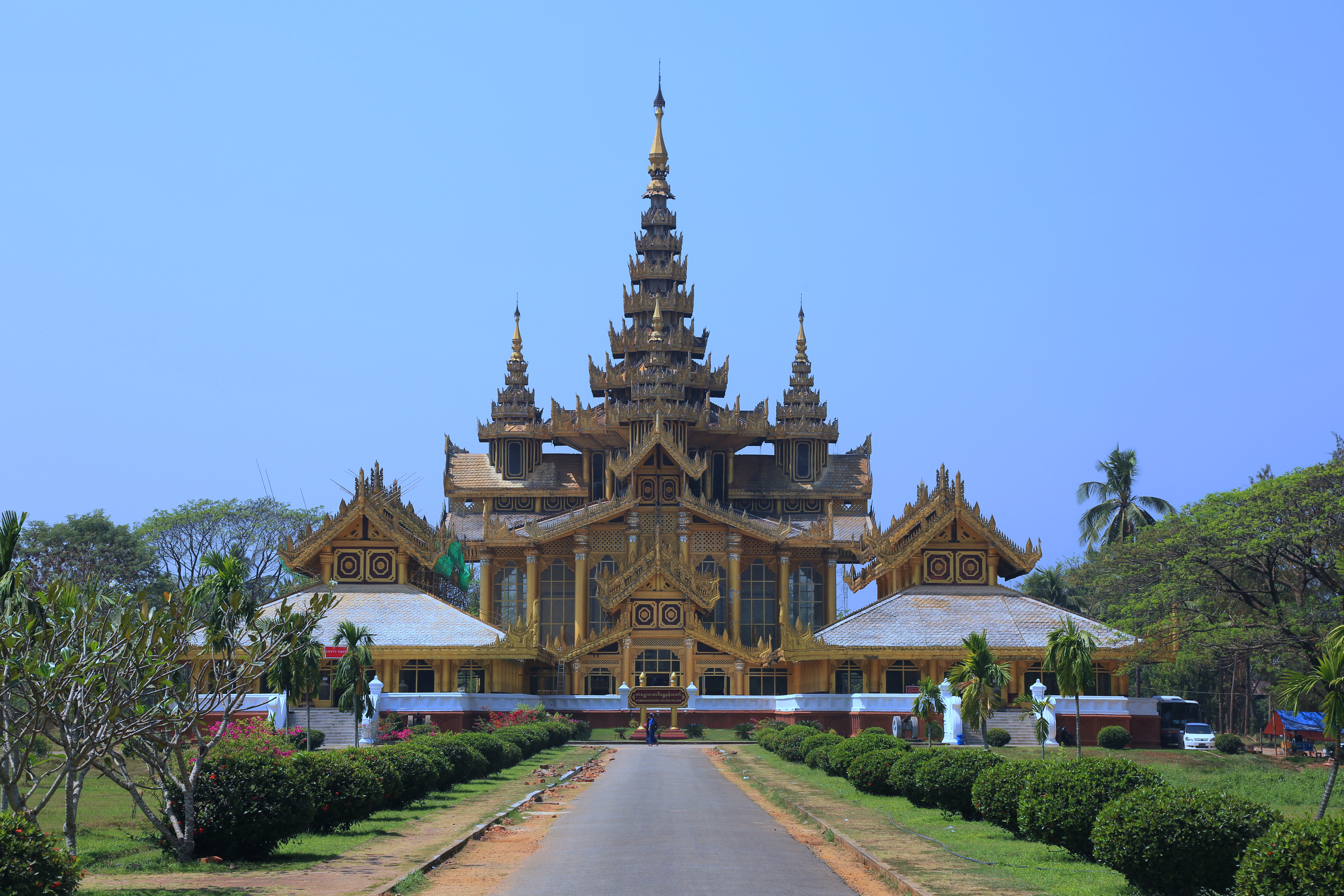
Kanbawzathadi Palace
Of the nine royal thrones that once stood inside Kanbawzathadi Palace, eight were consumed by fire in 1599. The ninth -- the Thihathana, or Lion Throne, carved with snarling figures and sheathed in gold leaf -- survived, and it sits today in the National Museum in Yangon, separated by four centuries and 80 kilometers from the palace it was built for. That single artifact captures the story of Kanbawzathadi: a place of astonishing wealth, catastrophic destruction, and stubborn resurrection.
A Conqueror's Capital
King Bayinnaung was not modest in his ambitions. By the mid-1550s, this Taungoo dynasty ruler had forged the largest empire in the history of mainland Southeast Asia, encompassing much of present-day Myanmar, Thailand, and parts of China. He needed a capital to match. Construction of Kanbawzathadi began in 1553 at the center of Hanthawadi -- modern Bago -- inside a walled city pierced by 20 gates. The palace complex spread across 70 acres, an expanse of 76 apartments and halls where the business of empire was conducted. Bayinnaung was a collector of symbols as much as territories. He possessed many white elephants, the ultimate marker of royal power in Theravada Buddhist culture, and he obtained a sacred Buddha tooth relic from Sri Lanka, installing it in the nearby Mahazedi Pagoda.
Gilded Roofs and European Witnesses
European merchants and adventurers who visited Bago in the late 1500s left accounts that read like fairy tales. The Great Audience Hall -- the largest structure in the complex -- was roofed with actual gold plates. Inside, rows of massive teak pillars supported ceilings covered entirely in gold paint, and the Lion Throne dominated the far end of the hall, where the king received ministers and foreign envoys. The Bhammayarthana Throne Hall, also called the Bee Throne Hall, served as the king's private quarters. Its architecture was characteristically Burmese: multiple roof sections stacked above false floors, crowned by a pyatthat, the distinctive seven-tiered spire that marked royal buildings. Other halls housed the chambers of queens and royal family members, each with its own throne decorated with a distinct motif for different ceremonial occasions.
Forty-Three Years of Splendor
The palace's life as a functioning seat of power lasted barely four decades. In 1599, armed conflict swept through Bago. Invaders looted the palace systematically -- furniture, personal belongings, ceremonial objects -- and then set it ablaze. What the flames did not destroy, the jungle eventually reclaimed. For nearly four hundred years, the remains of Bayinnaung's great palace lay buried beneath mounds of earth and vegetation, the precise layout of its halls preserved only in old texts and the fading memory of Mon and Burmese chronicles. The city of Bago grew over and around the ruins, and Kanbawzathadi became a story rather than a place.
Unearthed After Four Centuries
In 1990, excavation teams began digging into six earthen mounds at the site. What they uncovered was remarkable. Brick foundations traced the outlines of the palace buildings with precision, and hundreds of original teak pillars from the 16th century emerged from the soil -- 167 in the Great Audience Hall alone, 135 of them inscribed in Mon script with the names of towns, regions, and donors who had contributed them. Nearly 2,000 Buddha images were found, crafted in Mon, Siamese, and Burmese styles, evidence of the cosmopolitan culture that had flourished here. By 1992, several buildings had been reconstructed following the original designs, informed by the archaeological evidence and surviving historical drawings.
Voices in Teak and Gold
Today, the reconstructed palace gives visitors a sense of scale rather than authenticity -- the gold paint is new, the thrones are replicas, and the halls echo with tourist footsteps rather than courtly ceremony. But the Nandawya research museum on the grounds displays the real artifacts: those inscribed teak pillars, ancient coins, pottery, scales and weights from the empire's trade networks, glazed jars, weapons, and the extraordinary collection of 16th-century Buddha images. Each Mon inscription on a pillar is a voice from the 1550s -- a town official, a regional lord, a devout donor -- recorded in a language that predates the Burmese empire that swallowed their kingdom. The pillars survived the fire, the jungle, and the centuries. They remain the truest witnesses to what Bayinnaung built.
From the Air
Located in central Bago at 17.33N, 96.49E, approximately 80 km northeast of Yangon. The palace grounds cover roughly 70 acres and are visible as a large cleared compound in the city center. Nearest major airport is Yangon International (VYYY). The Shwemawdaw Pagoda, one of Myanmar's tallest, rises nearby and serves as a prominent visual landmark. Best viewed at 3,000-5,000 ft to appreciate the palace layout within Bago's urban grid.