Kandy Esala Perahera
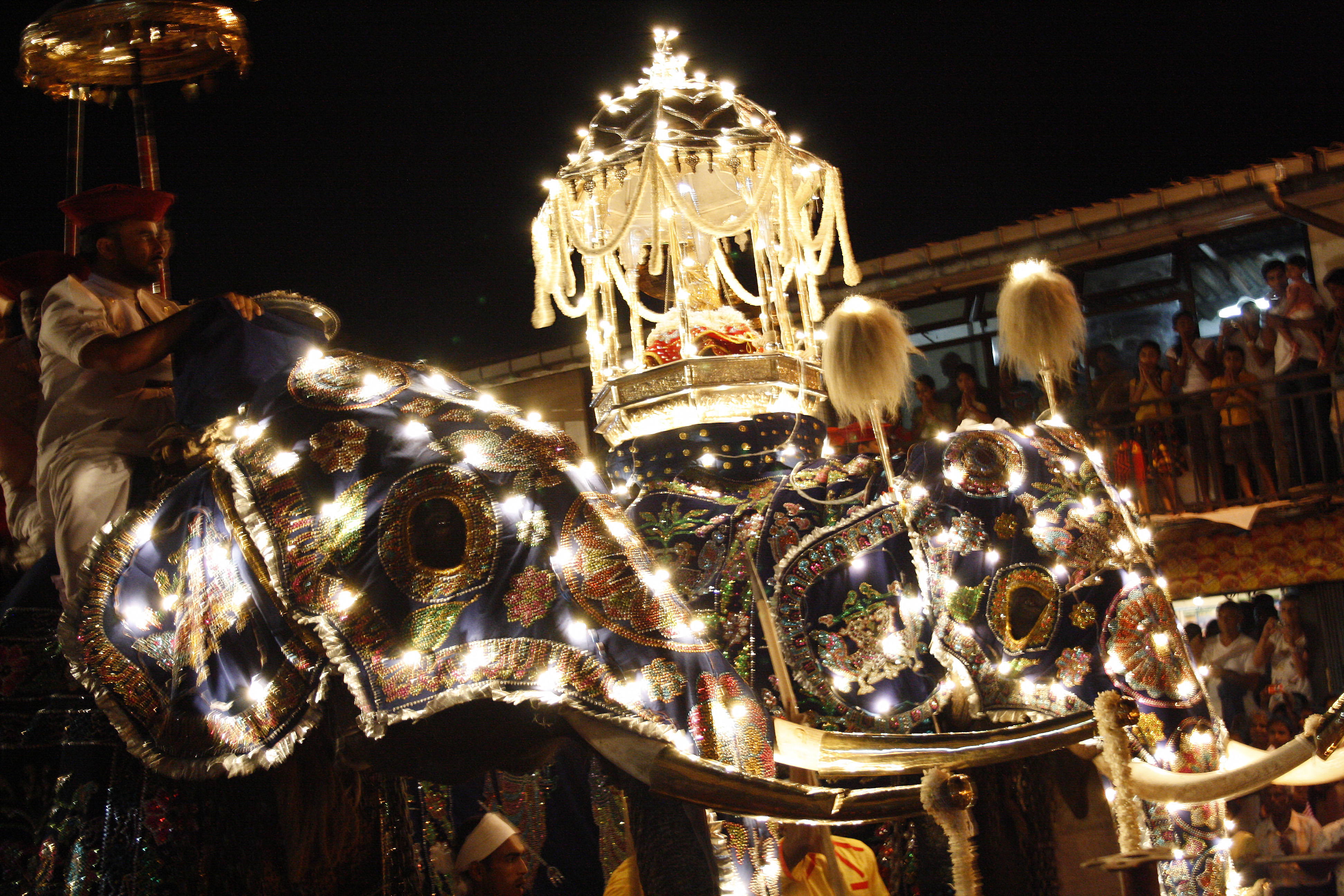
A cannon fires at dusk, and Kandy holds its breath. Then the whip-crackers appear, spinning flame in the half-light, clearing the path for what follows: a tusker elephant draped in illuminated cloth, carrying a golden casket on its back. Inside that casket sits a replica of what Buddhists consider their most sacred possession on this island -- the tooth relic of the Buddha himself. The Kandy Esala Perahera has begun, as it has every July or August for more than fifteen centuries, and for the next ten nights this hill city will belong to the procession.
Two Processions Made One
The Perahera's roots reach back to the 3rd century BCE, when a ritual procession called the Esala Perahera was performed to invoke the blessings of the gods for timely rainfall. Centuries later, in the 4th century CE, the Sacred Tooth Relic arrived in Sri Lanka from India, roughly eight centuries after the passing of the Buddha. A second procession -- the Dalada Perahera -- began to honor it. Over time, these two traditions fused into the spectacle that exists today, a ceremony that is at once a prayer for rain and a veneration of the Buddha's relic. The Buddhist monk Upali Thera shaped its evolution, arguing that a procession honoring Brahminical deities was inconsistent with Buddhist principles. The king he counseled declared: "Henceforth, gods and men are to follow the Buddha." The procession reoriented itself around the relic, and it has remained so ever since.
Five Processions, Ten Nights
The festival unfolds in three phases, each escalating in grandeur. It begins with the Kap Situveema, a quiet ritual in which a sanctified young jackfruit tree is cut and planted at each of the four Devales -- shrines dedicated to the guardian deities Natha, Vishnu, Katharagama, and the goddess Pattini. For five nights, small processions circle within each shrine's precincts. Then comes the Kumbal Perahera, five nights during which the four processions converge before the Temple of the Sacred Tooth Relic, where the Tooth has been housed since the 16th century. Each deity's golden insignia rides in a domed canopy on an elephant's back, attended by drummers in white and dancers whose movements have been rehearsed for weeks. Finally, the Randoli Perahera arrives -- named for the royal palanquins that once carried Kandyan queens -- and the procession reaches its full scale, drawing hundreds of thousands of spectators to Kandy's streets.
The Maligawa Tusker
At the heart of the procession walks the Maligawa Tusker, the elephant chosen to carry the Sacred Casket. This is not a role assigned lightly. The tusker must be large, calm, and accustomed to crowds and noise -- the cannon blasts that mark key moments in the Perahera are audible across the entire city. Behind the tusker walks the Diyawadana Nilame, the chief lay custodian of the relic, dressed in full Kandyan ceremonial attire. Several tuskers have achieved legendary status in this role: Raja, whose taxidermied remains are displayed in the palace complex, served for decades before his death in 1988. Nadungamuwa Raja and Millangoda Raja are among the others revered in Sri Lankan cultural memory. These elephants are not mere participants. They are considered sacred servants, and their names are remembered with a reverence that speaks to the depth of this tradition.
What Survives the Kingdom
When the British took the Kandyan Kingdom in 1815, the procession lost its royal patron. The custody of the Sacred Tooth Relic passed to the Maha Sangha, the Buddhist monastic order, and the position of Diyawadana Nilame was created to manage the relic's care in the absence of a king. The Perahera could have died with the kingdom. Instead, it adapted. Today the monks of the Malwatte and Asgiriya Chapters conduct the rituals, while the Diyawadana Nilame coordinates the enormous logistical effort -- consulting the official astrologer for auspicious timing, liaising with privately owned elephants, coordinating drumming groups through four senior officials. Upon the procession's conclusion, a formal letter called the Perahera Sandeshaya is delivered to the President of Sri Lanka, a symbolic acknowledgment that the tradition endures. The festival concludes with the Diya Kepeema, a water-cutting ceremony at the Mahaweli River in nearby Getambe, closing a cycle of devotion that has outlasted every empire that ever tried to govern this island.
From the Air
Kandy Esala Perahera takes place in central Kandy (7.297N, 80.638E), along streets surrounding the Temple of the Tooth at approximately 465m elevation. The procession route is not visible from altitude, but the Temple of the Tooth complex sits at the north shore of Kandy Lake, which serves as the primary visual reference. Nearest airport is Bandaranaike International (VCBI/CMB), 115km southwest. No commercial airport in Kandy itself. The Mahaweli River, site of the concluding water-cutting ceremony, flows east of the city center.