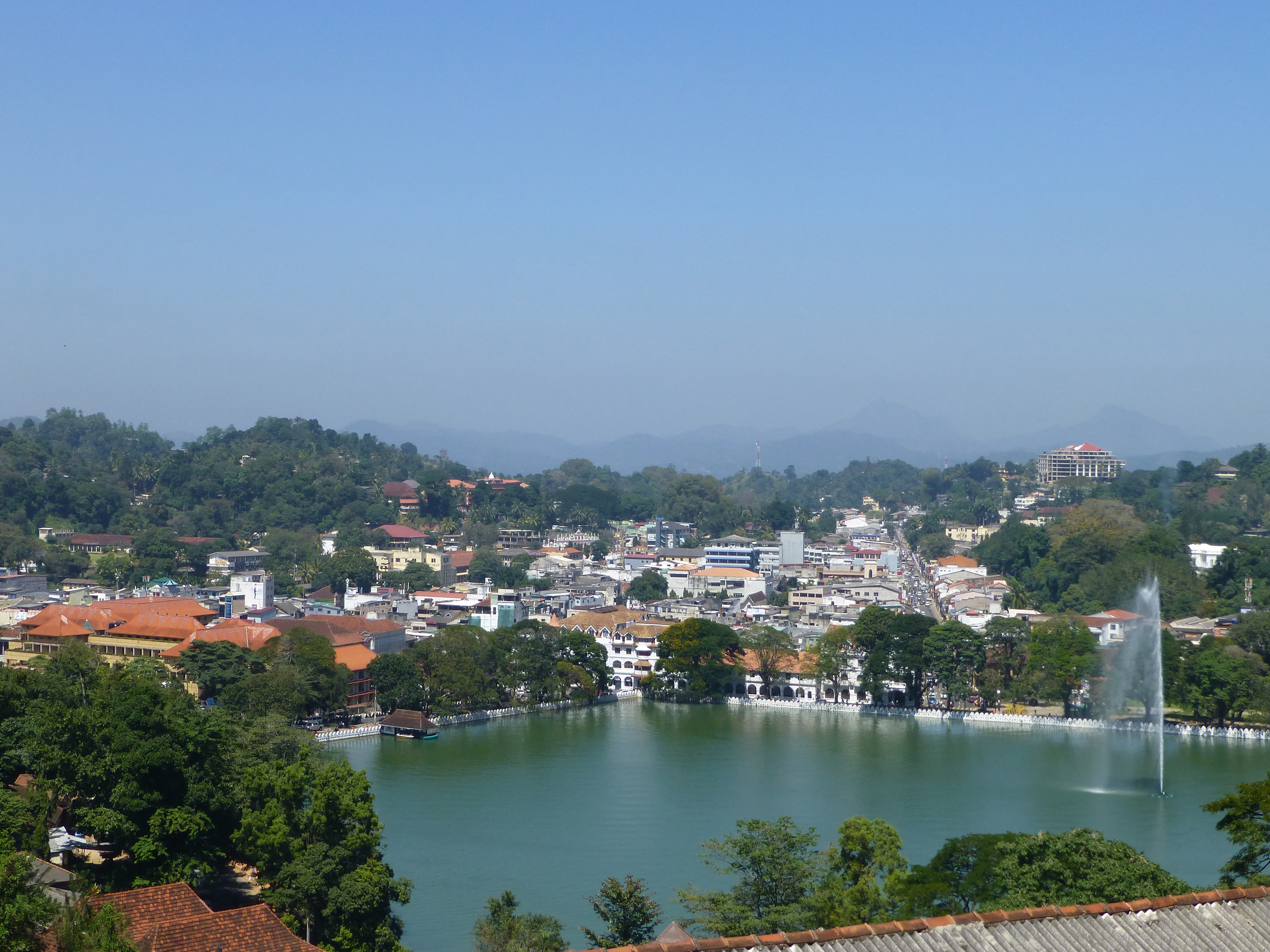
Kandy Lake
The paddy fields that once stretched before the Temple of the Tooth are gone. In their place lies a lake that should not exist -- an artificial body of water that a king created in 1807 because he wanted one. Sri Vikrama Rajasinha, the last king of Kandy, looked at the productive rice paddies called Tigolwela and saw something else: a mirror for his temple, a setting worthy of his palace. The lake he built contributed to the grievances that turned his own chiefs against him. Two centuries later, the king is gone and the kingdom is gone, but Kandy Lake defines the city. Every guidebook photo frames it. Every evening stroller circles it. The extravagance outlasted the extravagant.
A Sea of Milk
The name came first. Before the lake existed, a small pond in the middle of the Tigolwela paddy fields was known as Kiri Muhuda -- the Sea of Milk. When the king dammed the fields and flooded them, the new lake inherited the old pond's name. The architect was Deveda Moolacharya, and the engineering was straightforward but ambitious: a dam stretching from the Paththirippuwa, the distinctive octagonal tower on the Temple of the Tooth's south side, across to the Poya-maluwa. A roadway was built atop the dam, giving the king a direct route to the Malwatte Vihare on the lake's opposite shore. According to British records from Sir John D'Oyly, the dam was constructed between 1810 and 1812, suggesting the lake took several years to fill and settle into its final form. The steps that originally led down into the water from the Mahamaluwa are still visible today.
The Island and the Wall
In the lake's center sits a small island -- the Diyathilaka Mandapaya -- that the king created by excavating soil from both the palace end and the Malwatte Vihare end of his new dam, leaving a raised platform behind. The island initially served as a Royal Summer House where the queen and ladies of the court relaxed. Legend holds that a secret tunnel connected it to the palace, though no tunnel has been confirmed. The British repurposed the island as an ammunition store and ringed it with a fortress-style parapet. Around the lake itself, the king began constructing the Walakulu Bamma -- the Clouds Wall -- a decorative parapet extending roughly 630 meters around half the shoreline. Triangular holes in the wall once held oil lamps lit on festival nights, their flickering light reflected across the water. Sri Vikrama Rajasinha never finished the wall. The British captured Kandy before he could, and the Walakulu Bamma remains unfinished to this day.
The Cost of Beauty
The lake was not a popular project. Sri Vikrama Rajasinha's building ambitions -- the lake, the Clouds Wall, the Bathing Pavilion -- required labor that his subjects resented providing. The king was already politically vulnerable: he was of South Indian Nayak descent rather than Sinhalese, and his authority rested on the support of powerful chieftains who held the real administrative power. His construction projects and harsh treatment of dissenting chiefs eroded that support. The Kandyan Convention of 1815, which handed the kingdom to the British, was signed not because the British conquered Kandy militarily but because the chieftains turned against their king. Sri Vikrama Rajasinha was exiled to Vellore in southern India, where he lived out his remaining years. The irony is that his most criticized creation became his most enduring legacy -- a body of water that gave Kandy its iconic character.
Six Thousand Square Meters of Reflection
Kandy Lake today covers approximately 18.4 hectares with a circumference of 3.21 kilometers and a maximum depth of 18.5 meters. The shaded path that rings it passes beneath trees -- nuga, palm, sal, and mara -- some planted over seventy years ago and now maintained by the Municipal Council. Indian cormorants, white egrets, wood storks, and pelicans populate the shoreline. The Malwatte temple, one of the two head temples of the Siyam Nikaya sect of Theravada Buddhism, overlooks the water. Fishing is prohibited, a protection that has been in place since the lake's creation. Until 1960, the Kandy water board drew drinking water from the lake for the surrounding community, but pollution ended that practice. The lake faces environmental pressures today, and local schools and the government work to address them. But the view remains what the last king intended: the Temple of the Tooth reflected in still water, the hills rising behind, a manufactured paradise that became genuine.
From the Air
Kandy Lake (7.292N, 80.640E) is clearly visible from the air as an artificial water body in the center of Kandy at approximately 465m elevation. The lake measures roughly 3.2km in circumference. The Temple of the Tooth complex is visible on its north shore, and the Queen's Bathing Pavilion (Ulpange) extends into the lake from the south side. The small island (Diyathilaka Mandapaya) is visible at the lake's center. The Walakulu Bamma (Clouds Wall) is visible as a decorative parapet along approximately half the shoreline. Nearest airport is Bandaranaike International (VCBI/CMB), 115km southwest.