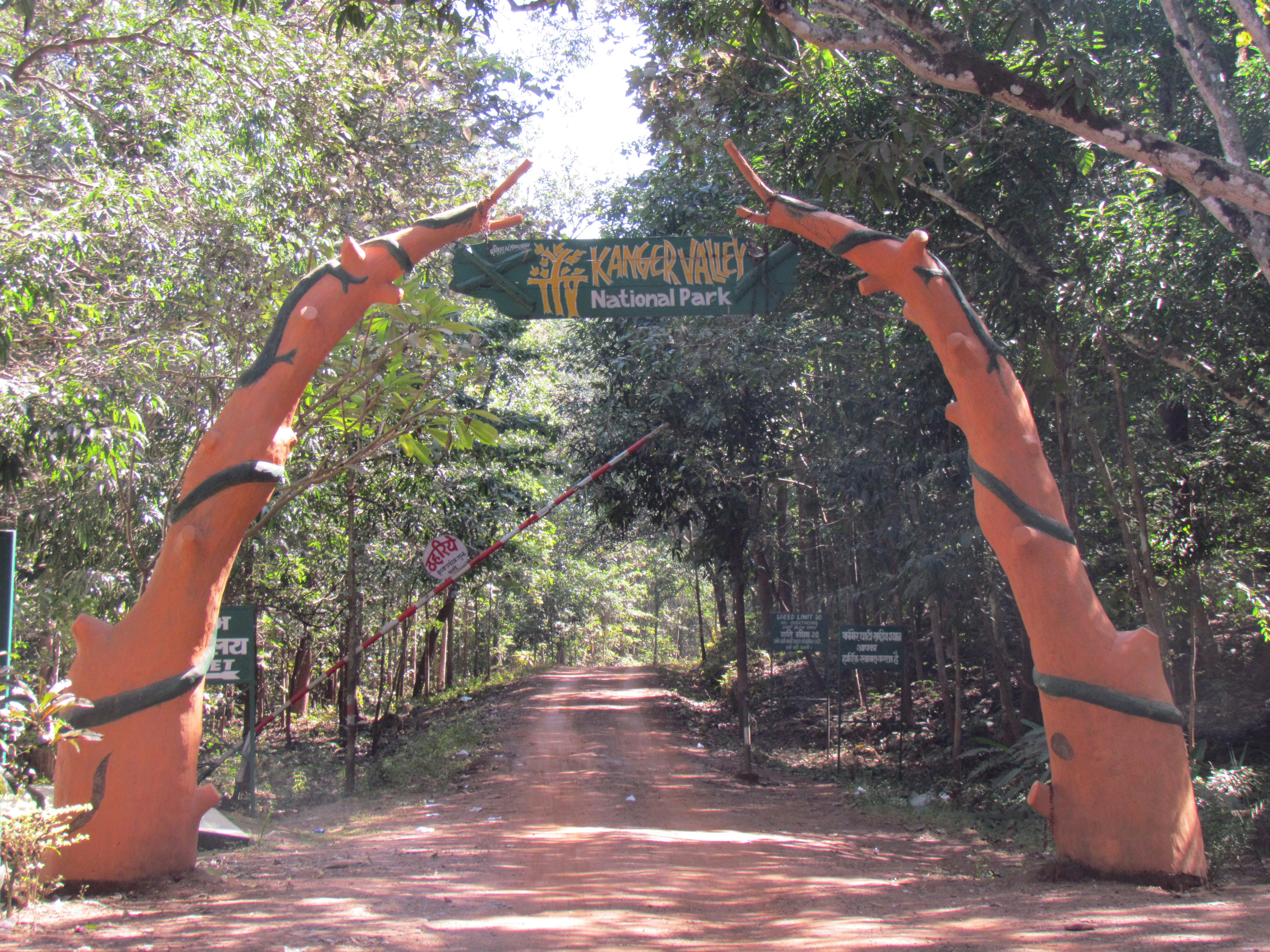
Kanger Valley National Park
Somewhere in the perpetual darkness of Kotumsar Cave, 35 meters below the forest floor, a fish swims without eyes. Indoreonectes evezardi, a blind, albino loach, has spent so many generations in the lightless pools of Kanger Valley National Park that evolution stripped away what it no longer needed. This fish is a fitting emblem for a park that rewards those willing to look beneath the surface, a place where the real wonders hide underground, in limestone chambers that have been growing stalactites for millions of years, inside forests so dense they remain among the last truly virgin woodlands on the Indian peninsula.
A River Runs Through It
Kanger Valley takes its name from the Kanger River, one of the few perennial rivers in the Bastar region, which flows northwest to southeast through deep gorges at the park's center. Established in July 1982, the park covers approximately 200 square kilometers, stretching 33.5 kilometers from the Tirathgarh waterfalls in the west to the Kolab River on the Odisha state boundary in the east. The Kanger feeds into the Godavari River system, making the entire park a critical catchment area. Altitudes range from about 338 meters to well above on the park's steep eastern ridges, where the terrain becomes so rugged that human intrusion is nearly impossible. In 2025, the national park was added to UNESCO's tentative list for World Heritage status.
Worlds Below the Canopy
Four major limestone caves lie north of the Kanger River between Madarkonta and Kodri Bahar: Kotumsar, Kailash, Dandak, and Devgiri. Kotumsar Cave, discovered by local people around 1900 and first scientifically explored by geographer Shankar Tiwari in 1951, descends about 35 meters below ground and extends roughly 1,371 meters in length. Its five chambers maintain a constant temperature near 28 degrees Celsius in perpetual darkness, and the main hall produces remarkable acoustics. Kailash Cave, discovered more recently in 1993, holds a different surprise: at its far end, a massive stalagmite formation resembles a Shivlinga, and the hollow walls produce musical notes when struck. Tribal tales surround these caves, which are also known locally as Gupanpal. Scientists have documented 49 mammal species, 144 bird species, and 113 spider species in the park.
Where Milk Falls from the Forest
Tirathgarh Falls, located about 38 kilometers from Jagdalpur, earns its local nickname as the "Milky Fall" honestly. Water from the Mugabahar River splits into multiple streams that zigzag down rocky slopes from a height of more than 100 feet, the white spray giving the impression of cascading milk against the surrounding green forest. At the base of the falls sits a temple dedicated to Shiva and Parvati, drawing thousands of pilgrims alongside the nature tourists each year. The best months to visit are October through February, when the monsoon has recharged the rivers but the flooding has subsided. Farther into the park, Kanger Dhara offers a gentler spectacle: the Kanger River tumbles over undulating folded rocks, the product of ancient igneous intrusions into sedimentary terrain, creating a series of small cascades.
Tooth, Claw, and Feather
The park's 553 documented plant species create a mixed moist deciduous forest dominated by sal, teak, and bamboo. Within this canopy, the Bastar hill myna, the state bird of Chhattisgarh, calls from the treetops alongside racket-tailed drongos, red junglefowl, and steppe eagles. On the ground and in the marshes, the cast is wilder: tigers, leopards, sloth bears, wild boar, and mouse deer share the territory. Along the Kanger River at Bhainsa Darha, mugger crocodiles bask on sand banks 65 kilometers from Jagdalpur, watched from a tower that overlooks a lake also inhabited by smooth Indian otters and tortoises. The marshy areas formed by seasonal tributaries, with names like Ekta Jhodi and Komkel Jhodi, create crucial wet habitat where chital, barking deer, and panthers converge in the early dry season.
A Park and Its People
Forty-eight villages lie within five kilometers of the park's boundary, and one forest village, Kotamsar, sits inside the park itself. The tribal communities of Bastar have lived alongside these forests for centuries, depending on them for fuel wood, bamboo, and non-timber forest produce. The park is divided into two ranges: the Kotamsar Range in the west, where villages press close and biotic pressure is heavy, and the Koleng Range in the east, where fewer settlements and more formidable terrain leave the forest comparatively undisturbed. Reaching the park requires traveling 27 to 33 kilometers from Jagdalpur, the gateway city in southern Chhattisgarh. The main entry is at the Kotamsar barrier on the Jagdalpur-Darbha road, part of a national highway that connects Chhattisgarh with Andhra Pradesh.
From the Air
Kanger Valley National Park (18.83N, 82.01E) sits 30 km southeast of Jagdalpur in the Bastar region of Chhattisgarh. From altitude, the park appears as a dense, unbroken forest canopy running northwest to southeast along the Kanger River gorge, flanked by steep hills. The nearest airport is Maa Danteshwari Airport, Jagdalpur (VEJP). The park extends east to the Kolab River on the Odisha border. At recommended viewing altitude of 5,000-8,000 feet, Tirathgarh Falls may be visible as a white streak on the park's western edge. Monsoon months (June-October) bring heavy cloud cover.