Kanheri Caves
In 1839, Dr. James Bird pried open a ruined brick stupa in front of Kanheri's Great Chaitya cave and found, beneath a circular stone sealed with gypsum, two small copper urns. One held ashes mixed with a ruby, a pearl, pieces of gold, and a tiny gold box containing a fragment of cloth. The other held a silver box and more ashes. Copper plates inscribed in the ancient Lat script confirmed what Bird already suspected: the remains belonged to followers of the Buddha. He had uncovered relics from a community that carved 109 caves into a single basalt hill on the outskirts of what is now Mumbai -- one of the largest rock-cut monastic complexes in India.
A University in Stone
The first caves at Kanheri were hewn from the dark basalt around the 1st century BCE, and new excavations continued for nearly a thousand years. What began as simple shelters for meditating monks grew into an elaborate complex that functioned as a Buddhist university during the eras of the Maurya and Kushan empires. The site's location was strategic: it sat along trade routes connecting the ports of Sopara and Kalyan to inland centers like Nasik, Paithan, and Ujjain. Merchants passing through made donations that funded increasingly ambitious excavation. The earliest caves reflect the Hinayana school of Buddhism, austere and focused on the monastic community. Later additions bear the mark of the Mahayana tradition, with elaborate sculptures of the Buddha surrounded by attendants and bodhisattvas. Cave 90 features Buddha seated on a lotus throne, flanked by figures with serpent hoods -- iconography that would have been unthinkable to the complex's earliest inhabitants.
The Great Hall and the Darbar Cave
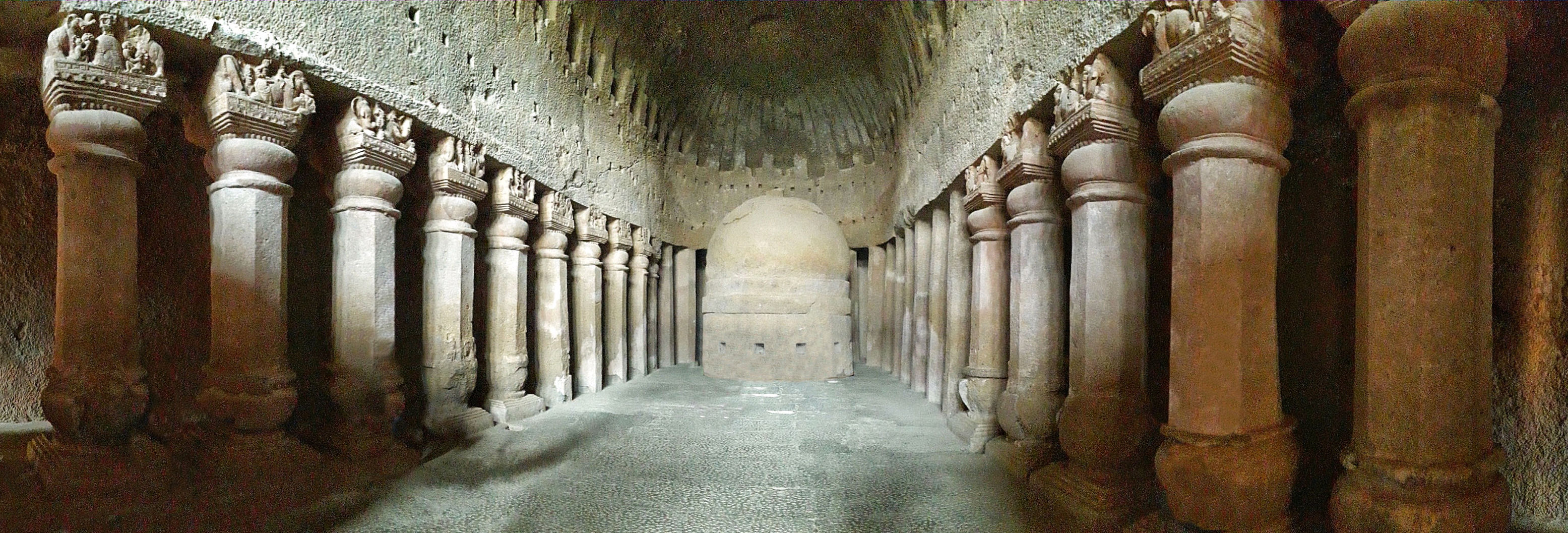
The Great Chaitya cave, the largest prayer hall in the complex, dominates the hillside with its vaulted interior and carved pillars. But it is Cave 11 -- the Darbar or Maharaja cave -- that reveals the most about how this community organized itself. Neither a typical vihara nor a simple shrine, it served as a dharmasala, a place of assembly. Its layout is the only known surviving example that echoes the great hall erected by King Ajatashatru at Rajagriha for the first Buddhist convocation, held immediately after the Buddha's death. According to the Mahavamsa, that original hall had carpets laid for 500 priests, a throne for the high priest on the north side, and a preaching pulpit "fit for the deity himself" in the center, facing east. The Darbar cave at Kanheri preserves the architectural memory of that assembly -- a space designed not for individual contemplation but for collective deliberation.
Cisterns That Never Run Dry
What strikes every visitor, past and present, is water. Nearly every cave has its own cistern carved into the rock beside the front court, and these remain filled with clear water year-round. Rock-cut channels above the caves capture monsoon rain and direct it into these reservoirs, an engineering system so effective that it has outlasted the monks who designed it by centuries. In front of many caves, holes in the courtyard floors and mortises cut into the rock facades reveal where wooden posts and rafters once supported awnings -- sheltering the cave entrances during the torrential monsoon rains that sweep across Mumbai from June to September. Stairs cut into the rock surface connect the cave groups, many with carved channels for handrails along their sides. This was infrastructure built for a permanent community, not occasional pilgrimage. The monks who lived here thought in decades and centuries, carving their solutions directly into the mountain.
The Gallery of Stupas
South of the Great Chaitya cave, a ruined stairway descends to a long gallery stretching over 200 yards, sheltered by overhanging rock. The floor conceals the foundations of small brick dagobas buried in dust -- probably sixteen to twenty in number. Beyond these stands the ruin of a large stone stupa, once richly sculptured, explored by Mr. E.W. West in 1853. Behind it, three small cells contain decayed sculptures with traces of plaster still bearing painted pigment. The floor rises sharply, revealing eleven more brick stupas, then another level with thirty-three more, their bases ranging from four to six feet in diameter. All have been destroyed nearly to their foundations, and all appear to have been rifled -- no relics were found in any that West examined. On the veranda pilasters nearby, inscriptions in Pahlavi script testify to the international reach of this Buddhist community, connecting it to the Persian-speaking world across the Arabian Sea.
Sacred Ground in a National Park
Today the Kanheri Caves sit within the Sanjay Gandhi National Park, about 30 kilometers from central Mumbai. The dense forest that surrounds the hill would have been familiar to the monks -- they chose this location precisely for its isolation from the bustle of the ancient ports. Cave 34 preserves unfinished paintings of the Buddha on its ceiling, brushstrokes abandoned mid-creation for reasons lost to history. On the eastern slope, squared stones, foundations, and water tanks mark where a large colony of monks once lived outside the caves themselves. The spartan plinth beds carved into the rock of the viharas -- simple stone platforms where monks slept -- offer a stark contrast to the ornate sculptural programs of the later Mahayana caves. The complex is protected as a Monument of National Importance by the Archaeological Survey of India. Walking from the austere early caves to the richly decorated later ones traces the transformation of Buddhism itself, from a monastic discipline of renunciation to a devotional tradition embracing art, imagery, and cosmic grandeur.
From the Air
Located at 19.21°N, 72.91°E within the Sanjay Gandhi National Park in Mumbai's northern suburbs. The cave complex is carved into a forested basalt hill that rises from the surrounding parkland. From the air, look for the green expanse of the national park contrasting with the dense urban sprawl of Borivali. Nearest major airport is Chhatrapati Shivaji Maharaj International Airport (VABB), approximately 25 km to the south. Best viewed at 2,000-3,000 ft; the caves themselves are not visible from altitude, but the distinctive forested hill stands out clearly.