Kanishka Stupa
According to Buddhist tradition, the Buddha once pointed to a small boy shaping a mud mound and said that on that very spot, a king named Kanishka would one day raise a great monument. Whether prophecy or legend, the story captures something true about what happened at Shaji-ki-Dheri on the outskirts of Peshawar nearly two thousand years ago. There, in the 2nd century CE, the Kushan king Kanishka built a stupa so tall it became one of the most celebrated structures of the ancient world -- a tower of devotion that drew pilgrims across continents and endured in memory long after its stones had crumbled.
A King's Offering
Kanishka ruled the Kushan Empire at its zenith, when its territory stretched from Central Asia deep into the Indian subcontinent. A patron of Buddhism, he chose the outskirts of Peshawar -- the heart of the ancient Gandhara region -- as the site for his grandest act of religious devotion. Around 150 CE, the first stupa rose at Shaji-ki-Dheri, built to house sacred Buddhist relics. A Khotanese scroll discovered centuries later at Dunhuang, in what is now northwestern China, recounts how the king's desire to build was met by four divine beings who appeared as boys, molding a small stupa from mud and telling Kanishka that this was to be his great work. The legend gave the monument a cosmic mandate: this was not merely a king's project, but the fulfillment of the Buddha's own words.
Reaching for the Sky
The original stupa was impressive, but the structure that became legendary was the rebuilt version of the 4th century CE. Reconstructed under continued Kushan rule, it took on a cruciform plan with four staircases, four corner bastions, and possibly freestanding pillars at each corner. The tower-like structure that rose from this base was extraordinary in scale -- ancient accounts placed it among the tallest buildings in the known world. In 726 CE, nearly six centuries after the original construction, the Korean Buddhist pilgrim Hyecho traveled through Gandhara and recorded what he found. "The monastery is called Kanishka," he wrote in his memoir. "There is a great stupa which constantly glows." That a pilgrim from Korea would journey this far to see it speaks to the monument's reputation across the Buddhist world.
Bones Beneath the Rubble
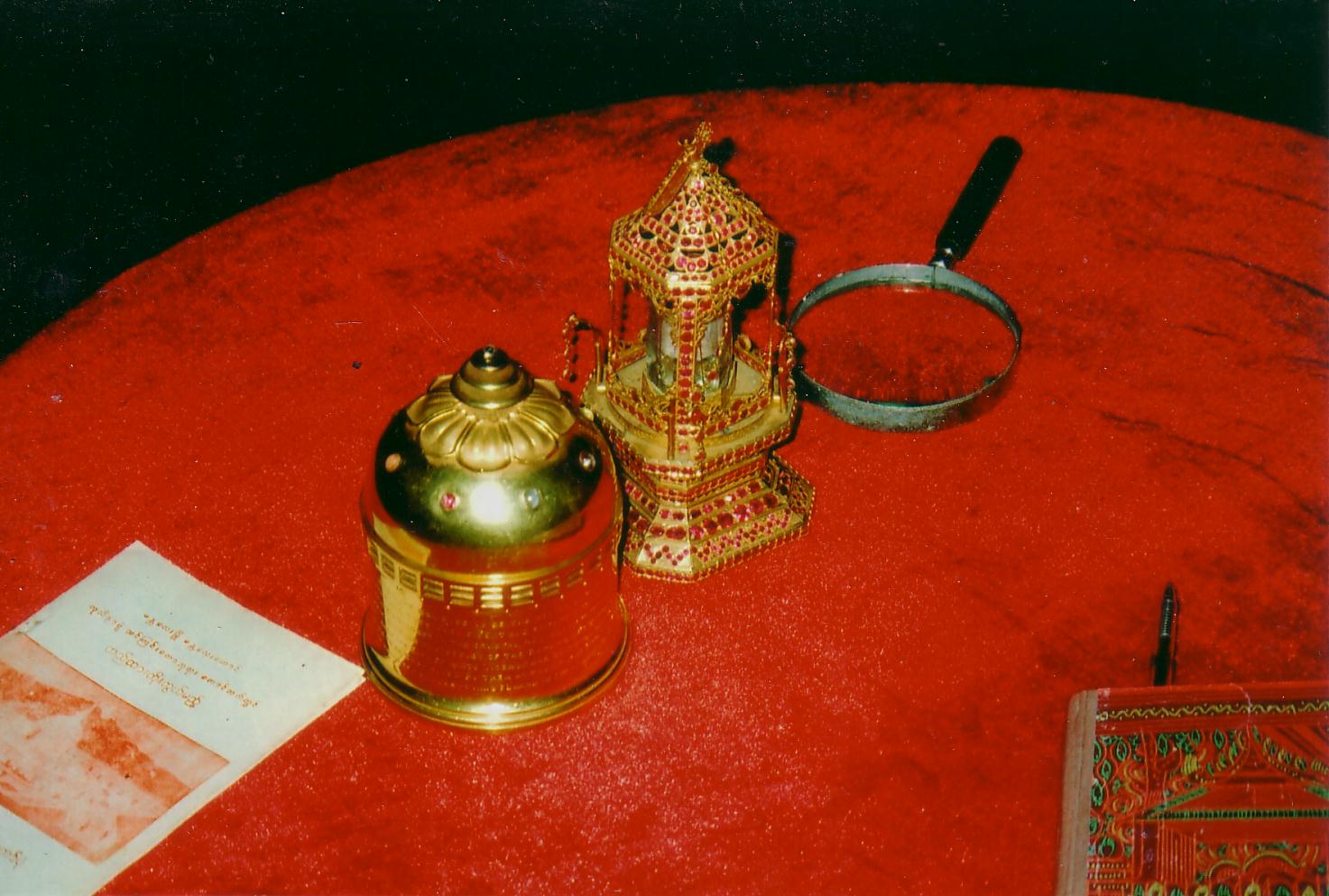
By the early 20th century, the stupa had long since collapsed, its location known only through scattered references in ancient texts. In 1908, British archaeologist David Brainard Spooner led an excavation at Shaji-ki-Dheri that brought the monument back into the light. What Spooner's team found at the base of the ruined stupa was remarkable: the Kanishka casket, a gilded copper reliquary, inside which sat a six-sided inner reliquary of rock crystal. Inside lay three small fragments of bone -- relics attributed to the Buddha himself. The casket bore a dedication inscribed in Kharoshthi script that named Kanishka as the patron. The bone fragments were eventually transferred to the U Khanti Hall at Mandalay Hill in Burma, where they remain objects of veneration. The casket itself became one of the most important archaeological finds in the history of Gandharan Buddhism.
Where Empires Met and Prayed
The Kanishka Stupa was more than a religious monument. It was a statement about the kind of empire Kanishka wanted to build -- one that drew legitimacy from the spiritual authority of Buddhism while commanding the trade routes that connected Rome, Persia, China, and India. Peshawar, known in antiquity as Purushapura, sat at the crossroads of these civilizations. The Gandhara region around it produced a singular artistic tradition: Greco-Buddhist art, in which the forms of classical Greek sculpture merged with Buddhist iconography. The stupa and its associated monastery were products of this cultural confluence, a place where pilgrims from Korea, scrolls from China, and artistic traditions rooted in the Hellenistic world all converged on a single mound of earth and stone.
Echoes at Shaji-ki-Dheri
Today the site at Shaji-ki-Dheri sits quietly on the outskirts of a sprawling modern Peshawar. The stupa itself is gone -- reduced to archaeological traces and the objects now dispersed across museums in Pakistan and Myanmar. But the story it represents endures. From the air, the flat terrain east of Peshawar gives little hint of what once stood here: a structure so tall it defined the skyline of an ancient capital, so sacred that pilgrims crossed continents to see it, and so carefully constructed that when archaeologists finally dug through its ruins, they found the crystal casket exactly where a king had placed it nearly two millennia before. The boy making a mud mound may have been legend. The stupa Kanishka built in his place was anything but.
From the Air
Located at 33.999N, 71.592E on the eastern outskirts of Peshawar at Shaji-ki-Dheri, elevation approximately 1,100 feet. The site is now within Peshawar's suburban sprawl and not visually prominent from the air. Peshawar Bacha Khan International Airport (OPPS) lies approximately 5 nm to the northwest. The broader Peshawar valley, with the mountains of the Khyber region to the west and the Indus plain to the east, provides geographic context for this ancient crossroads. Best viewed at 2,000-4,000 feet AGL in conjunction with other Gandhara-era sites in the region.