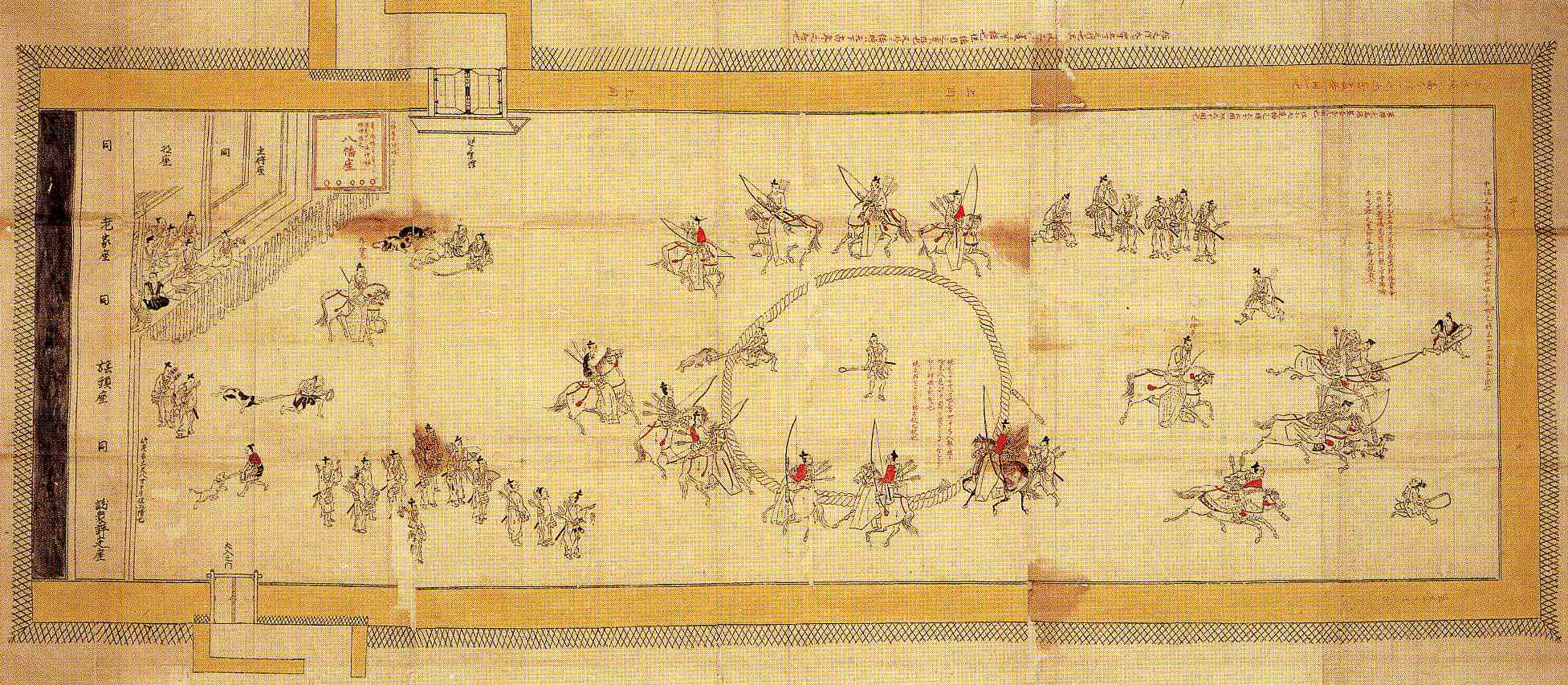
Kannonji Castle
Three highways converge in the flatlands below Mount Kinugasa, and for two centuries the clan that held its summit held the keys to central Japan. Kannonji Castle, perched at 400 meters on the ridgeline of this mountain in what is now Ōmihachiman, Shiga Prefecture, was not simply a fortress. It was a tollbooth, a throne, and a watchtower rolled into one. From its ramparts, the Rokkaku clan could survey the Nakasendō and Tōkaidō highways linking Kyoto with the eastern provinces, as well as the Hokkoku Kaidō highway reaching north to the Sea of Japan. Lake Biwa shimmered to the west. Anyone marching on the imperial capital had to pass through this bottleneck first.
A Clan Carved Into Stone
The precise year Kannonji Castle was built remains unknown, but sometime during the 14th century the Rokkaku clan -- a cadet branch of the Sasaki clan who had risen to prominence during the Kamakura period -- chose the ridged peak of Mount Kinugasa as their seat of power. The Rokkaku served as shugo, or military governor, of Ōmi Province, though they effectively controlled only its southern half. Their northern rivals, the Kyogoku clan, held the rest. A Buddhist temple called Kannonshō-ji already occupied the mountain's upper slopes, and the castle took its name from this ancient sanctuary. Originally called Sasaki Castle, the fortification was rebuilt during the Ōnin era between 1467 and 1477, a period of devastating civil war that tore Japan apart.
Hands That Changed the Flag
Kannonji Castle changed hands three times during the Ōnin War alone -- twice in clashes between the Rokkaku and the Kyogoku, and a third time in a fratricidal struggle between rival branches of the Rokkaku themselves. Stability returned under Rokkaku Takayori, who died in 1520 after reunifying the clan by seizing estates from nobles and Buddhist temples with the backing of the Muromachi shogunate. His son Rokkaku Sadayori, who lived from 1495 to 1552, transformed the castle town of Ishidera at the mountain's base into a thriving commercial center by abolishing the restrictive local guild system. He sheltered Shogun Ashikaga Yoshiharu after Yoshiharu was expelled from Kyoto, and extended Rokkaku influence over the powerful Azai clan to the north. During the Kōji era of 1555 to 1558, the stone ramparts were enlarged to accommodate small cannons -- an early sign that Japan's age of the sword was giving way to gunpowder.
Nobunaga's Bloodless Triumph
In September 1568, Oda Nobunaga marched westward toward Kyoto with an army intent on remaking Japan. The Rokkaku, loyal to the Ashikaga shogun, attempted to block his advance from Kannonji Castle. It was a fatal miscalculation. Nobunaga's general Niwa Nagahide crushed the Rokkaku forces so completely that by the time Nobunaga himself arrived at the castle gates, there was no one left to resist him. He entered Kannonji Castle unopposed and in triumph, then continued his march to the capital. The defeated lord Rokkaku Yoshikata fled south into the mountainous Kōka region, where he waged a guerrilla resistance from Mikumo Castle for several years. He never recovered his ancestral stronghold. Nobunaga kept Kannonji Castle garrisoned even after completing his grand new fortress at nearby Azuchi Castle, recognizing the older site's enduring strategic value.
Fire and Silence
The end came suddenly. When Nobunaga was assassinated in 1582 at the Honnō-ji incident in Kyoto, the power vacuum ignited chaos across his domains. Kannonji Castle was attacked and burned, possibly by local peasants turned looters who also torched the magnificent Azuchi Castle nearby. Two centuries of military history went up in flames in a single convulsion of opportunistic violence. Today the ruins sit quietly among cedar forests on Mount Kinugasa, protected as a National Historic Site since 1982. Hikers reach them via a 25-minute walk from JR Azuchi Station, climbing first past the ancient temple of Kuwanomi-dera, then through groves of Japanese cedar to the castle grounds. From the main courtyard, a trail continues to the neighboring Kannonshō-ji temple, where the panoramic view across the plains and Lake Biwa reveals exactly why the Rokkaku chose this mountain -- and why Nobunaga wanted it.
From the Air
Located at 35.146N, 136.158E on Mount Kinugasa (433m) near the eastern shore of Lake Biwa. The castle ruins sit on the ridgeline just below the summit, adjacent to Kannonshō-ji temple. From the air, look for the forested mountain rising from the flat agricultural plains between Lake Biwa to the west and the urban area of Ōmihachiman. The ruins of the more famous Azuchi Castle are visible on a neighboring hill to the northwest. Nearest airport is Osaka Itami (RJOO) approximately 80km southwest, or Chubu Centrair (RJGG) approximately 90km east. Recommended viewing altitude 2,000-3,000 feet for terrain detail.