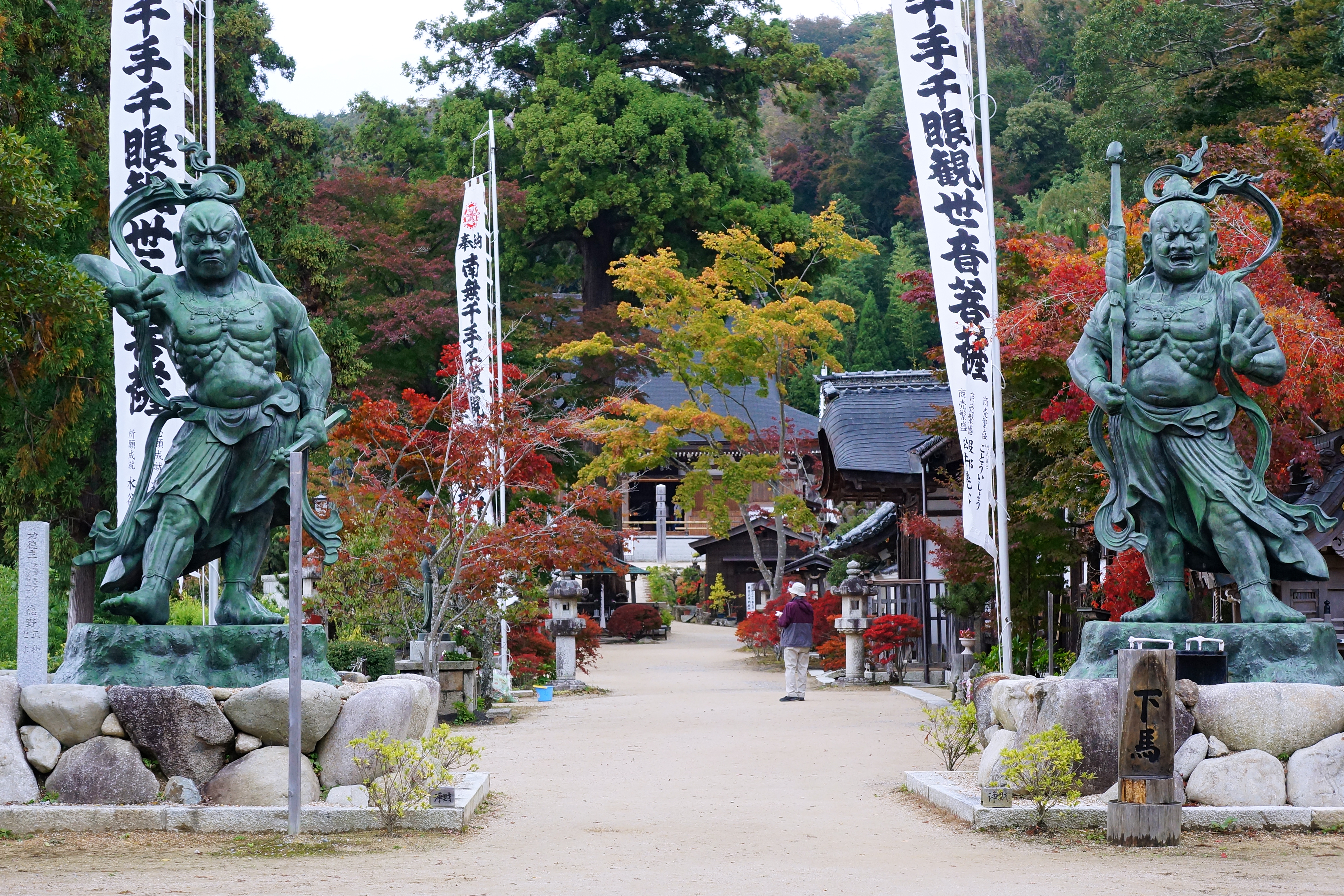
Kannonshō-ji
A mermaid once rose from the reed-choked waters near Lake Biwa and begged a prince for salvation. Or so the legend goes. At Kannonshō-ji, the Tendai Buddhist temple clinging to the south side of Mount Kinugasa's summit at 370 meters above sea level, the boundary between myth and history has always been porous. The temple is the 31st stop on the Saigoku Kannon Pilgrimage, one of Japan's oldest and most revered pilgrimage circuits. For fourteen centuries, devotees have climbed this mountain in Ōmihachiman, Shiga Prefecture, to venerate a statue of Senjū Kannon -- the Thousand-Armed Bodhisattva of Compassion. What they find at the top is a story of destruction and renewal that mirrors the cycle of suffering and transcendence at the heart of Buddhism itself.
The Fisherman Who Became a Mermaid
According to legend, the temple was founded in the year 605, during the 13th year of Empress Suiko's reign, when Prince Shōtoku visited the area. In one version of the founding story, a mermaid appeared to the prince in the reedy shallows of Kanzaki County. She told him she had once been a fisherman from Katata, a village on Lake Biwa's shore, but her repeated taking of life had condemned her to reincarnate as a sea creature wracked with suffering. She pleaded for a statue of Senjū Kannon to be enshrined in a temple so her soul could find peace. Prince Shōtoku obliged, carving the statue himself. Later accounts say the mermaid attained Buddhahood, and her body was retrieved from the water and placed in the temple. For centuries, Kannonshō-ji displayed what it claimed was the mermaid's mummy -- until fire consumed it in 1993.
Emperors on the Run
Whatever its legendary origins, the temple certainly existed by the 11th century during the Heian period. By the Kamakura period, it sat at the heart of a volatile landscape. Mount Kinugasa also hosted Kannonji Castle, stronghold of the Rokkaku clan who governed southern Ōmi Province. In 1333, the temple found itself caught up in imperial drama when the Rokuhara Tandai official Hōjō Nakatoki, attacked by Ashikaga Takauji, attempted to flee eastward with Emperor Kōgon and two retired emperors, Go-Fushimi and Hanazono. The temple served as lodging for these fugitive royals during their desperate escape. The Rokkaku initially protected the temple, but during the Eiroku era of 1558 to 1570, the lord Rokkaku Yoshikata expanded Kannonji Castle so aggressively that he appropriated most of the temple grounds, forcing the monks to rebuild at the mountain's foot. That reconstruction had barely finished when Oda Nobunaga defeated the Rokkaku on September 12, 1568, and the new temple buildings burned in the battle.
A Pattern of Ashes
Kannonshō-ji's history reads like a cycle of destruction and resurrection. After Kannonji Castle fell to ruin, the temple rebuilt on its original mountaintop location in 1597. A new main hall went up in 1606. During the Edo period, the temple flourished as a pilgrimage destination. In 1880, the main hall was rebuilt again, with the old structure dismantled and relocated to Nenshō-ji in nearby Kōra. Then in 1882, the temple acquired the Zelkova Palace, a structure from Hikone Castle, to serve as its new main hall. That building survived over a century -- until 1993, when fire struck again. The mountain location made firefighting nearly impossible. The blaze destroyed the hall, the temple's principal image -- a standing Senjū Kannon statue inscribed with the date 1497 and designated a National Important Cultural Property -- and the famous mermaid mummy. Centuries of irreplaceable history turned to ash in hours.
Twenty Trips to India
The current wooden main hall, built in the elegant irimoya hip-and-gable style, was completed in 2004. But the true labor of devotion was the new principal image. Buddhist sculptor Myōkei Matsumoto carved a seated Senjū Kannon statue standing 3.56 meters tall, with a total height of 6.3 meters including its halo. The statue is made from 23 tons of sandalwood imported from India -- a material that was officially prohibited for export. The temple's chief priest traveled to India more than 20 times, negotiating patiently over years until he secured special permission to export the sacred wood to Japan. Meanwhile, the original main image from before the fire -- which had somehow survived unscathed -- was designated a hibutsu, a secret Buddha, and opened to the public in 2022. It is scheduled to be revealed again only once every 33 years.
From the Air
Located at 35.145N, 136.161E on the south side of Mount Kinugasa's summit (433m), on the eastern shore of Lake Biwa near Ōmihachiman. The temple sits adjacent to the ruins of Kannonji Castle on the same mountain. From the air, look for the forested mountain rising prominently from the flat rice paddies east of Lake Biwa. The temple complex is visible as a clearing near the summit on the mountain's south face. Nearest airports: Osaka Itami (RJOO) approximately 80km southwest, Chubu Centrair (RJGG) approximately 90km east. Recommended viewing altitude 2,000-3,000 feet to see the mountain's relationship to Lake Biwa and the surrounding plain.