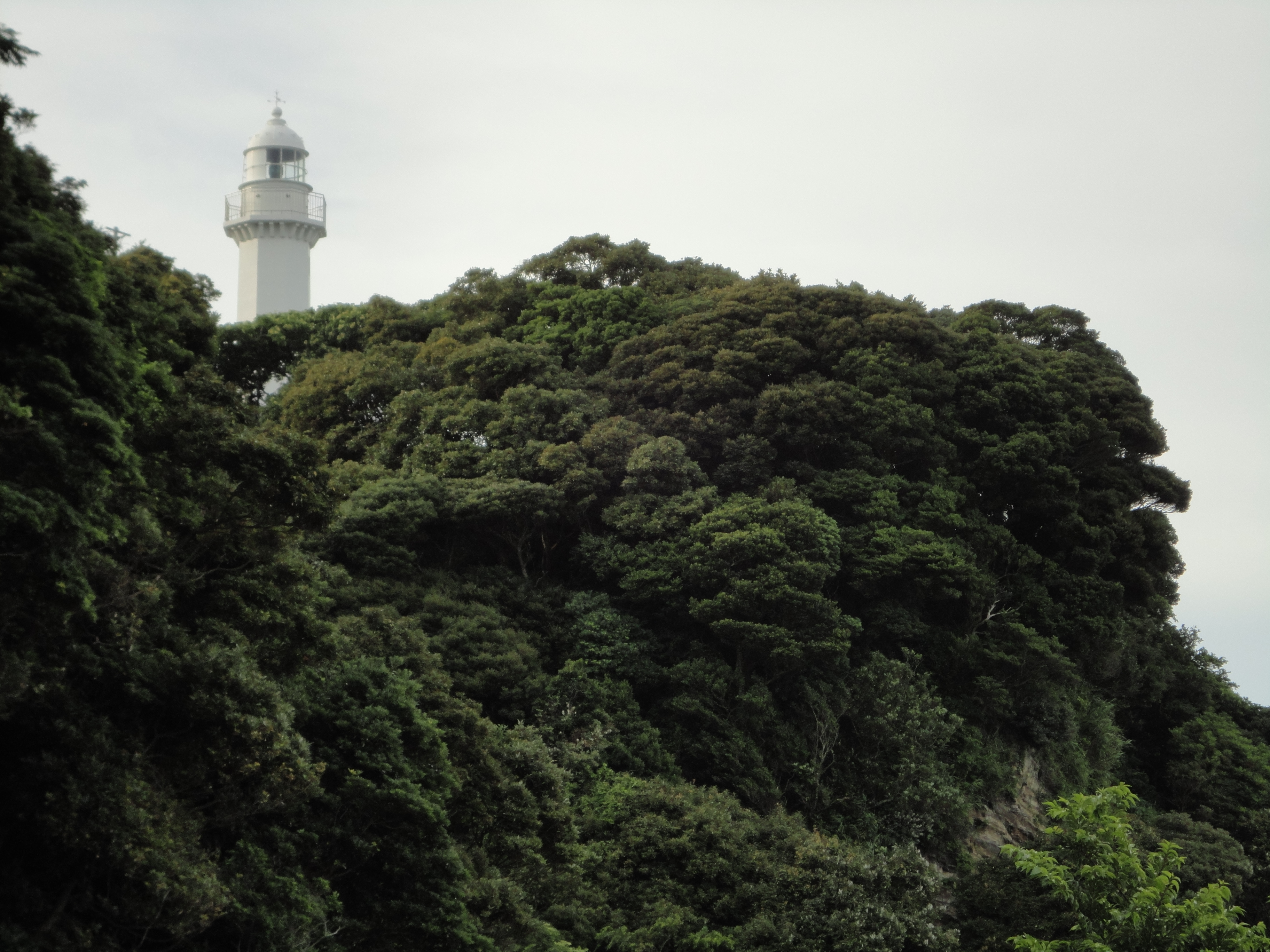
Kannonzaki Lighthouse
The lighthouse was first lit on February 11, 1869, while cannon fire from the Boshin War still echoed across Japan. That detail alone makes Kannonzaki extraordinary -- the country's very first modern lighthouse flickered to life during the dying convulsions of the Tokugawa Shogunate, a beacon of the new world being born even as the old one fought its last battles. Perched on Cape Kannon at the mouth of Tokyo Bay, where the Miura Peninsula juts into the shipping lanes that connect the capital to the open Pacific, Kannonzaki has stood watch over these waters in three different incarnations, each one destroyed and rebuilt as Japan itself was reshaped by earthquakes and war.
A Treaty Etched in Light
Kannonzaki owes its existence to diplomacy, not just engineering. The Anglo-Japanese Treaty of Amity and Commerce of 1858 -- the agreement that pried open Japan's ports to foreign trade after centuries of isolation -- specifically mandated the construction of eight lighthouses to make Japanese waters navigable for Western vessels. The Tokugawa Shogunate, which had neither the technology nor the expertise to build Western-style navigational aids, turned to France and England for help. The site at Cape Kannon was chosen because of its strategic position at the entrance to Tokyo Bay, where ships heading to and from the newly established Yokosuka Iron Works needed guidance through the narrow Uraga Channel. Construction fell to Francois Leon Verny, a French engineer already employed at the Yokosuka Iron Works. Verny used bricks manufactured at his own ironworks to build a rectangular, white-painted structure -- Western engineering rising from Japanese soil.
Built Three Times
If any structure embodies Japan's relationship with seismic violence, it is Kannonzaki. Verny's original brick lighthouse stood for over fifty years before an earthquake on April 26, 1922, destroyed it completely. The replacement, built as a reinforced concrete structure and completed on March 15, 1923, lasted exactly six months. On September 1, 1923, the Great Kanto Earthquake -- magnitude 7.9 -- fractured the concrete, cracked the walls, and collapsed the top of the tower. Tokyo and Yokohama burned in the aftermath; over 100,000 people died. The lighthouse was just one small casualty among many. Restoration began on September 18, 1924, and the third and present Kannonzaki Lighthouse was completed on June 1, 1925. This version, sturdier and more resilient, has now stood for a full century, outlasting everything the Pacific Ring of Fire has thrown at it.
The French Engineer at the Edge of Empire
Francois Leon Verny -- known more formally as Leonce Verny -- arrived in Japan in 1865, four years before the lighthouse was completed. He came to build the Yokosuka Iron Works, one of the Meiji era's most ambitious modernization projects, and he stayed to help construct the navigational infrastructure that would connect Japan to global maritime trade. The bricks for Kannonzaki's first lighthouse were fired in Verny's own kilns at Yokosuka, making the structure a product of both French expertise and Japanese industrial ambition. Work began in November 1868 and was finished in just four months. Verny then moved on to build the Nojimazaki Lighthouse on the opposite shore of Tokyo Bay, completed in December 1869. Together, these twin lights marked the gateway to Japan's new capital for the ships of every trading nation in the world.
A Star of Silver Screen
For many Japanese, Kannonzaki is inseparable from a single film. Times of Joy and Sorrow, director Keisuke Kinoshita's 1957 drama, tells the story of a lighthouse keeper and his family navigating the hardships of life during World War II. Kannonzaki features prominently on the film's poster and in its opening scenes, its white tower standing as a symbol of quiet endurance against the backdrop of war. The film became a massive popular success and cemented the lighthouse in the national imagination as something more than a navigational aid -- it became a monument to the ordinary Japanese families who endured extraordinary times. Today, visitors to Cape Kannon can walk the coastal trails of Kannonzaki Park, where the lighthouse still stands against the blue expanse of Tokyo Bay, guiding ships as it has since the final days of the samurai age.
From the Air
Cape Kannon at 35.256N, 139.745E, on the eastern tip of the Miura Peninsula where it narrows toward the Uraga Channel. The white lighthouse tower is visible from low altitude against the green headland. Best viewed at 1,500-3,000 feet from over Tokyo Bay. Nearby airports include RJTT (Tokyo Haneda) approximately 25nm north and RJTY (Yokota AB) approximately 45nm northwest. The Uraga Channel between Cape Kannon and the Boso Peninsula opposite provides a dramatic visual corridor.