Kansas City Massacre
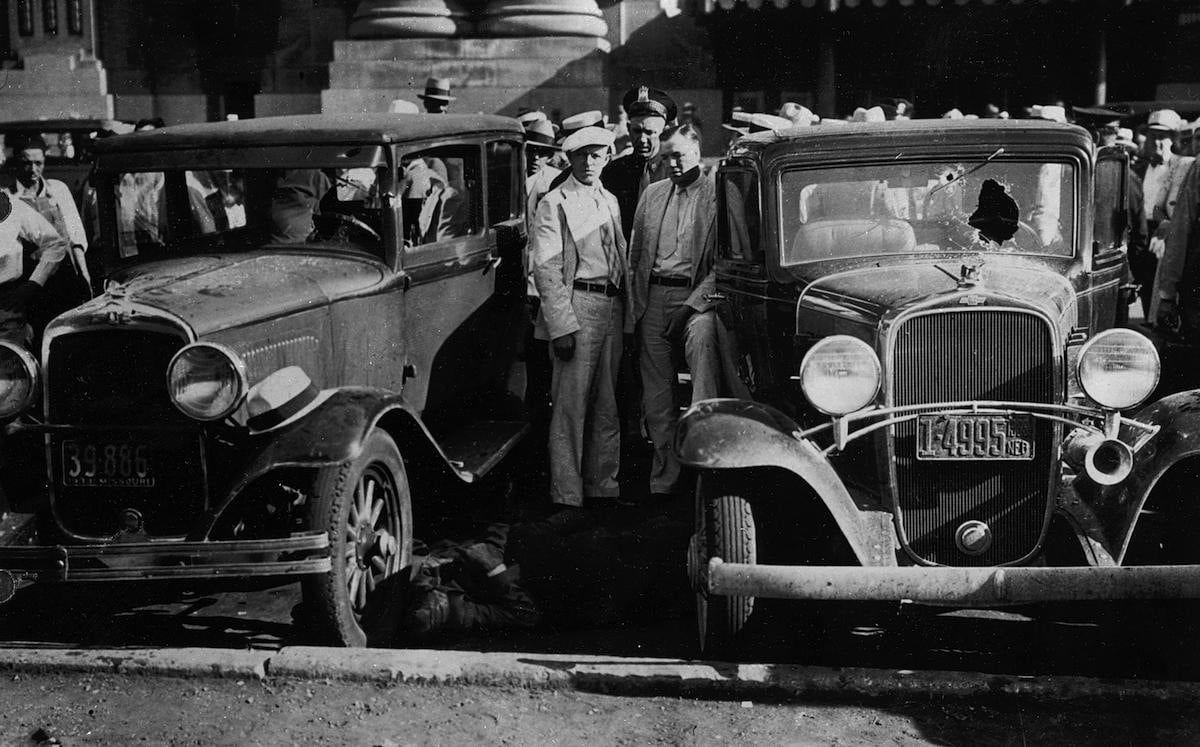
"Let 'em have it!" The command rang out across the parking lot of Kansas City's Union Station at 7:15 on the morning of June 17, 1933. Within thirty seconds, four law enforcement officers and a handcuffed prisoner lay dead or dying beside a Chevrolet sedan. The Kansas City Massacre, as it became known, was over almost before anyone understood what was happening. But its consequences would reshape American law enforcement forever, transforming the FBI from an agency whose agents could not legally carry firearms into the armed federal force the world knows today.
The Prisoner and the Plan
Frank "Jelly" Nash was a career criminal who had been running since escaping the U.S. Penitentiary at Leavenworth, Kansas, on October 19, 1930. First convicted in 1913 for robbing a store in Sapulpa, Oklahoma, Nash had shot his own accomplice in the back to keep the money. He cycled through prison sentences, twice convincing wardens to reduce his time, before escaping Leavenworth with a 25-year sentence still hanging over him. The FBI traced him to Hot Springs, Arkansas, where two agents and McAlester, Oklahoma Police Chief Otto Reed captured him on June 16, 1933. They boarded a Missouri Pacific train for Kansas City, arriving the next morning. Word of the capture reached Nash's underworld friends. Richard Galatas, Herbert Farmer, "Doc" Louis Stacci, and Frank Mulloy engineered a rescue scheme, recruiting Vernon Miller to carry it out. According to the FBI, Charles "Pretty Boy" Floyd and Adam Richetti arrived in Kansas City to help.
Thirty Seconds at Union Station
Seven officers escorted the handcuffed Nash through Union Station's grand lobby and out the east entrance to Agent Raymond Caffrey's waiting Chevrolet. Nash was placed in the front seat. Agents Lackey, Smith, and Chief Reed climbed in the back. Caffrey walked around to the driver's side. Agent Lackey spotted two armed men running from behind a parked Plymouth. Before he could shout a warning, machine gun fire erupted from approximately fifteen feet away. Officers W. J. Grooms and Frank Hermanson of the Kansas City Police Department died instantly. Agent Caffrey fell with a fatal head wound. Inside the car, Frank Nash and Chief Reed were killed. Agent Lackey survived with three bullets in his back. Agent Smith was unscathed, having dropped forward in the back seat. The gunmen rushed to the car, one shouting, "They're all dead. Let's get out of here." They fled in a dark Chevrolet, disappearing westward.
A Mystery That Endures
The FBI named Vernon Miller, Pretty Boy Floyd, and Adam Richetti as the gunmen. Miller was found dead in a Detroit ditch on November 29, 1933, his mutilated body suggesting a falling out with criminal associates. Richetti was captured after a car accident in Wellsville, Ohio, in October 1934, convicted of the massacre murders, and executed on October 7, 1938. Floyd was killed in a shootout with FBI agents and local police on an Ohio farm on October 22, 1934. With his dying breath, Floyd denied involvement. That denial has fueled decades of controversy. Three books argue Floyd and Richetti were framed by J. Edgar Hoover's FBI. Underworld figure Blackie Audett claimed the real gunmen were Maurice Denning and William Weissman. Some historians argue the massacre was not a rescue attempt at all but a syndicate hit to silence Nash, who had extensive underworld connections. The evidence remains far from conclusive.
The FBI Reborn
Whatever the truth about the gunmen, the Kansas City Massacre transformed American law enforcement. Before June 17, 1933, FBI agents did not have statutory authority to carry firearms or make arrests. They could perform citizen's arrests and call a U.S. Marshal. Within a year, Congress gave the FBI full authority to carry guns and make arrests. The agency acquired its first Thompson submachine guns and Winchester Model 1907 self-loading rifles, later adopting specially modified Remington Model 81 semi-automatic rifles. The four conspirators who engineered the scheme were convicted in January 1935 and sentenced to two years and $10,000 fines each, the maximum penalty allowed. Union Station itself, where the bullet holes once pocked the limestone, went on to become one of Kansas City's most beloved landmarks, restored in a $250 million renovation in the 1990s. The massacre remains the defining moment in the station's long history.
From the Air
The massacre occurred at the east entrance of Union Station, located at 39.085N, 94.585W, at 25th Street and Grand Avenue in Kansas City. The Beaux-Arts station building is a prominent landmark visible from the air, directly south of downtown and immediately north of the Liberty Memorial tower. Nearest major airport: Kansas City International (KMCI). Recommended viewing altitude: 2,000-4,000 feet AGL to see Union Station's distinctive architecture and surrounding rail yard.