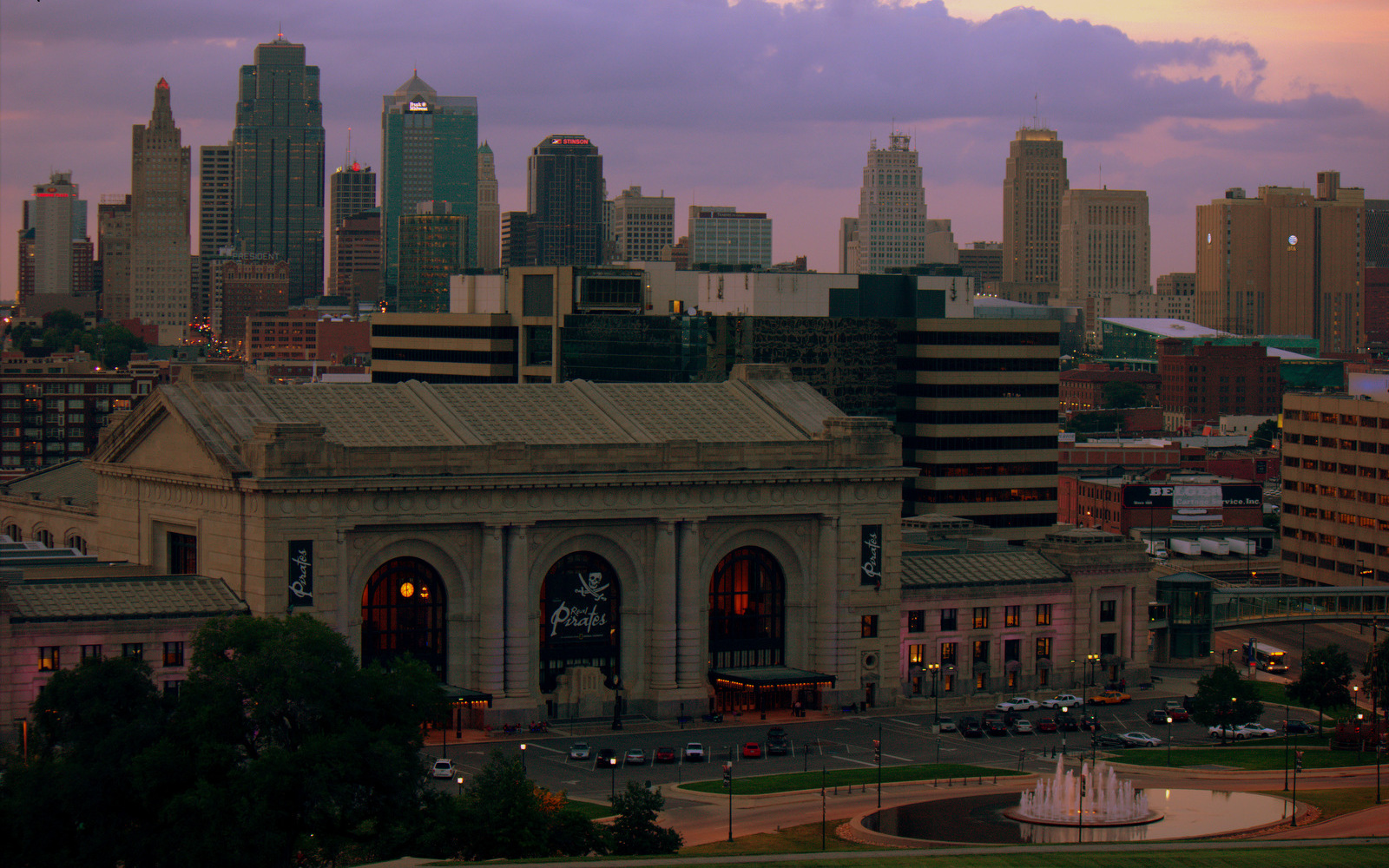
Kansas City Union Station
The chandeliers weigh 3,500 pounds each. There are three of them, hanging from a Grand Hall ceiling that soars to a height that makes even the most seasoned traveler pause. Kansas City Union Station opened in 1914 as a monument to the railroad age, built by twelve railroads working together through the Kansas City Terminal Railway. Its predecessor, the 1878 Union Depot in the flood-prone West Bottoms, had been nicknamed the "Jackson County Insane Asylum" by critics who thought it was too large. Union Station's builders made no such apology for ambition. They placed their Beaux-Arts masterpiece on high ground at 25th Street and Grand Avenue, above the floodplain, and let the scale speak for itself.
When Twelve Railroads Built One Station
The list of railroads that jointly operated Kansas City Union Station reads like a roll call of American transportation history: the Atchison, Topeka and Santa Fe; Chicago, Burlington and Quincy; Chicago, Rock Island and Pacific; Kansas City Southern; Missouri Pacific; Union Pacific; and six others. At its peak in 1945, at the close of World War II, the station handled more than 670,000 passengers annually. Soldiers shipping out and coming home passed through the Grand Hall beneath that massive clock face, their footsteps echoing across floors designed to move crowds efficiently from ticketing to the perpendicular waiting hall extending out above the tracks. The station was not merely a building; it was the physical expression of Kansas City's position as a central hub connecting the coasts.
Blood on the Pavement
On June 17, 1933, the station became the site of one of the most notorious crimes in American history. Federal agents and police officers were escorting captured fugitive Frank Nash through Union Station to a waiting car when gunmen opened fire with Thompson submachine guns. Four lawmen were killed, along with Nash himself, in an attempt by the Kansas City underworld to free the prisoner. The Kansas City Massacre, as it was immediately dubbed, exposed the lawlessness of Tom Pendergast's Kansas City and directly led Congress to grant FBI agents the authority to carry firearms and make arrests. The thirty-second gunfight outside the east entrance changed the nature of federal law enforcement permanently.
Decline and the Bubble
The same forces that killed passenger rail across America hollowed out Union Station. Traffic plummeted through the 1950s. The building deteriorated. By 1983, the station had largely closed, with Amtrak's operations confined to a small "bubble" inside the Grand Hall. Even that indignity ended in 1985, when all passenger operations were moved to a smaller facility adjacent to the old station. The city sued developer Trizec, which had built two office buildings on surrounding property but failed to redevelop the station, and settled in 1994. That settlement helped fund just under half of the ambitious plan that would save Union Station.
A Civic Resurrection
In 1996, a public-private partnership launched a $250 million restoration, funded in part by a bistate sales tax levied across Kansas and Missouri counties. By 1999, Union Station had reopened not merely as a train station but as a cultural destination. Science City brought more than 50 hands-on exhibits. The Regnier Extreme Screen, five and a half stories tall, became the region's largest movie venue. Restaurants, shops, a planetarium, and rotating museum exhibitions filled the grand spaces. Train service returned in 2002 when Amtrak resumed operations, making Kansas City Missouri's second-busiest train station. The KC Streetcar began stopping at Union Station in 2016, connecting it to the River Market and downtown. The 2023 NFL Draft was held in front of and partially inside the station, and four Amtrak trains serve it daily, including the Southwest Chief running between Chicago and Los Angeles. The Grand Hall chandeliers, all 3,500 pounds of each, still hang overhead.
From the Air
Union Station sits at 39.085N, 94.585W at 25th Street and Grand Avenue, immediately south of downtown Kansas City. The Liberty Memorial tower rises directly to its south, creating one of Kansas City's most recognizable visual pairings from the air. The rail yards extend west behind the station. Crown Center and the Hallmark headquarters complex are to the east. Nearest major airport: Kansas City International (KMCI). Charles B. Wheeler Downtown Airport (KMKC) is along the river to the north. Recommended viewing altitude: 2,000-4,000 feet AGL.