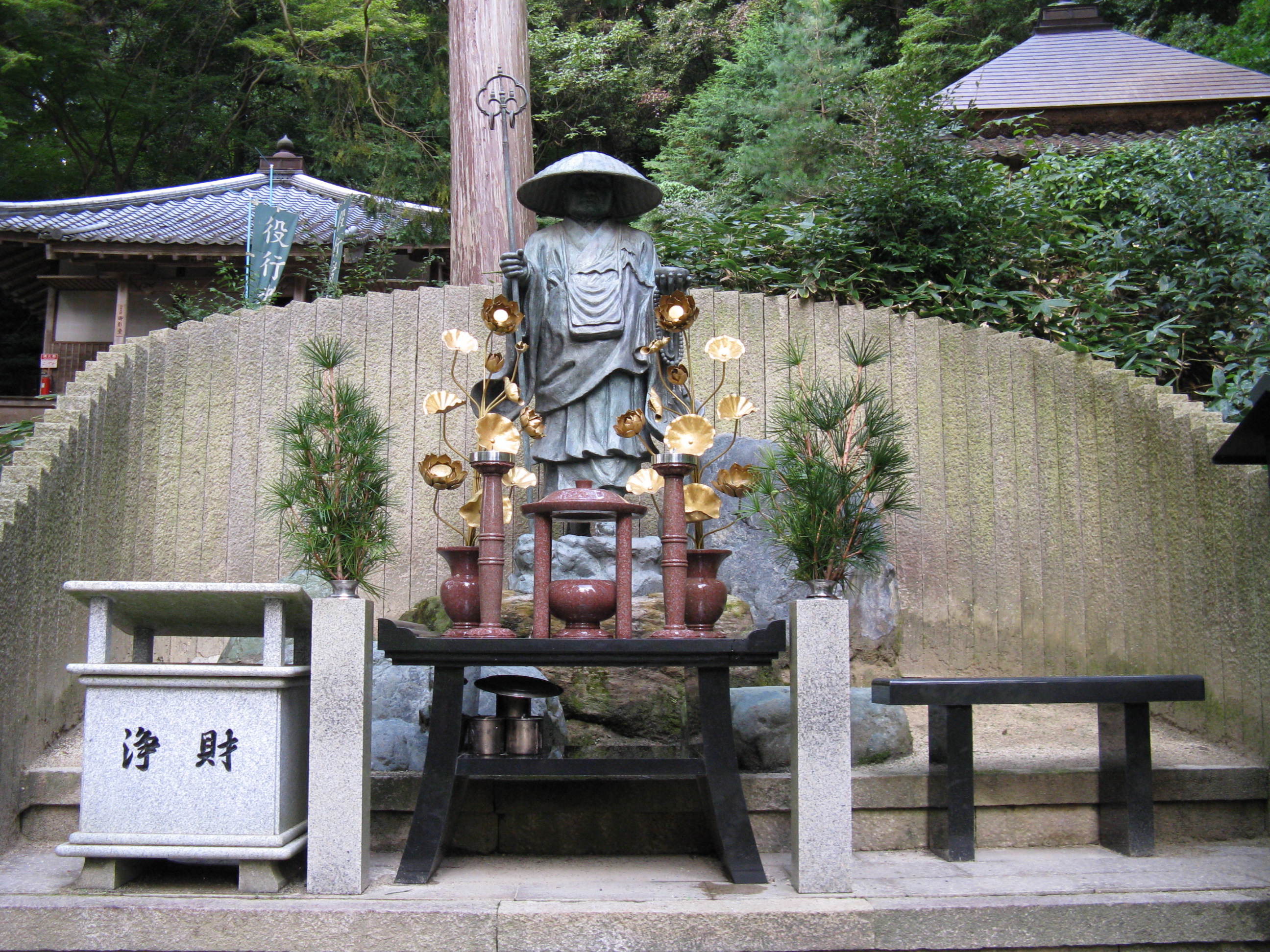
Kanshin-ji
Seven stone cairns, each representing a star of the Big Dipper, stand scattered among the cedars on a hillside in southern Osaka Prefecture. No other Buddhist temple in Japan venerates this constellation. The cairns have been here since 808, when the monk Kukai is said to have arranged them during a visit to a small mountain hermitage called Unshin-ji. That hermitage would become Kanshin-ji, a temple that over thirteen centuries has served as a center of esoteric Buddhist practice, an imperial refuge during civil war, and a repository of some of Japan's most extraordinary religious art. Tucked into the forested hills of Kawachinagano, far from the neon sprawl of central Osaka, it remains a place where the sacred and the celestial converge.
A Statue Carved from Scent
Behind the closed doors of the main hall sits Kanshin-ji's greatest treasure: a seated wooden statue of Nyoirin Kannon, 109.4 centimeters tall, carved from a single block of kyara incense wood during the Jowa era (834-848). Tradition holds that Kukai himself shaped it, and while scholars note that such attributions are common folklore, the statue's style is consistent with ninth-century craftsmanship, and four gold-and-bronze Buddha statues from the same period accompany it. The figure is classified as a hibutsu -- a hidden image -- sealed away from view except on April 17 and 18 each year. Those two days draw pilgrims and art historians alike, all hoping to stand before one of the finest examples of early Heian-period sculpture in existence. The statue is believed to have been commissioned under the patronage of Tachibana no Kachiko, empress of Emperor Saga.
When Emperors Took Shelter
Kanshin-ji's story is inseparable from the turmoil of the Nanbokucho period, when rival imperial courts tore Japan in half. The temple served as the bodaiji (memorial temple) for the Kusunoki clan, fierce loyalists of the Southern Court. In 1334, Emperor Go-Daigo built an imperial palace within the temple grounds. A quarter century later, from December 1359 to September 1360, Emperor Go-Murakami lived here, governing from what was essentially a fortified monastery. His grave remains on the temple grounds to this day. The physical mark of the Kusunoki connection is the Tatekake-to, a square single-story chapel that is actually the ground floor of a three-story pagoda that was never finished. Kusunoki Masashige ordered its construction to pray for the success of the Kenmu Restoration, but he was killed at the Battle of Minatogawa in 1336 before the upper stories could rise.
Warlords and Rebuilders
Power shifted and Kanshin-ji shifted with it. During the Kamakura period, the temple grew to encompass more than fifty subsidiary chapels. The Hatakeyama clan patronized it through the Muromachi period, but the Sengoku era brought Oda Nobunaga, who seized most of the temple's landholdings. Rebuilding came under Toyotomi Hideyoshi, and his son Toyotomi Hideyori restored the main hall and several other structures. By the An'ei era of the late eighteenth century, the hatamoto Kainosho clan had helped the temple recover to over thirty subsidiary chapels. But the long decline of the feudal order whittled that number down to just twelve by the final years of the Edo period. What survived, though, was remarkable: multiple National Treasures and Important Cultural Properties, including paintings, sculptures in gold and bronze, iron lanterns, a set of red breastplate armor attributed to Kusunoki Masashige, and the Kanshinji Engi Shizaicho -- a paper document from 883 AD whose survival in good condition is considered extraordinary.
Thirteen Centuries in the Hills
The temple's precincts were designated a National Historic Site in 1972 and later recognized as a Japan Heritage site. Yet Kanshin-ji has never become a mass-tourism destination. It sits in Kawachinagano's Teramoto neighborhood, reached by winding roads through dense forest. The compound unfolds gradually: stone steps climbing through moss-covered walls, halls darkened by overhanging branches, the faint sweetness of incense drifting from open doorways. The collection of Buddhist art spans virtually every major period of Japanese history, from Nara-period bronzes to Kamakura-period wooden guardian figures. Among the written treasures are 216 volumes of the Chusonji Sutra, rendered in gold and silver, and 688 temple documents bound into volumes that chronicle the institution's long, eventful life. For a temple founded over thirteen hundred years ago on a hillside where a wandering monk saw something worth venerating in the stars above, that continuity feels quietly astonishing.
From the Air
Located at 34.437N, 135.599E in the forested hills south of Osaka's urban core in the city of Kawachinagano. The temple compound is nestled in dense tree cover on the northern slopes of the Kongo mountain range and is difficult to spot from altitude, but the surrounding mountains and valleys are distinctive. Nearest major airport: Kansai International Airport (RJBB) approximately 25nm to the southwest. Osaka Itami Airport (RJOO) lies roughly 20nm to the north-northeast. Expect clear visibility in autumn and spring; summer months bring humidity and haze over the Osaka plain.