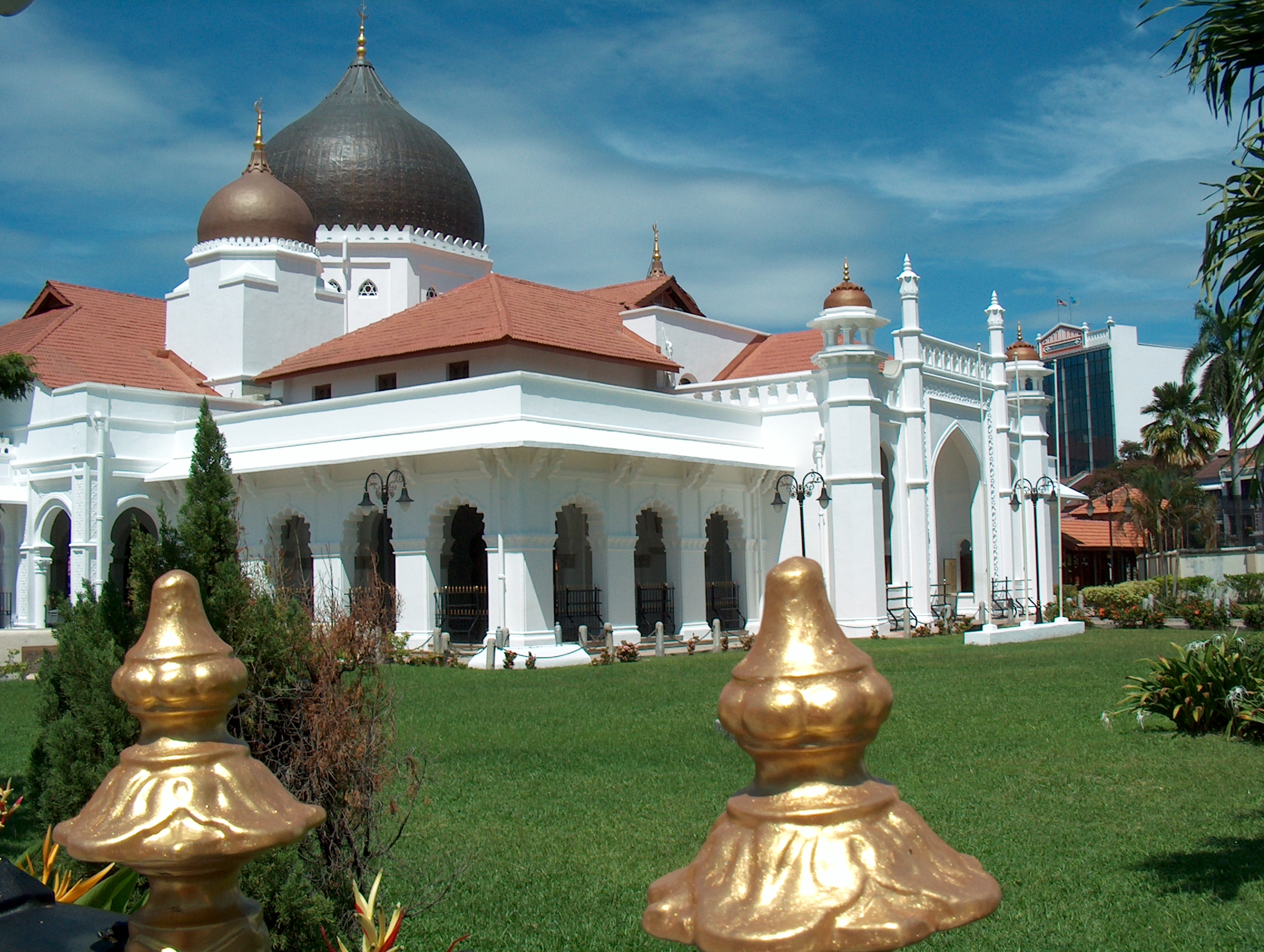
Kapitan Keling Mosque
Cauder Mohudeen was a ship foreman from Porto Novo, a coastal town the Tamils called Parangipettai, about 50 kilometers south of Pondicherry in India. Born around 1759, he arrived in Penang during the early years of the British settlement and rose to become the recognized leader of the South Indian Muslim community. In 1801, Lieutenant Governor Sir George Leith made it official, appointing Mohudeen as the Kapitan of the "Keling" community and granting him a plot of land on the south side of Chulia Street. On that plot, Mohudeen built a mosque. It still stands, more than two centuries later, at the corner of Buckingham Street and what is now called Jalan Masjid Kapitan Keling, the street renamed in its honor.
A Captain for the Community
The title "Kapitan" was a colonial institution borrowed from the Portuguese and Dutch, a system in which the colonial government appointed leaders from within each ethnic community to serve as intermediaries. The Chinese community had its Kapitan Cina; the South Indian Muslims had their Kapitan Keling. The term "Keling" itself is a Malay word for people of Indian origin, one that carries offensive connotations today but did not at the time of the mosque's founding. Cauder Mohudeen's appointment reflected the practical reality of governing a polyglot port city. Penang under Francis Light's open immigration policy had attracted Malays, Chinese, Indians, Arabs, and Europeans, and the colonial administration needed trusted figures who could manage disputes, collect information, and maintain order within each community. The mosque Mohudeen built became more than a place of worship. It was the institutional anchor of the Tamil Muslim quarter known as the Chulias.
Horseshoe Arches and King Edward's Plaques
The mosque visitors see today is largely the product of a 1930 renovation that gave the building its present form. The earlier structure had been deemed impractical, but in keeping with Islamic tradition, the mosque was not demolished and rebuilt. Instead, it was enlarged. The central prayer hall was doubled in height, ventilation was improved, and the design allowed more natural light to flood the interior. Step inside and the effect is immediate: white marble floors stretch beneath a high ceiling, and the interior aisles are defined by a series of horseshoe arches, an architectural form that traces its lineage through Moorish and Indian Islamic building traditions. Above the arches sit King Edward's plaques, a detail that anchors the renovation firmly in its colonial moment. The exterior is painted in warm ochre, while geometric patterns cover the facade and interior walls. No human or animal forms appear in the decoration, following Islamic artistic conventions.
At the Crossroads of Four Faiths
The Kapitan Keling Mosque occupies one of the most remarkable religious intersections in Southeast Asia. Within a few blocks of the mosque stand the Sri Mahamariamman Temple, the Goddess of Mercy Temple (Kuan Yin Teng), and St. George's Church, representing Hinduism, Chinese Buddhism, and Christianity alongside Islam. This cluster earned the area the informal name "Street of Harmony," and it is not an accident of urban planning. George Town's founding as a free port attracted diverse communities who built their institutions close to the commercial center. The mosque sits at the heart of the Tamil Muslim neighborhood, but its neighbors tell the broader story of Penang's multicultural character. UNESCO recognized this layered heritage when it inscribed George Town as a World Heritage Site in 2008, and the Kapitan Keling Mosque is one of the listed properties within the core zone.
From Chulia Street to World Heritage
The mosque's survival through more than two centuries of colonial transitions, Japanese occupation, independence, and rapid modernization is itself a kind of testimony. Penang's Indian Muslim community, the Chulias, maintained the mosque through periods when other historic buildings were being demolished for development. The 1930 renovation was ambitious but respectful, preserving the original footprint while adapting the structure to modern needs. Today the mosque remains an active house of worship, its daily call to prayer echoing through streets where the descendants of the community Cauder Mohudeen once led still live and work. It is the first permanent Muslim institution established in the Penang area, a distinction that gives it a historical weight beyond its architectural beauty. The building stands as evidence that communities, not just colonial governments, shaped the cities of the Strait of Malacca.
From the Air
Located at 5.42N, 100.34E in the heart of George Town's UNESCO core zone on Penang Island. Penang International Airport (WMKP) is approximately 11 km to the south. The mosque's ochre exterior and dome are visible from low altitude within the dense urban grid of historic George Town. Best viewed at 1,500-2,500 ft where the Street of Harmony cluster of religious buildings becomes apparent. Butterworth Air Base (WMKB) lies across the channel on the mainland.