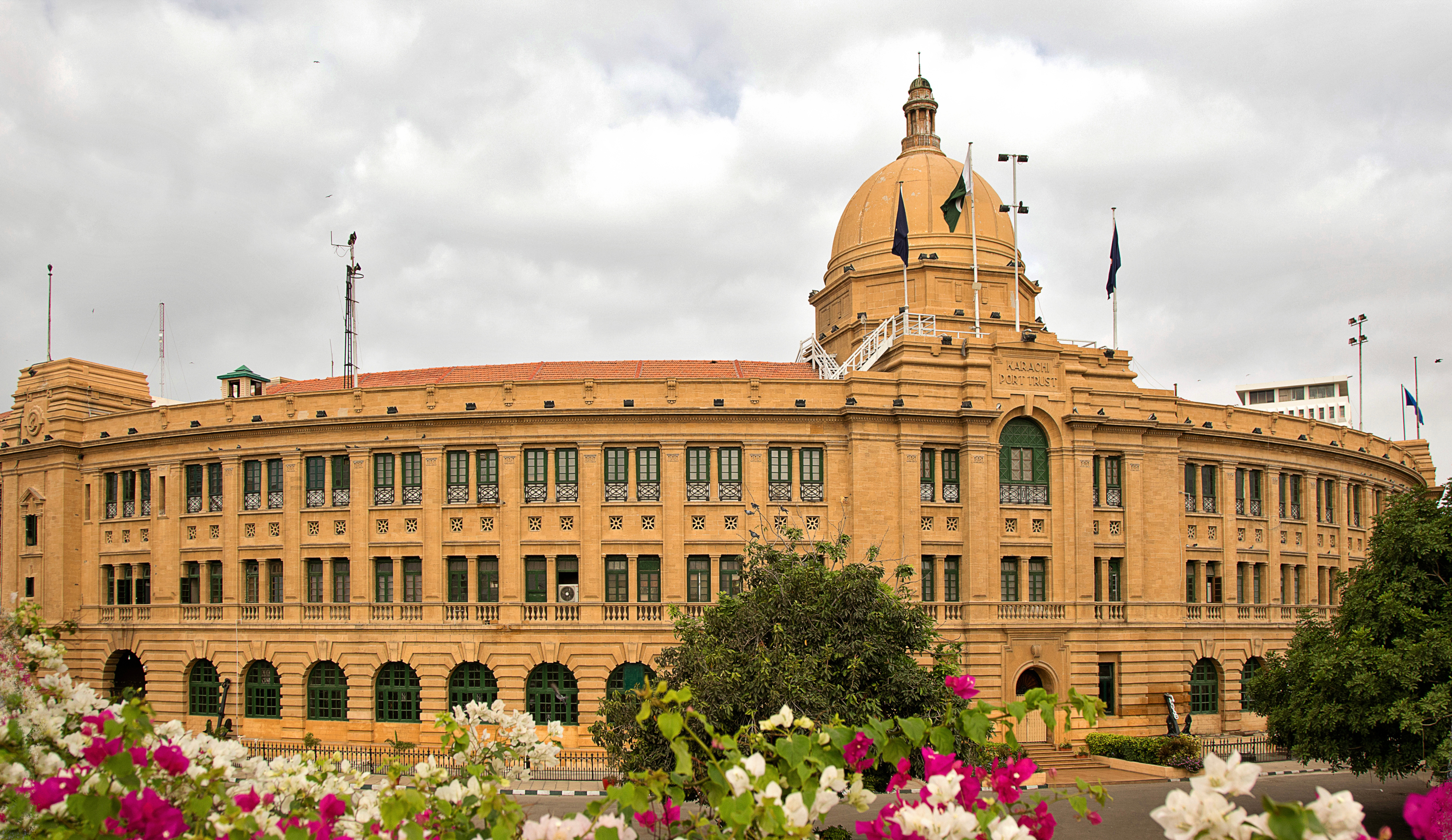
Karachi Port Trust Building
The Karachi Port Trust Building was designed to be the first thing visitors saw when they arrived by sea, a showpiece that would announce the city's importance. Instead, within months of its January 1916 inauguration, it became a 500-bed military hospital. World War I had different plans for George Wittet's grand creation, and the building spent its first three years treating wounded soldiers rather than administering port affairs.
Wittet's Curved Masterpiece
George Wittet, the consulting architect to the Government of Bombay, designed the building in a style that fused British, Hindu, and Gothic elements. Wittet was already known for designing the Gateway of India in Bombay and the Chhatrapati Shivaji Maharaj Vastu Sangrahalaya museum. For the KPT Building, he chose yellow-toned stone imported from Jaipur for the facade, giving it a warm glow that distinguished it from the grey and buff buildings around the port. The most notable exterior feature is the curved facade, unusual for administrative buildings of the era. At its center rises a large dome designed in a Roman rather than Islamic style, a deliberate architectural choice in a city where most domed structures followed Mughal conventions.
Teak, Anchors, and an Open-Cage Elevator
Inside, the building reveals a love of materials that has aged remarkably well. Costly teak wood appears everywhere, from window frames painted dark green to a polished staircase that connects the floors. The elevator itself is wooden, featuring an open-cage design through which passengers can watch each floor pass by, the mechanism fully visible behind a single railing. Two large anchors flank the only entrance, a fitting emblem for a building that administers one of Asia's major ports. The floors are tiled in black and white cemented tiles, purpose-made by mixing different colors into the cement. On the second floor, beneath the dome, sits the Board Room, where painted arch-shaped windows filter light and old clocks bearing the name Elliot Brother Company, London, still mark the hours.
From Hospital to Headquarters
Construction began in 1912, with the Napier Mole Road extended to the site by 1914, terminating at a spot called Willingdon Place. The Marquess of Willingdon, Governor of Bombay, inaugurated the building on January 5, 1916. But the ongoing First World War immediately diverted it from its intended purpose. The spacious rooms and high ceilings that Wittet had designed for port administrators instead housed 500 hospital beds for the Indian General Hospital. The building functioned as a military hospital until May 1919, when it finally assumed its original role as the headquarters of the Karachi Port Trust. The Record Room on the second floor holds original proceedings and files dating back to 1893, an unbroken paper archive stretching over 130 years.
Standing Watch on Muhammad Ali Jinnah Road
The KPT Building occupies approximately 1,400 square meters in central Karachi's Kharadar neighborhood, near the Native Jetty Bridge and Merewether Clock Tower. It is adjacent to the Imperial Customs House and sits opposite Qamar House on Eduljee Dinshaw Road. The Pakistan Navy has looked after the building on many occasions, a reminder that maritime authority has always been the building's reason for existence. More than a century after Wittet drew his plans, the curved facade of Jaipur stone still catches the eye of anyone approaching from the port, fulfilling at least part of its original ambition to be the first impression of Karachi.
From the Air
Located at 24.847N, 66.993E on Muhammad Ali Jinnah Road in Karachi's Kharadar neighborhood, near the port facilities. The building's distinctive curved facade and Roman-style dome may be visible at lower altitudes. The Port of Karachi's wharves and cranes are immediately adjacent. Jinnah International Airport (OPKC) lies approximately 16 km to the east.