Karako-Kagi Site
In 1992, during the 47th excavation campaign at the Karako-Kagi site in Tawaramoto, Nara Prefecture, archaeologists pulled a shard of earthenware from the soil and found themselves staring at an image that changed everything: a drawing of a multi-story tower, sketched by someone who had actually seen it standing, roughly 2,000 years ago. The Yayoi people who lived at Karako-Kagi were not supposed to have built structures like that. They were rice farmers, metalworkers, potters -- important, but assumed to live in modest pit dwellings and raised-floor granaries. That single drawing on a piece of broken pottery forced historians to reimagine an entire era. A full-scale reconstruction of the tower now stands at the site, rising above the flat Nara basin like a beacon from a world most people never knew existed.
The Nara Basin's First City
Karako-Kagi sprawls across approximately 420,000 square meters of the Nara basin's low, river-laced floodplain, making it the largest Yayoi-period archaeological site in the entire Kinki region. The settlement thrived from roughly the second century BCE to the second century CE, a span of about 400 years during which Japan was transforming from a hunter-gatherer society into an agricultural one. The village encompassed housing, farming plots, fortifications, and specialized workshops -- a complex community with clear evidence of social organization. Over a century of excavations, beginning in the early 1900s, have yielded an extraordinary volume of artifacts: farming implements, ritual objects, and approximately 100 shards of earthenware bearing painted images, representing roughly one-third of all such decorated Yayoi pottery ever found in Japan. The site sits near the Makimuku ruins, which would later become associated with the emergence of the Yamato state, suggesting that this stretch of the Nara basin was a center of power long before recorded history.
Fire, Bronze, and Feathers
Karako-Kagi was not merely a farming village. Excavations revealed tools and facilities dedicated to metalworking, evidence that bronze and possibly iron were being worked here during the Yayoi period. This kind of metallurgical activity marks Karako-Kagi as a site of regional significance, a place with the technical knowledge and trade connections needed to process metal. But the surprise came in 2023, when researchers published findings about chicken bones excavated from the site. Collagen from one bone was carbon-dated to 381-204 BCE, corresponding to the middle Yayoi period and representing the earliest conclusive evidence of domestic chicken breeding in the Japanese archipelago. Four of the ten bird bones found belonged to juveniles, strongly suggesting intentional breeding rather than wild capture. This discovery rewrote the timeline of animal domestication in Japan, placing the practice centuries earlier than previously believed.
A Tower That Rewrote History
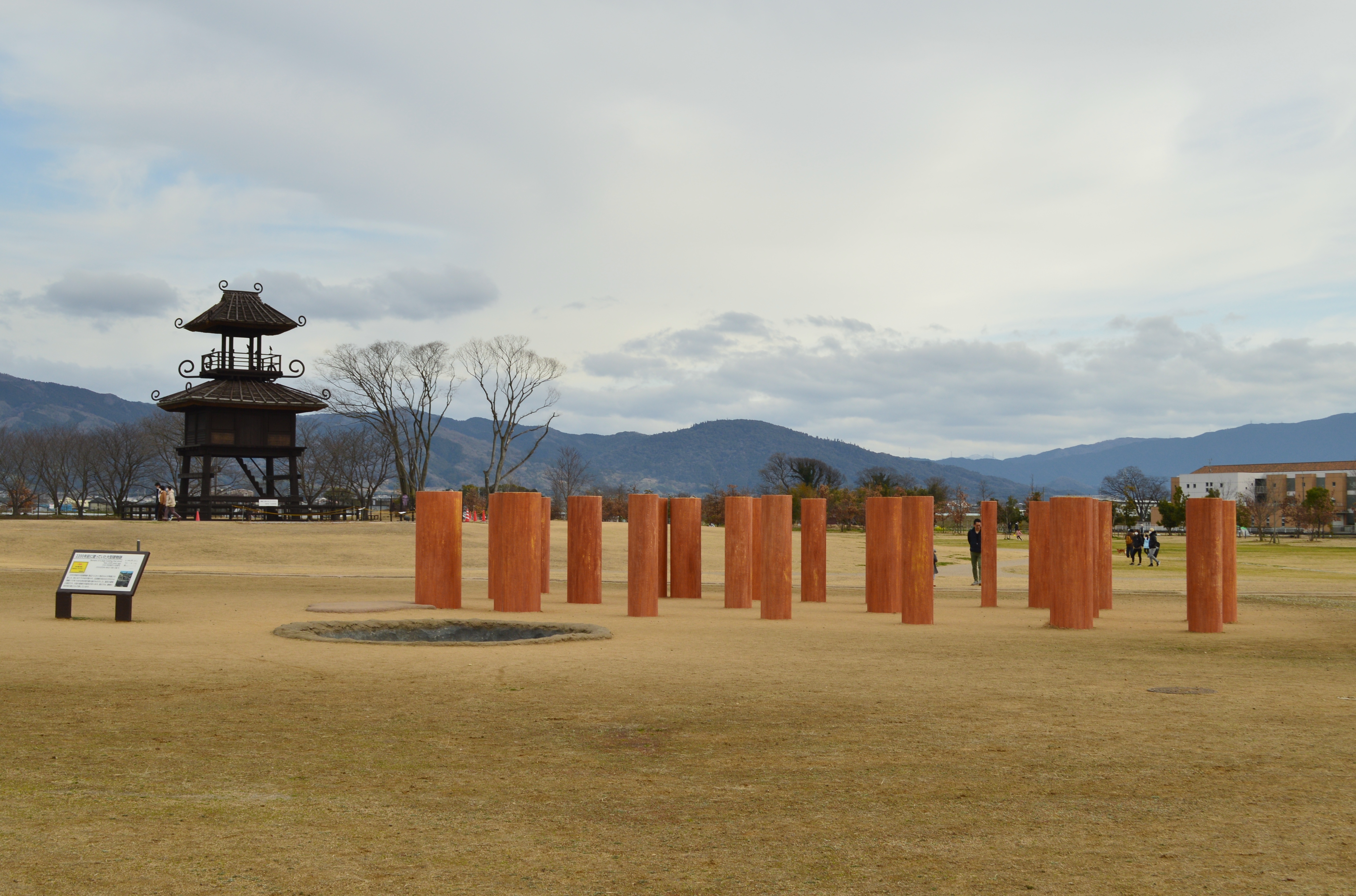
The painted earthenware found during the 1992 dig depicted something unprecedented: a building of more than two stories, rendered with enough detail to suggest the artist was recording something real. Scholars of the Yayoi period had long assumed that architectural ambition during this era was limited to single-story structures -- raised granaries for rice storage, pit houses for dwelling. The tower drawing shattered that assumption. Since Yayoi pictorial pottery generally depicted things from daily life -- boats, animals, farming scenes, people -- the consensus among archaeologists is that this multi-story structure actually existed at Karako-Kagi. The tower may have served as a watchtower, a ritual platform, or a symbol of the community's status. A modern reconstruction based on the pottery image now stands at the park, its wooden frame and elevated platform offering visitors a tangible connection to the ingenuity of Yayoi builders who lived two millennia ago.
Where Children Play on Ancient Ground
Today Karako-Kagi is a public park where joggers circle a pond and children scramble over paths that trace the outlines of excavated buildings. The Karako-Kagi Archaeological Museum, opened in 2004 on the second floor of a local civic building, displays artifacts across three rooms organized by category: pottery, food-preparation tools, and ritual objects. A highlight is a haniwa clay figure in the form of a cow, designated an Important Cultural Property, though this piece dates from the later Kofun period and was found in nearby burial mounds rather than the Yayoi village itself. The site was designated a National Historic Site, and marked excavation zones with interpretive signage allow visitors to stand exactly where archaeologists uncovered the evidence of Japan's agricultural revolution. The nearest train stations are a 15-to-20-minute walk away, and the flat terrain of the surrounding Nara basin makes the reconstructed tower visible from a distance -- much as the original must have been when it served as a landmark for a thriving Yayoi community.
From the Air
Located at 34.557N, 135.802E in the flat Nara basin of central Japan. The site is a public park with a distinctive reconstructed Yayoi tower that may be visible from low altitude. The terrain is flat agricultural land threaded by rivers. Major airports: Kansai International (RJBB) approximately 55 km southwest, and Osaka Itami (RJOO) approximately 35 km northwest. From 3,000-5,000 feet, the Nara basin reads as a broad, flat patchwork of rice paddies and small towns bordered by forested hills to the east and south. The reconstructed tower at the park is the most identifiable ground feature.