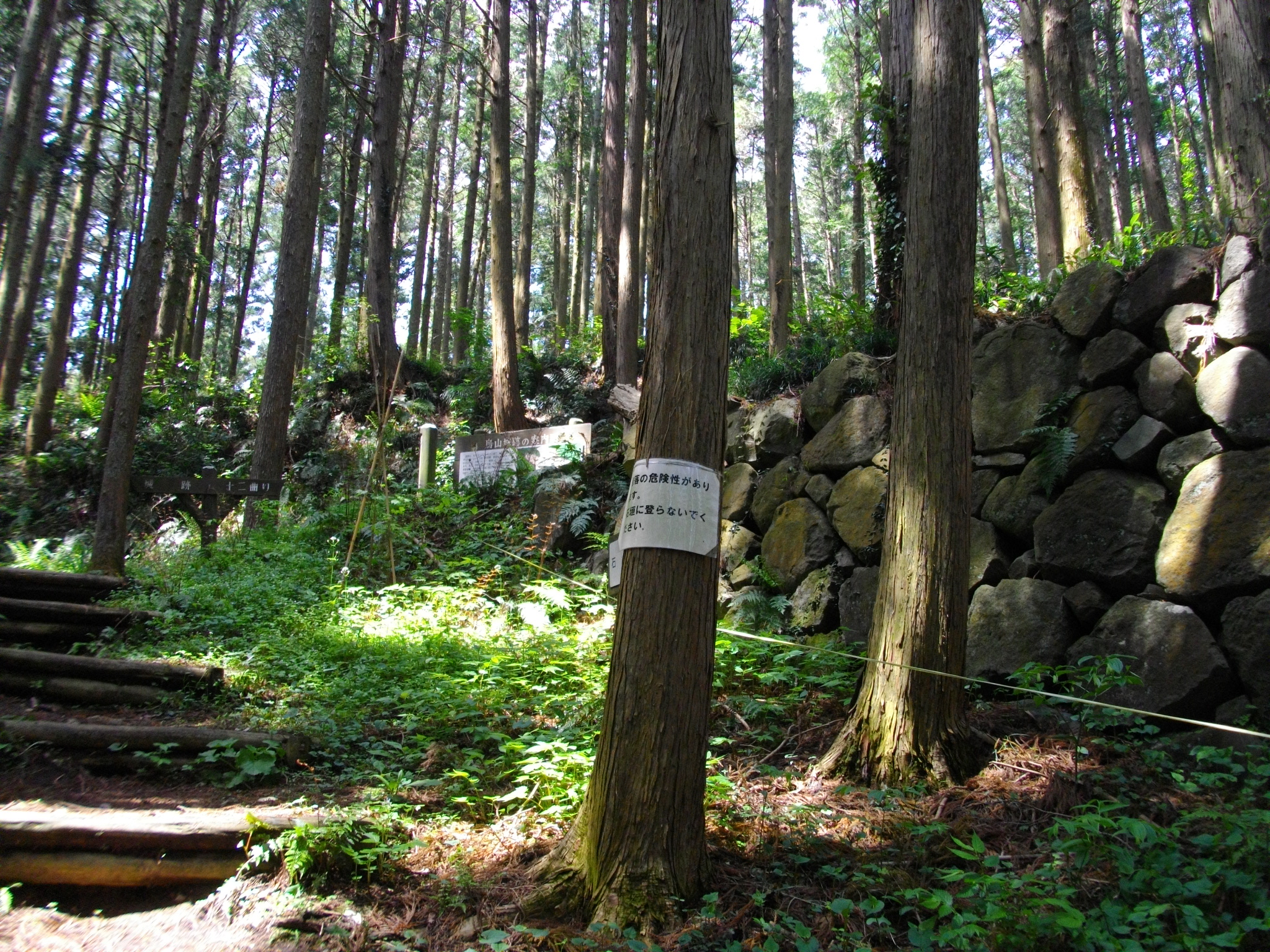
Karasuyama Castle
They called it Wagyu Castle -- the Sleeping Cow -- because from the valley floor, Mount Hachiko's silhouette looked like a reclining bovine. But there was nothing sleepy about the fortress built on its 206-meter summit. For over 170 years, Karasuyama Castle was the stronghold of the Nasu clan, a warrior family that held northern Tochigi through sheer stubbornness, repelling attacks from stronger neighbors and never once surrendering their walls. It took one of the most powerful men in Japanese history to finally pry it from their hands, and even then, the offense was political, not military. The Nasu didn't lose the castle in battle. They lost it because they failed to show up for one.
The Nasu Clan's Unbroken Walls
Nasu Sukeshige built the original castle in 1418, positioning it on Mount Hachiko where the terrain itself served as a defensive weapon. The castle area stretched roughly 370 meters east to west and 510 meters north to south, with five concentric enclosures reinforced by dry moats, vertical moats, horikiri (ridge-cutting trenches), and earthworks. Stone walls surrounded the main enclosure -- an unusual feature for mountaintop castles in the Kanto region, where most fortifications relied on earth and timber alone. The Nasu clan made it their primary residence from 1514, and for the next 76 years the castle absorbed every assault thrown at it. The Satake clan, one of the most powerful warrior families in the Kanto, repeatedly tried to take it by force. They never succeeded. The Nasu fought against stronger powers for over 50 years and did not yield an inch.
The Battle They Didn't Attend
In 1590, Toyotomi Hideyoshi -- the warlord who was in the process of unifying all of Japan -- summoned the nation's lords to join his siege of Odawara Castle, the stronghold of the Hojo clan. Attendance was not optional; it was a declaration of loyalty to the new order. The Nasu, whether through defiance, miscalculation, or the isolation of their mountain domain, failed to appear. Hideyoshi's punishment was swift and permanent. He divided the Nasu holdings and awarded their ancestral fortress to Oda Nobukatsu, a son of Oda Nobunaga. The castle that had withstood decades of military assault changed hands through a political failure that took no more than a stroke of a brush on a document.
Five Clans and a Reconstruction
Under the Tokugawa shogunate, Karasuyama Castle became the seat of the 20,000-koku Karasuyama Domain, but its occupants changed with remarkable frequency. The Narita clan governed first, followed by the Matsushita, then the Hori, then the Itakura. In 1659, Hori Chikayoshi undertook a major reconstruction of the castle complex, rebuilding most of the gates and constructing the San-no-Maru Goten, the primary daimyo residence within the third enclosure. Finally, in 1725, a junior branch of the Okubo clan received the domain and held it through the end of the Edo period. Five ruling families in just over a century -- each inheriting the Sleeping Cow, each leaving their mark on its walls and gates.
Snow, Fire, and Silence
When the Boshin War swept through Japan in 1868 and 1869, the conflict that ended the shogunate and restored imperial rule, Karasuyama Castle chose the winning side. It declared for the Emperor and was bypassed by the fighting. The irony is that survival in war led to abandonment in peace. The castle was formally decommissioned in 1869. Three years later, the San-no-Maru palace -- Hori Chikayoshi's grand daimyo residence from 1659 -- collapsed under the weight of heavy snow. In 1873, fire consumed what remained. The Meiji government completed the erasure in 1871, ordering the destruction of surviving castle structures across the country. What stands today on Mount Hachiko is a public park draped in cedar forest, where stone walls, earthen ramparts, and the carved-out shapes of dry moats are the only testimony to a fortress that never fell to an enemy but could not survive its own country's transformation.
From the Air
Located at 36.66N, 140.15E on Mount Hachiko (206m) in Nasukarasuyama, northern Tochigi Prefecture, Japan. The castle ruins sit on a wooded hilltop that is difficult to distinguish from surrounding forested terrain at altitude; look for the Nasukarasuyama town center along the Naka River as a reference. Nearest airports: Fukushima Airport (RJSF) approximately 90km north, Ibaraki Airport (RJAH) approximately 60km south. The surrounding terrain is hilly with elevations generally below 500m. Weather is typical of interior Kanto -- clear mornings with afternoon cloud development in summer, excellent visibility in autumn and winter.