Kargil War Memorial
Dras holds a distinction that few towns would envy: it is the second-coldest inhabited place on Earth, a settlement where winter temperatures plunge past minus forty degrees. In this unforgiving landscape, on the Srinagar-Leh Highway about five kilometers from the town center, stands the Kargil War Memorial. It faces Tiger Hill, the very peak where some of the fiercest fighting of the 1999 conflict took place. The memorial does not let you forget the cold. The altitude, the wind, the barren mountains pressing in from every direction all reinforce the same message: the soldiers who fought here did so in conditions that would test anyone's will to simply survive, let alone wage war.
A Winter Invasion
In the winter of 1998-99, Pakistani forces crossed the Line of Control and occupied numerous strategic heights overlooking the National Highway connecting Srinagar to Leh. The positions they took gave them domination over the only road linking Ladakh to the rest of India, a lifeline for both military resupply and civilian commerce. When the intrusions were discovered in May 1999, the Indian Army launched Operation Vijay to retake the lost ground. What followed was more than two months of combat at altitudes exceeding 16,000 feet, in terrain where artillery had to be hauled up near-vertical slopes and infantry fought through waist-deep snow. The conflict ended with Pakistani withdrawal, but not before hundreds of soldiers on both sides had been killed in some of the highest-altitude warfare in modern history.
Names on the Wall
The memorial's central feature is a wall inscribed with the names of Indian soldiers who fell during the war. Walking along it, the scale of sacrifice becomes tangible in a way that aggregate casualty figures never quite manage. The Captain Manoj Kumar Pandey Gallery commemorates a 24-year-old officer who was posthumously awarded the Param Vir Chakra, India's highest military decoration, for leading his men in the capture of strategic positions despite being gravely wounded. His citation describes him continuing to fight and encourage his troops even after being hit multiple times, until a final bullet took his life. The gallery preserves his story alongside those of other decorated soldiers, turning individual acts of courage into something visitors can stand before and try to comprehend.
Standing Before Tiger Hill
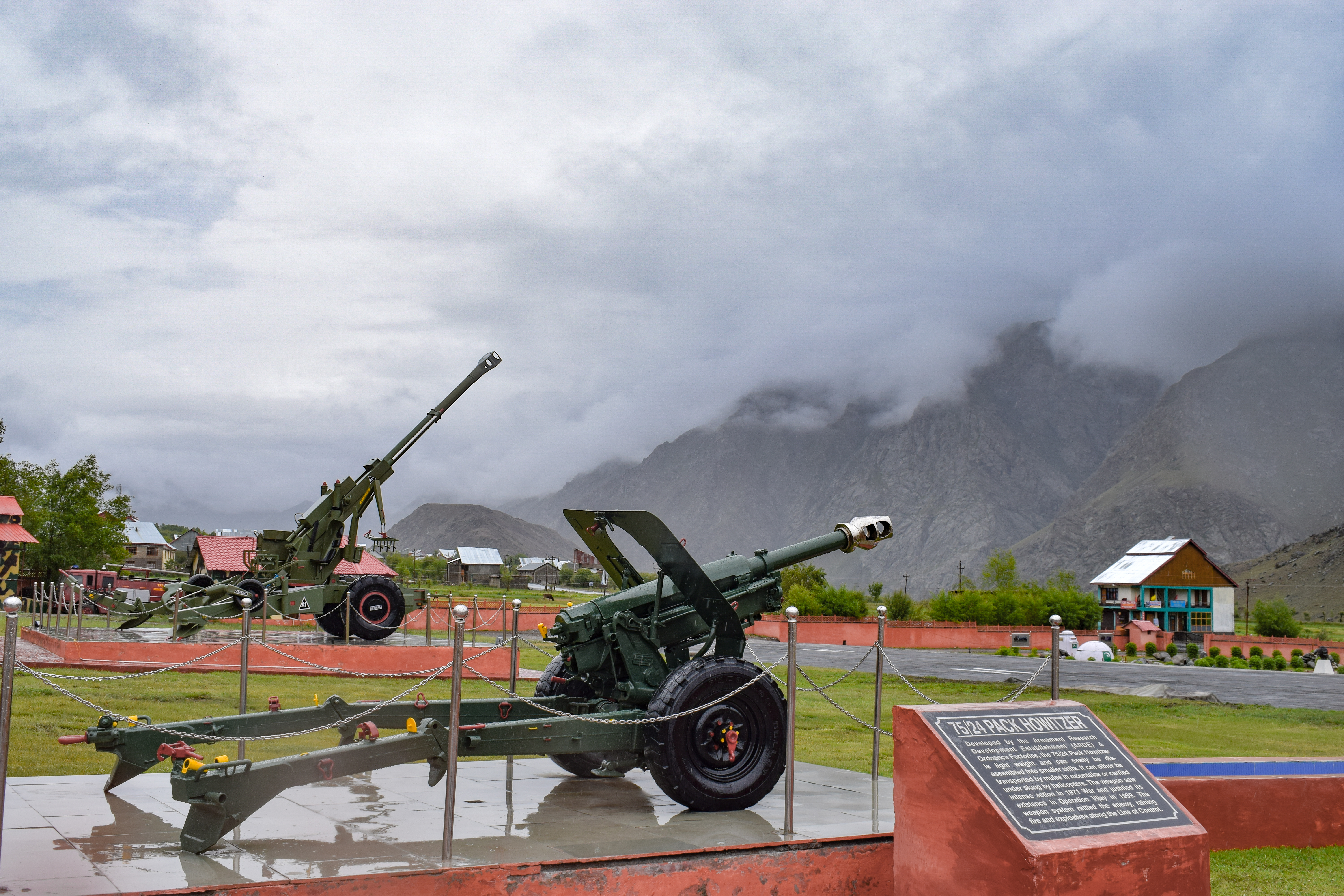
The memorial's placement is deliberate. From the site, visitors look directly at Tiger Hill, the 16,700-foot peak whose capture became the symbolic turning point of the war. What the eye sees is a wall of rock and ice so steep that it seems implausible anyone could fight their way up it, which is precisely why the Pakistani forces who occupied it believed they were unassailable. The Indian soldiers who proved them wrong climbed a 1,000-foot vertical cliff face in freezing rain. Artillery pieces displayed at the memorial are relics of the bombardment that supported the final assault, a barrage from 22 batteries that pounded the peak for 13 continuous hours. The landscape itself serves as the memorial's most powerful exhibit: no monument could communicate the extremity of the fighting as effectively as the mountains do.
A Place of Pilgrimage
Every year on 26 July, India observes Kargil Vijay Diwas, and the memorial becomes the focus of national remembrance. In 2012, the Flag Foundation of India installed a giant national flag weighing 15 kilograms on a 100-foot flagpole at the site, a splash of saffron, white, and green against the monochrome brown and gray of the Ladakhi mountains. By 2016, the memorial was drawing roughly 125,000 visitors annually, a number that has continued to grow as improved roads have made the journey from Srinagar more accessible. For many Indians, the visit is an act of patriotic duty. For others, it is personal: families come to find a father's or brother's or son's name on the wall, to touch the letters and stand in the place where they fought. The cold that greets every visitor is the same cold those soldiers endured, and in Dras, that is no small thing.
From the Air
Located at 34.43°N, 75.81°E on the Srinagar-Leh National Highway (NH 1D) in the town of Dras, Ladakh. Tiger Hill (Point 5060, elevation 5,062 m) is visible directly to the south. The terrain is extremely mountainous and barren, with the Zoji La pass to the west. Nearest airports are Kargil Airport (limited operations) and Kushok Bakula Rimpochee Airport in Leh (VILH), approximately 230 km east along NH 1D. Srinagar's Sheikh ul-Alam International Airport (VISR) is about 160 km to the west. The region is heavily militarized. Best visibility in summer months; winter conditions can be extreme with temperatures below -40°C.