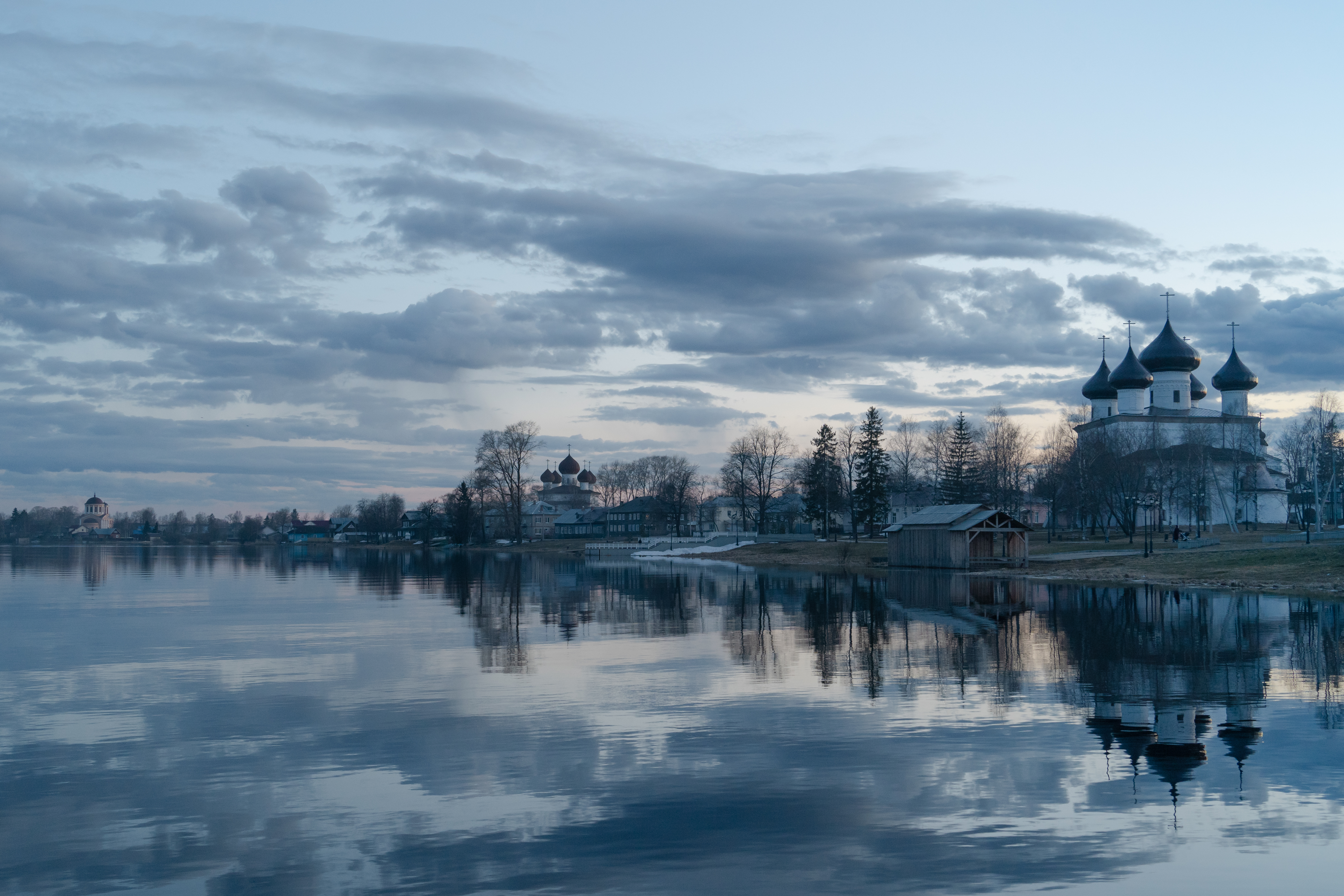
Kargopol
The railroad never came to Kargopol. In September 1894, the town's Duma debated twice whether tracks connecting Vologda to Arkhangelsk should pass through their streets, concluded that the railway would hurt local trade, but petitioned for it anyway -- reasoning that being bypassed would hurt even more. By then construction had already started on a route that ran straight through unpopulated land to the east, and the detour was too great. That decision, or rather that accident of geometry, sealed Kargopol's fate: a slow slide from one of Russia's richest medieval cities into a quiet backwater where seventeenth-century churches still outnumber gas stations.
Traders at the Edge of the Known World
When Kargopol first appeared in chronicles in 1146, it was a trade station of the Novgorod Republic and one of the most northerly permanent Russian settlements. Sitting on the Onega River just north of Lake Lacha, the town anchored the southwestern corner of what medieval Scandinavians called Bjarmaland, the semi-mythical fur-trading territory of the Russian North. For two centuries, Kargopol was the most significant commercial center in the region, a place where furs, wax, and walrus ivory moved south toward Novgorod and eventually Constantinople. During the reign of Ivan the Terrible, the town's position on the ancient route between Moscow and Arkhangelsk -- then Russia's only seaport -- made it one of the most prosperous cities in the country, especially after the English Muscovy Company began operating in the mid-sixteenth century.
Rebellion, Execution, and Quiet Decline
Prosperity brought conflict. During the Time of Troubles, Kargopol withstood a siege by Polish and Lithuanian brigands, holding fast while much of Russia fractured. In 1608, the peasant rebel Ivan Bolotnikov met his end here, executed after a failed uprising that had briefly threatened Moscow itself. But Kargopol's golden age was ending. When Peter the Great opened St. Petersburg as Russia's new window to the West, the old northern trade routes that had sustained the town for centuries became irrelevant overnight. Kargopol faded to obscurity -- though not before producing Alexander Baranov, born here in 1747, who would become the first governor of Russian America and manage the Russian fur trade in Alaska for nearly two decades.
White Stone and Iron Hands
What Kargopol's decline preserved is extraordinary. During its seventeenth-century golden age, the town developed a highly localized brand of medieval Russian architecture, and an unusual number of these buildings survive. The earliest is the black-domed Cathedral of the Nativity of Christ, built of dolomite by Novgorodian craftsmen and consecrated in 1562. Step inside and look up: a curious iron hand protrudes from the drum of the dome, an enigma that has never been fully explained. The hallmark of Kargopol's churches is their delicate stone carving, a tradition that spans the Resurrection Church from the late 1600s, the Church of the Nativity of Saint John the Baptist from the 1740s, and the ensemble of three churches -- the Annunciation, Saint Nicholas, and Church of the Nativity of the Theotokos -- clustered together from the 1670s through the 1740s.
Clay Figures and National Park
Beyond its churches, Kargopol is known throughout Russia for something humbler: clay toys. Kargopolskiye igrushki are small, simply shaped figures painted in traditional patterns -- bears, horses, women in folk dress -- that have been made here for generations. The craft survives as both folk art and living cultural practice, sold in workshops and the Kargopol State Museum of History, Art, and Architecture, which was founded in 1919 and now manages fifteen historic buildings across the town. The museum is a cloak organization in the Russian sense, combining ethnographic and art collections with direct stewardship of architectural monuments. Adjacent to town lies the Kenozersky National Park, one of Russia's most important protected landscapes, where traditional northern Russian villages and wooden churches persist in a setting of boreal lakes and forests.
The Town the Train Forgot
Today Kargopol remains reachable only by road, connected to the M8 highway via a paved route through Nyandoma. The Onega River is navigable only between the town and Lake Lacha; rapids block any passage downstream. An airport exists but has handled only cargo since the early 1990s. The Ministry of Culture classifies Kargopol as a historical town, restricting new construction in the center. What results is a place that feels genuinely preserved rather than curated, where the pace of life matches the pace at which these stone churches were carved. The merchants of 1894 feared the railroad would ruin their trade. They were wrong about the mechanism but right about the transformation: Kargopol's isolation is now its most valuable asset.
From the Air
Located at 61.50N, 38.93E in Arkhangelsk Oblast, Russia. The town sits along the Onega River, several miles north of Lake Lacha, which is a major visual reference from altitude. Kargopol Airport (no ICAO code in active use) exists but handles only cargo. Nearest significant airports include Plesetsk to the north and Nyandoma to the east along the M8 corridor. Best viewed at 3,000-6,000 feet; the cluster of white-stone churches along the river is visible against the surrounding boreal landscape. Lake Lacha to the south is an unmistakable landmark.