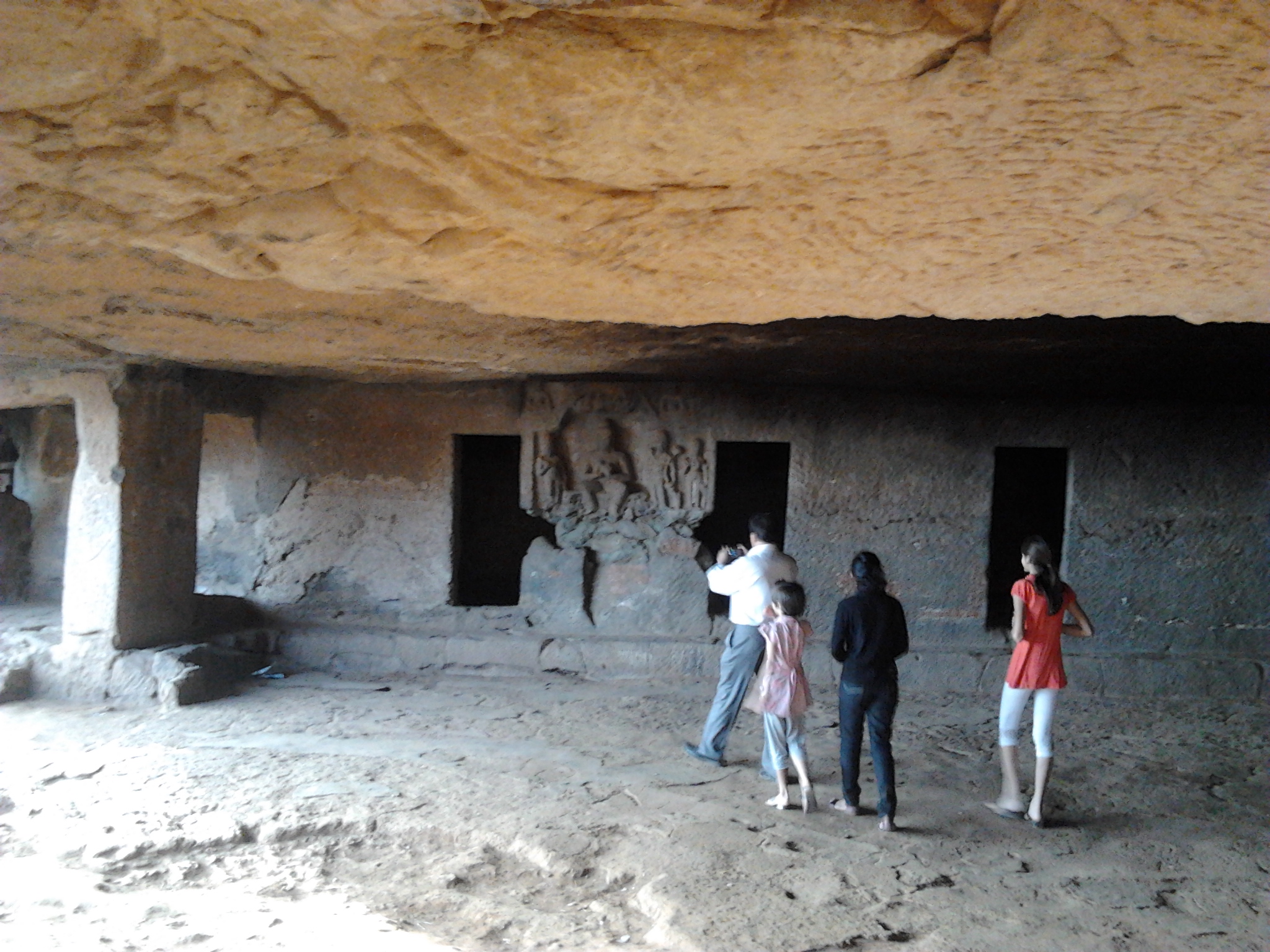
Karla Caves
Six of the pillars inside the Grand Chaitya were donated by Greeks. Their names -- Sihadhaya, Dhamma, Yasavadhana, Chulayakha -- are Buddhist, not Hellenic, but the dedicatory inscriptions identify them plainly: Yavanas from the town of Dhenukakata. That merchants of Greek descent were funding Buddhist prayer halls in a Maharashtra hillside in the 1st century CE tells you something about what the Karla Caves actually were: not an isolated monastery, but a node in a trade network that stretched from the Arabian Sea deep into the Deccan Plateau, where commerce and faith traveled the same roads.
Carved Where the Routes Converged
The caves sit in a rocky hillside about 60 kilometers from Pune, near the hill station of Lonavala. They arose along a major ancient trade route running eastward from the Arabian Sea into the Deccan interior -- and this was no coincidence. Buddhist monastic establishments deliberately positioned themselves near commercial arteries, serving as lodging houses for traveling merchants. The relationship was symbiotic: traders found safe shelter; monks found patrons. The earliest cave shrines at Karla date to roughly 160 BCE, and construction continued over seven centuries, from the 2nd century BCE to the 5th century CE. The complex holds 16 caves in total, including 3 Mahayana-era additions, and was historically associated with the Mahasanghika sect of Buddhism. Today the site is a protected monument under the Archaeological Survey of India.
The Grand Chaitya
Cave 8 is why people come to Karla. Known as the Grand Chaitya, it is the largest and most completely preserved chaitya hall -- a Buddhist prayer hall with an apsidal plan -- from its period anywhere in India. The scale is striking: large windows cut directly into the rock flood the interior with natural light, illuminating sculpture of unusual quantity and ambition. The hall was funded not by a single royal patron but by a consortium. Local merchants, Buddhist monks and nuns, and the self-described Yavana donors all contributed, each recording their gift in dedicatory inscriptions on the pillars and walls. A merchant named Bhutapala from Vaijayanti inscribed his completion of what he called "this stone mansion," though scholars believe he may have been referring specifically to the ornate veranda sculptures rather than the entire cave.
Rulers Who Left Their Names at the Gate
On the lintel to the right of the Grand Chaitya's entrance, an inscription names Nahapana, a Western Satraps ruler of Saka (Indo-Scythian) origin. His son-in-law Ushavadata dedicated an entire village to support the monks of the Karla chaitya -- though neither man is credited with constructing the hall itself. About a generation later, the Satavahana ruler Vasishthiputra Pulumavi, who reigned from approximately 130 to 159 CE, placed his own inscription on the opposite lintel. The two inscriptions face each other across the entrance, representatives of rival dynasties who nonetheless both chose to associate their names with this particular sacred space. Additional decorative panels depicting the Buddha with attendants were added to the veranda during the Mahayana period and date to the 6th century CE, evidence that the caves continued to attract devotion long after their original construction.
The Greeks of Dhenukakata
Among the most intriguing voices preserved at Karla are the Yavana donors. The term Yavana referred broadly to people of Greek or Indo-Greek descent, and six pillars of the Grand Chaitya bear their dedicatory inscriptions. All identify themselves as coming from Dhenukakata, thought to be the town of Danahu near Karli. Their names are Buddhist -- suggesting thorough cultural integration -- yet they maintained their ethnic identity in their dedications. These were not isolated gifts. The Yavanas also donated a complete cave at the Nasik Caves and left inscriptions at Junnar. Their presence at Karla speaks to a western Deccan where Greek-descended communities participated actively in Buddhist religious life, blending identities in ways that modern categories of civilization struggle to contain.
A Temple Among the Caves
The monastery once stood flanked by two grand pillars, each 15 meters tall. Only one survives. The space where its companion stood is now occupied by a temple dedicated to the goddess Ekveera, worshipped most notably by the Aagri and Koli communities of Mumbai. The coexistence is characteristic of the site's long history: Buddhist caves and Hindu devotion sharing the same hillside, layered over centuries of use. From above, the caves are part of a dense constellation of rock-cut sites scattered through the Sahyadri Hills -- Bhaja, Bedse, Patan, and Nasik are all within reach. Together, they represent one of the most remarkable concentrations of ancient rock-cut architecture in the world, carved over more than a millennium by hands that understood stone as a medium for permanence.
From the Air
Located at 18.78N, 73.47E, about 60 km from Pune near Lonavala. The caves are cut into a rocky hillside in the Sahyadri Hills and are not easily visible from high altitude, but the surrounding terrain -- steep scarps and the Lonavala plateau -- is distinctive. Recommended viewing altitude: 3,000-5,000 ft AGL. Nearest airports: Pune Airport (VAPO) to the southeast, Lohagaon Air Force Station nearby. Mumbai (VABB) is approximately 120 km northwest.