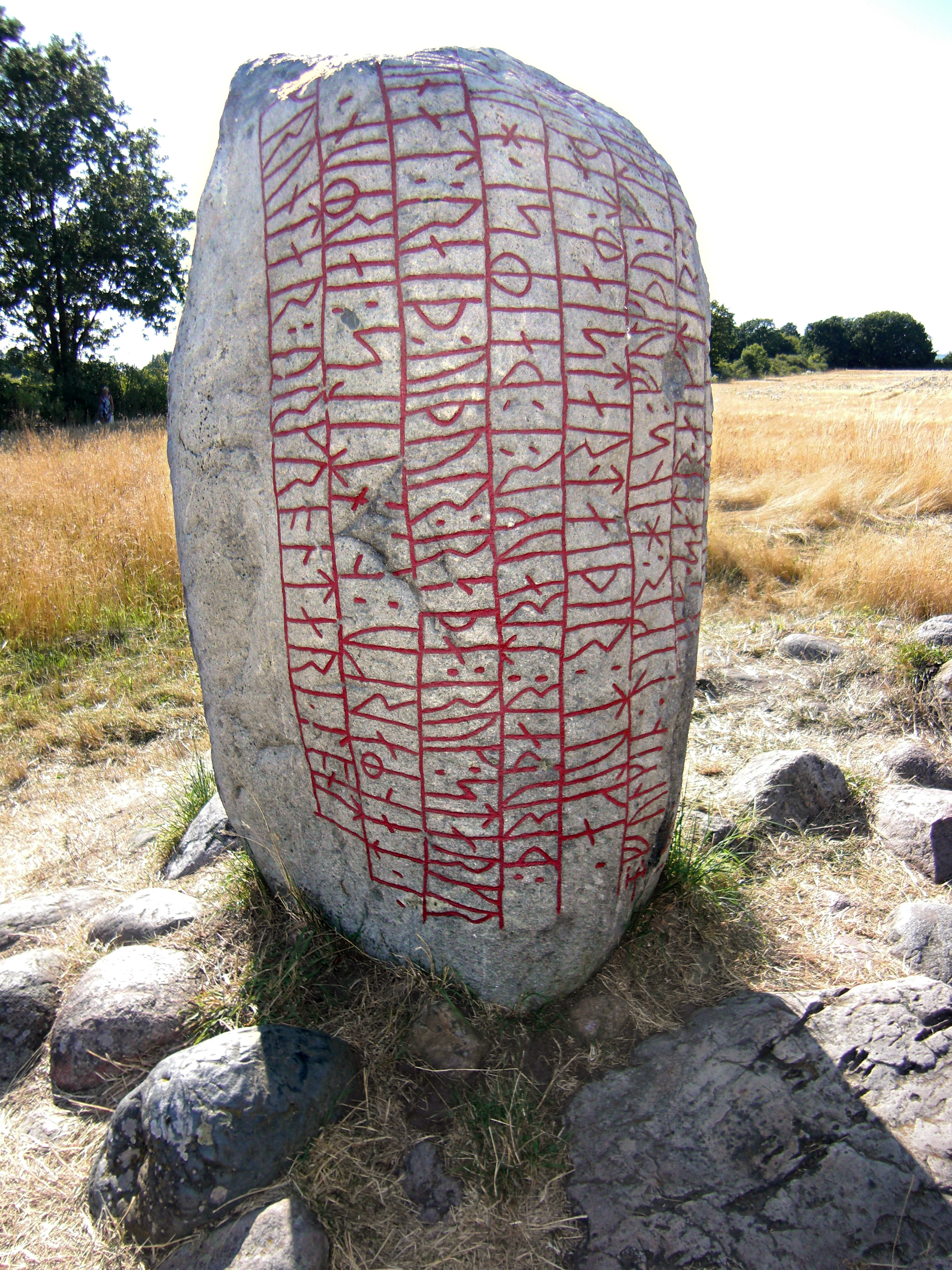
Karlevi Runestone
Most men knew that. The phrase appears halfway through the inscription carved into a 1.4-meter granite slab standing near the Kalmarsund strait on the island of Oland. It is a poet's aside to the audience, a millennium-old wink acknowledging that everyone already recognized the greatness of the warrior buried in the mound below. The Karlevi Runestone, dated to the late tenth century, preserves something found nowhere else in the runic record: a complete stanza of skaldic verse, the complex poetic form that Viking court poets used to immortalize their lords.
The Lordly Meter
Skaldic poetry followed strict rules that made it fiendishly difficult to compose. The drottkvaett, or lordly meter, required precise syllable counts, internal rhymes, and elaborate metaphors called kennings. To carve such a stanza into stone was extraordinary. The Karlevi inscription opens with prose identifying the deceased as Sibbi the Good, son of Fuldar, then shifts into verse that calls him a tree of Thrudr's enmities, a kenning meaning warrior through Thor's daughter. The poet further names him a chariot-Vidurr of the sea's vast expanse, invoking one of Odin's many names. These layered references would have been immediately understood by any educated Viking, each metaphor unlocking another dimension of praise.
Between Two Faiths
The reverse side of the stone tells a different story. Alongside symbols of Norse paganism, including what appears to be Thor's hammer Mjollnir, researchers have identified a small Christian cross and a fragmentary Latin inscription that may read In nomine Iesu, meaning in the name of Jesus. The Karlevi Runestone stands at a crossroads of belief, erected during the period when Christianity was spreading through Scandinavia but had not yet displaced the old gods. Its patron or the carvers hedged their spiritual bets, honoring the dead warrior with both traditions.
A Warrior's Company
The stone is contemporary with the Battle of Fyrisvellir, fought around 984-985 CE, and scholars have suggested that warriors who fought in that engagement may have raised it to honor their fallen chieftain. The poetic stanza declares that no more upright, strife-strong warrior will rule over land in Denmark, a reference that has puzzled historians. Did Sibbi the Good have Danish connections? Did he claim Danish territory? The answer lies buried with him, but the boast itself survives, carved in runes that have weathered a thousand winters beside the Baltic Sea.
The RAK Tradition
Runologists classify the Karlevi stone's style as RAK, meaning the runic text bands have straight ends without the dragon or serpent heads found on more elaborate monuments. This simpler style places the emphasis squarely on the text itself rather than decorative flourishes. The stone joins a small family of monuments depicting Thor's hammer, including the Altuna runestone, the Stenkvista stone, and several Danish inscriptions. Each hammer carving represents a conscious choice to invoke the thunder god's protection for the dead, a tradition that would fade as Christian symbols displaced pagan imagery on Scandinavian memorials.
Poetry Preserved in Stone
Viking Age Scandinavians composed thousands of skaldic stanzas, but most survived only through later manuscript copies made centuries after their original composition. The Karlevi Runestone offers something different: poetry frozen in stone at the moment of its creation, unfiltered by generations of scribal transmission. The carver may have made errors, the reading remains uncertain in places, but this is the voice of the tenth century speaking directly. Flestr vissi that, the inscription says. Most men knew that. Now, over a thousand years later, the stone still stands by the sea, ensuring that men continue to know the greatness it commemorates.
From the Air
Located at 56.61N, 16.45E on the western coast of Oland island, Sweden, near the village of Karlevi. The runestone sits close to the shoreline of Kalmarsund strait. From the air, Oland appears as a long, narrow island paralleling the Swedish mainland. The stone itself is too small to see from cruising altitude, but its location near the coast makes the general area identifiable. Nearest airport is Kalmar Airport (ESMQ) on the mainland, approximately 6 nautical miles west across the strait. Approach from the west over Kalmarsund for context showing the stone's position between mainland Sweden and the island.