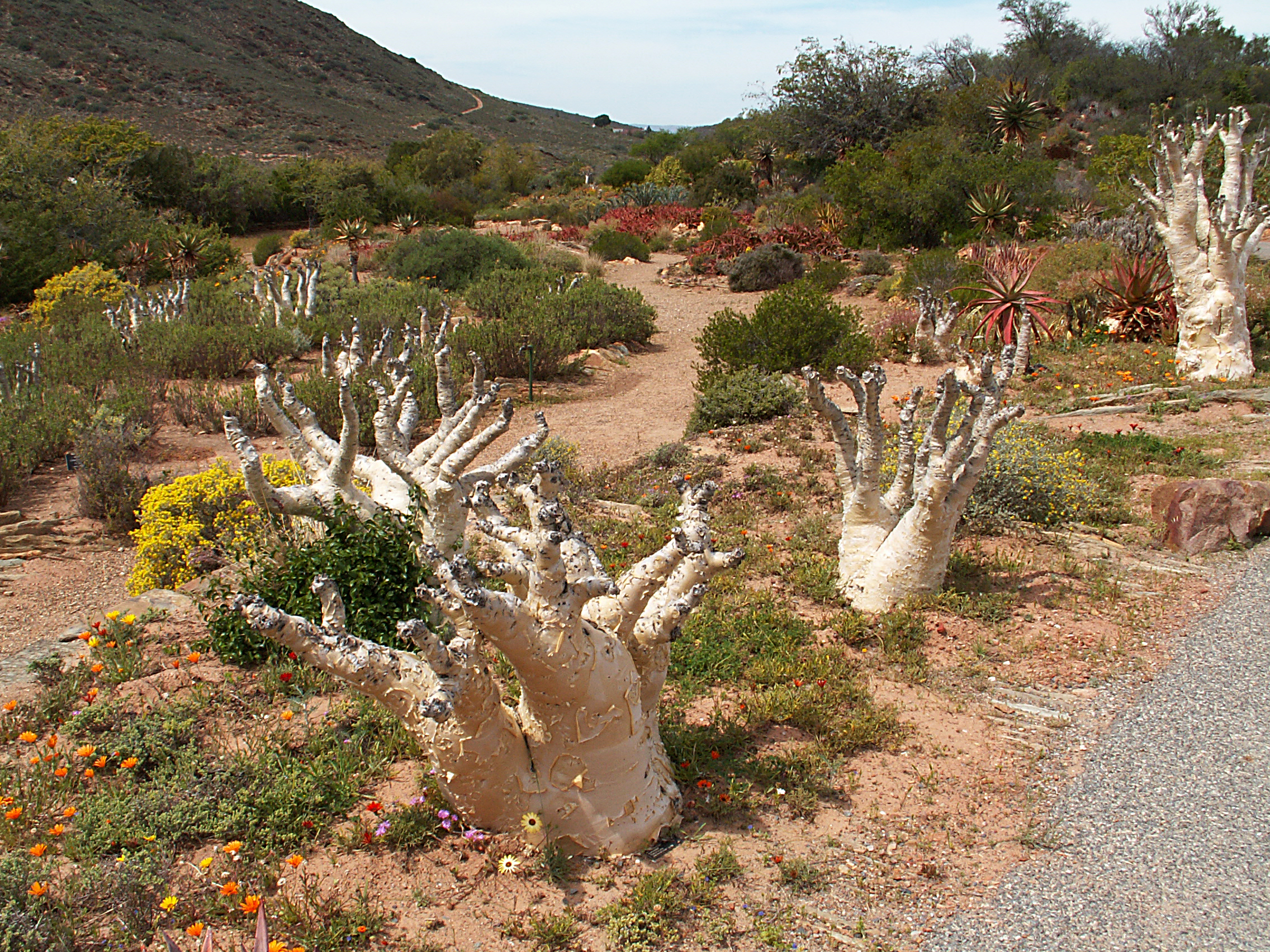
Karoo Desert National Botanical Garden
Most botanical gardens celebrate abundance -- tropical canopies, flowering meadows, the sheer extravagance of water and warmth. The Karoo Desert National Botanical Garden in Worcester celebrates the opposite. Here, at the foot of the Hex River Mountains, the starring plants are the ones that learned to hoard: succulents that store water in swollen leaves, stems that photosynthesize without bothering to grow foliage, bulbs that wait underground for years between flowerings. It is a garden dedicated to the proposition that beauty and austerity are not opposites.
A Garden That Moved
The garden was originally established in 1921 near Matjiesfontein, a remote railway stop deep in the Karoo interior. But in 1945, it relocated to Worcester, closer to Cape Town and better positioned to receive visitors. Today it is one of nine national botanical gardens managed by the South African National Biodiversity Institute, known as SANBI. The move to Worcester placed the garden at the ecological boundary where the winter-rainfall fynbos of the Western Cape meets the arid Karoo, giving it access to plant communities from both biomes within a compact area.
Three Thousand Ways to Survive Drought
Of the garden's 154 hectares, only 11 are formally cultivated. The rest preserves the natural vegetation of the area, including the unique Robertson Karoo vegetation type and patches of the threatened Breede Shale Renosterveld. Within the cultivated section, a network of pathways winds through one of the world's largest succulent collections. Including greenhouse specimens, the garden maintains nearly 3,000 species -- each one a solution to the same problem: how to live where rain is rare and heat is relentless. An additional 400 plant species grow wild on the garden's own grounds, having arrived without human assistance and persisting because the land was never plowed or paved.
Residents Who Were Not Planted
The garden's wild residents extend well beyond plants. Shrub hares shelter in the scrub, and grey mongooses hunt through the undergrowth. Three tortoise species patrol the grounds -- the angular tortoise, the leopard tortoise, and the parrot-beaked padloper -- alongside a range of small mammals, reptiles, and amphibians. The presence of these animals is a quiet argument for the garden's approach: by cultivating only a fraction of its land and leaving the rest undisturbed, it has preserved a functioning ecosystem rather than creating an outdoor museum. The tortoises, in particular, are a reminder that in the Karoo, survival favors the slow and well-armored.
Spring Transformation
For most of the year, the Karoo Desert National Botanical Garden has the muted palette of a semi-arid landscape -- dusty greens, grays, and the tawny brown of exposed earth. Then spring arrives, and the succulents flower. Vygies erupt in carpets of magenta, orange, and white, their petals opening only in direct sunlight, closing again as clouds pass overhead. The transformation is brief and dependant on rainfall, which means no two springs look the same. Visitors who time it right find themselves walking through a landscape that has gone from austere to astonishing in the span of a few weeks. The Hex River Mountains provide a dramatic backdrop, their peaks sometimes still carrying winter snow while the garden below blazes with color. It is the kind of spectacle that only drought-adapted plants can produce -- a concentrated burst of reproductive energy from organisms that spend most of their lives quietly conserving resources.
From the Air
Located at 33.62S, 19.45E at the foot of the Hex River Mountains in Worcester, Western Cape, South Africa. The garden is on the eastern edge of Worcester, identifiable from altitude by its position where the Breede River valley meets the mountain range. Worcester airfield (FAWO) is nearby. Cape Town International Airport (FACT) is approximately 110 km to the west via the Huguenot Tunnel route. The Hex River Mountains rise sharply to over 1,800 m to the east, creating a dramatic wall behind the garden. The Breede River valley floor is relatively flat agricultural land, making the garden's semi-arid terrain distinct from the irrigated vineyards surrounding it.