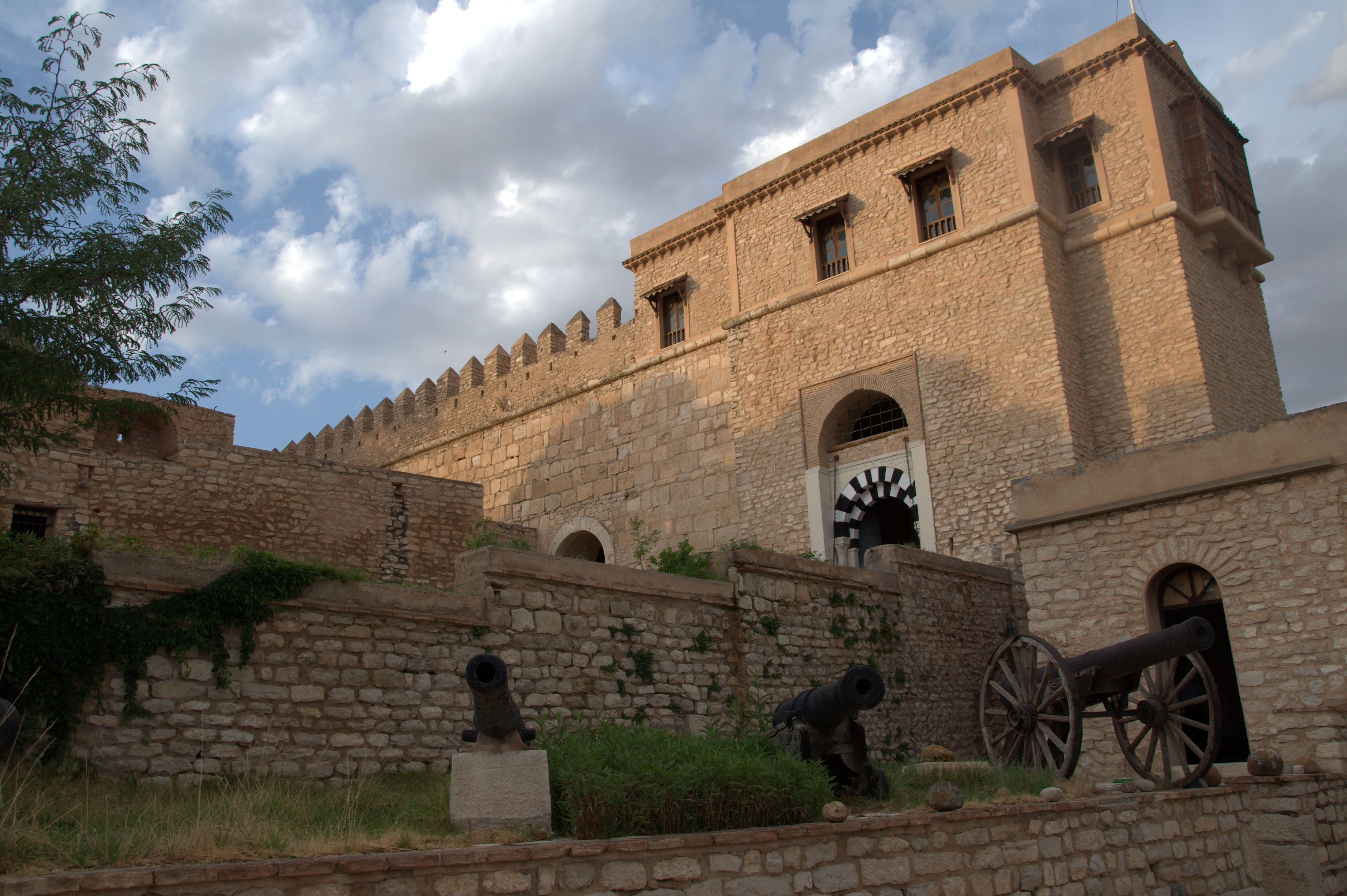
Kasbah of Le Kef
A secret door on the northwest side. Four watchtowers scanning the horizon. A moat threading down to the medina below. The Kasbah of Le Kef was built for a world where escape routes mattered as much as walls. Constructed in 1600 during Ottoman rule over Tunisia, the fortress sits atop a site that has served as a military strongpoint since Roman legions garrisoned the region. Each civilization that claimed El Kef added its own layer to the defenses, creating a fortification that reads like geological strata -- except the layers are made of strategic anxiety rather than rock.
Fortress of Many Masters
El Kef's strategic importance predates Islam, predates Christianity, predates the written records that survive. Roman texts and inscriptions found within the fort's walls confirm that the site served as a defensive position during the imperial period. Arab forces later recognized the same tactical advantages -- the commanding hilltop position, the clear sightlines across the surrounding countryside -- and maintained fortifications here. But it was the Ottomans who formalized the site as a kasbah in 1600, constructing the four watchtowers and barracks that formed the core of the fortress. They also built the secret escape door on the northwest face, a pragmatic acknowledgment that even the best-defended positions sometimes fall.
Hammuda Pasha's Moat and Humbolt's Towers
The first major renovation came during the mid-17th century under the ruler Hammuda Pasha. His engineers added a moat that descended from the kasbah to the bottom of the medina quarter, along with additional watchtowers, walls, and supporting fortifications. The moat served a dual purpose: defensive barrier and drainage channel for the steep hillside site. Nearly two centuries later, in 1806, a Dutch engineer named Humbolt oversaw another round of improvements, adding new towers along the northern side and repairing structures that time and weather had degraded. The result is a fortress whose architectural language spans Ottoman military pragmatism and European engineering precision, all layered over foundations that Roman masons laid.
A Self-Contained World
Within its walls, the kasbah contained everything a garrison needed to withstand isolation. Rooms surrounded an interior courtyard, providing quarters for soldiers and administrators alike. A mosque served the spiritual needs of the garrison. Ammunition stores stood ready. A basin collected rainwater -- essential in a region where water sources could be cut off by besieging forces. The fort functioned not merely as a military installation but as the administrative heart of the city, the place from which governance radiated outward into the surrounding countryside. Commands, taxes, and justice all flowed from behind these walls.
From Garrison to Festival Ground
Today the Kasbah of Le Kef has traded its military function for a cultural one. Tourists walk the ramparts where sentries once watched for approaching armies. The spaces that housed soldiers and stored gunpowder now serve as venues for festivals and cultural events. The transformation is fitting for a city whose name, El Kef, derives from a word meaning "rock" or "cliff" -- the fortress remains anchored to the same high ground that first attracted defenders, even as the nature of what it defends has changed. From the kasbah's towers, the view extends across the rolling countryside of northwestern Tunisia, the same landscape that Romans, Arabs, Ottomans, and the modern Tunisian state have each, in turn, surveyed and claimed.
From the Air
Located at 36.18°N, 8.71°E atop a prominent hill in the city of El Kef, northwestern Tunisia. The kasbah is visible from the air as a walled compound crowning the highest point of the city. Recommended viewing altitude: 3,000-5,000 feet AGL. Nearest airports: Tunis-Carthage International (DTTA) approximately 170 km east. The terrain is hilly with good visibility in clear weather. El Kef sits near the Algerian border.