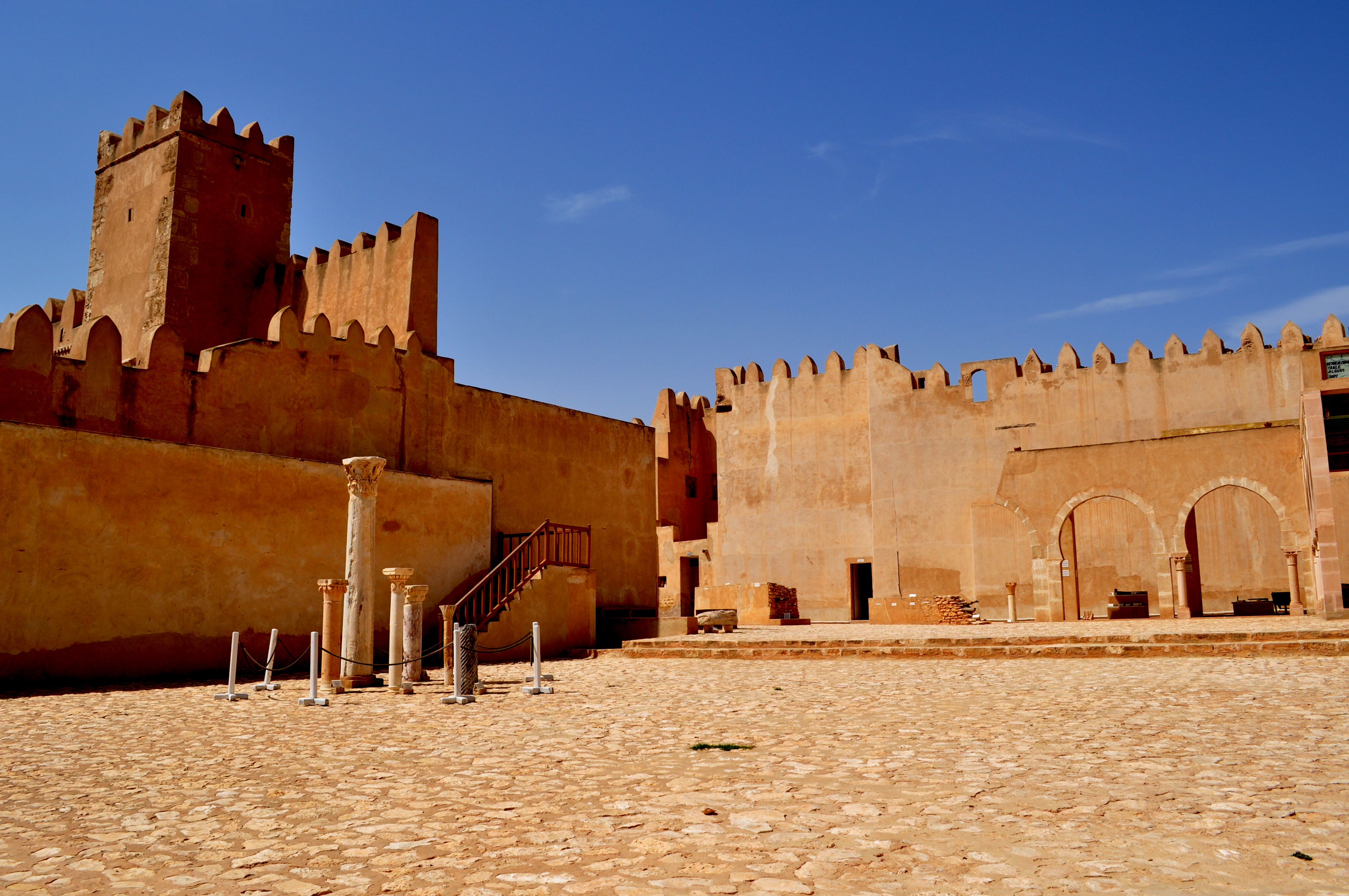
Kasbah of Sfax
Fire signals once leaped from tower to tower along the Tunisian coast, and the kasbah of Sfax was one of ten stations in the chain. Built by the Aghlabid dynasty in the early ninth century as part of a coastal surveillance campaign, the fortress sat directly on the shoreline, watching the Mediterranean for threats. Centuries of construction have since pushed the coastline away, leaving the kasbah stranded inland in the southwestern corner of the old city. But the building never stopped serving power, passing from watchtower to seat of government to military barracks to colonial garrison, each transition rewriting its purpose while preserving its stone.
Sentinels of the Shoreline
The Aghlabids, who had wrested control of Ifriqiya from the Abbasid caliphate and built their own independent dynasty in the early ninth century, understood that North Africa's coast required systematic defense. They constructed a network of ten observation towers along the shore at Sfax, linked by a fire-signal system that could relay warnings of approaching threats across dozens of miles. The kasbah was the central node: two high towers for monitoring the sea and communicating with surrounding stations, two mosques for the garrison's spiritual needs, and an underground facility that may have served as an emergency prayer room. Built atop the ruins of an earlier palace south of Mahares, inherited from previous civilizations, the kasbah was as much a statement of authority as a military installation.
The Seat of Everyone's Power
As the Aghlabid dynasty matured and the ribat fortification grew, the kasbah evolved from watchtower into the political center of the city. It became the seat of successive governors who administered Sfax under the Fatimids, Zirids, Almohads, and Hafsids, each dynasty inheriting the building along with the territory. The fortress was where power physically resided: whoever held the kasbah held Sfax. At the end of the Hafsid period, the local ruler Abu Abdullah al-Makeni seized the city from the central authority, operating from within these same walls. When the Ottomans arrived, the administrative system shifted. The governor's role changed, and the Aga, the local military commander, became the de facto ruler, responsible for all kasbahs and guards in the city. Ottoman military culture reshaped the building's interior even as its exterior retained its medieval character.
From Barracks to Museum
The French conquest of Tunisia in 1881 brought the building's military function full circle. French gendarmes replaced Ottoman soldiers, and the kasbah served as a colonial garrison until Tunisia's independence in 1956. The Tunisian National Guard briefly occupied it before the building was abandoned. For nearly twenty years it sat neglected, its walls deteriorating, its rooms empty. Then, in the 1980s, a restoration project overseen by Zouari transformed the kasbah into a museum of traditional Sfaxian architecture, which has characteristics distinct from other Tunisian cities. The building proved an ideal vessel: its own architectural elements, accumulated over a millennium, constituted much of the exhibit. The museum now houses galleries of building techniques and tools, sectional models of the medina's distinctive fences, and exhibitions of religious architecture from the old city.
Where Prisoners Became Paintings
The most striking transformation may be the smallest. Where the kasbah's prison once stood, its cells and punishment rooms now house the Art Gallery of Mohammed Al-Vandari, a gallery of fine arts. The upper mosque has been repurposed as an exhibition space for the religious establishments of the old city. Original waqf documents, old metal door knockers, and ancient hinges are displayed alongside architectural models, creating a portrait of a city that built with care and intention. Walking through the kasbah today, you move through time as much as space: from the Aghlabid watchtower foundations to Ottoman military modifications to French colonial alterations to the curatorial choices of the modern museum. Each era is legible in the stone, and none has been erased.
From the Air
Located at 34.73°N, 10.76°E in the southwestern corner of the medina of Sfax, Tunisia. The kasbah is part of the walled old city, distinguishable from the air by the medina's compact, roughly rectangular footprint. Sfax-Thyna Airport (DTTX) lies to the south. Approach from the southwest at 2,000-3,000 ft AGL to see how the kasbah anchors the corner of the medina walls. The Mediterranean coastline, now some distance from the fortress, was once directly adjacent.