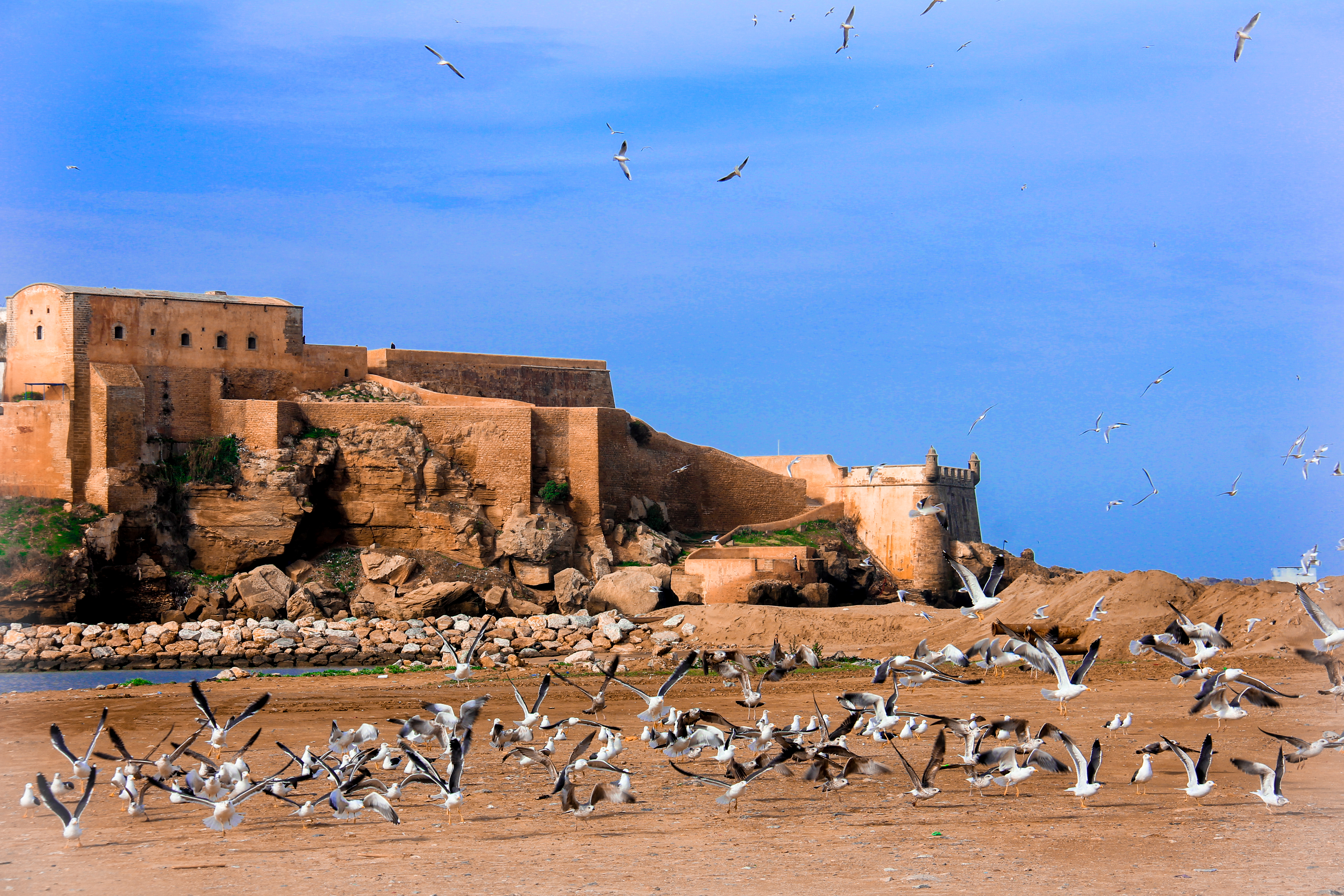
Kasbah of the Udayas
The streets are painted blue and white, and they climb a hill so steep that the Atlantic Ocean appears at the top of nearly every alley. The Kasbah of the Udayas sits at the mouth of the Bou Regreg river in Rabat, where Morocco meets the sea, perched on a rocky promontory that has been fortified, destroyed, and rebuilt so many times that its walls contain the compressed history of nine centuries of power.
Fortress on the River's Edge
The citadel's origins trace to an earlier ribat -- a fortified religious retreat -- that likely occupied this same strategic hilltop. In 1150 or 1151, the Almohad caliph Abd al-Mu'min built a new kasbah over the site, including a palace, a mosque, and an underground canal to divert water for the settlement. His successor, Caliph Ya'qub al-Mansur, expanded the fortifications between 1195 and 1199, inserting the monumental Bab Oudaia -- the Great Gate -- into the existing walls. This gate, with its elaborate carved stonework and horseshoe arches, remains one of the finest examples of Almohad military architecture. The name "Udayas" came later, in the 19th century, when members of the Udaya tribe, expelled from Fez, settled in the then nearly uninhabited kasbah and gave it the name it carries today.
Corsairs, Sultans, and Semaphore
During the 17th century, the kasbah took on new roles. A broad platform was constructed on its northeastern edge overlooking the river, used for semaphore signaling to coordinate with ships. The kasbah's position at the river mouth made it central to the maritime activity of Rabat and neighboring Sale, which at the time was home to the notorious Sale Rovers -- Barbary corsairs who operated from the estuary. Sultan Moulay Ismail, who ruled from 1672 to 1727, built a royal pavilion within the walls, a structure that survives today as the core of the Oudayas Museum. By the 18th century, the lower portions of the kasbah were expanded during the Alaouite period, creating the layered architectural character visible today -- Almohad foundations below, Alaouite additions above.
Gardens of Lost Andalusia
Between 1915 and 1918, during the French Protectorate, Maurice Tranchant de Lunel created the Andalusian Garden adjacent to Moulay Ismail's pavilion. Inspired by the Moorish gardens of al-Andalus, the formal garden features bougainvillea, citrus trees, and geometric plantings laid out around a central axis. It is a recreation of a vanished world -- the gardens of Muslim Spain -- transplanted to Morocco by a French architect working in a colonial administration. The irony is characteristic of the kasbah itself, where every layer of construction reflects a different political reality. A 1914 restoration of the broader kasbah, also led by Tranchant with local master craftsmen including Hadj Driss Tourouguy, preserved the historic fabric while adapting it for modern use.
Blue Walls and Atlantic Light
Today the Kasbah of the Udayas is simultaneously a residential neighborhood, a tourist attraction, and a UNESCO World Heritage Site, designated in 2012 alongside other historic sites in Rabat. Residents live behind the blue-and-white painted doors, and the narrow streets still follow the medieval plan. From the kasbah's upper terraces, the view extends across the Bou Regreg to the city of Sale, across the river mouth to the Atlantic, and southward along the Rabat waterfront. The former royal pavilion houses the National Jewellery Museum, which reopened in January 2023 after renovation. The Cafe Maure on its terrace serves mint tea with a panorama that encompasses nearly a millennium of Moroccan history. Each year, an open site adjacent to the kasbah hosts part of the Mawazine music festival, filling the ancient walls with sound and drawing the kasbah's story forward into the present.
From the Air
Coordinates: 34.031N, 6.836W. The Kasbah of the Udayas is clearly visible from the air as a fortified promontory at the mouth of the Bou Regreg river, with the Hassan Tower and Mausoleum of Mohammed V upstream to the south. The blue-and-white neighborhood is distinctive even at moderate altitude. Nearest airport: GMME (Rabat-Sale, 5 km northeast). Sale sits directly across the river.