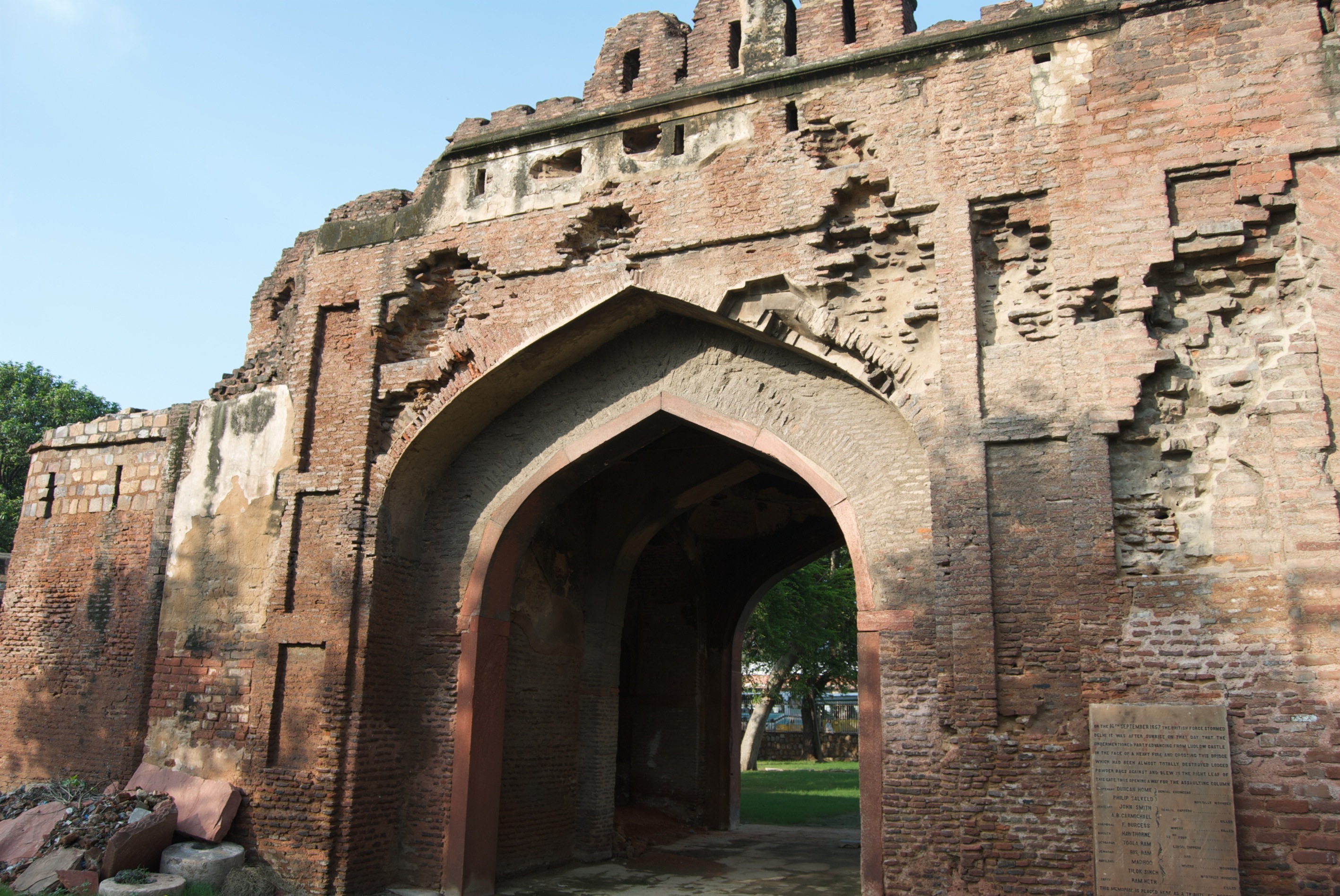
Kashmiri Gate, Delhi
On the morning of September 14, 1857, a small party of British engineers sprinted toward the northern wall of Shahjahanabad under heavy fire, carrying bags of gunpowder. Their target was a sandstone archway built two centuries earlier by Shah Jahan -- the Kashmiri Gate, named for the road that once led travelers north toward the Kashmir valley. The explosion that blew the gate open became one of the defining moments of the Indian Rebellion, earning several of the attackers the Victoria Cross. But the gate's story runs far deeper than that single violent morning. For four centuries, Kashmiri Gate has been a threshold between worlds: Mughal and British, old city and new, sacred and commercial.
Gateway to Shahjahanabad
When Shah Jahan moved his capital from Agra to Delhi in the mid-17th century, he built Shahjahanabad as a walled city worthy of the Mughal Empire's grandeur. Kashmiri Gate served as its northern entrance, facing the road that led toward Kashmir and the empire's frontier provinces. The gate opened onto a landscape of Mughal palaces and noble residences, with the Red Fort -- the emperor's own seat of power -- just a short walk to the southeast. For generations, anyone entering Delhi from the north passed through this archway: merchants hauling goods from Central Asia, soldiers returning from campaigns, pilgrims heading south to the great mosques. The gate was not merely decorative. It was the city's front door.
The British Enclave
When the British East India Company established a presence in Delhi in 1803, they found Shahjahanabad's walls crumbling -- battered by a Maratha siege led by Yashwantrao Holkar just a year later. The British reinforced the fortifications and, over the following decades, settled into the Kashmiri Gate neighborhood itself, building residential estates where Mughal nobles had once lived. A striking symbol of this cultural layering arrived in 1836: St. James' Church, commissioned by Colonel James Skinner, a legendary Anglo-Indian cavalry officer whose mixed heritage embodied the era's complexities. Skinner's Church, as it became known, still stands near the gate -- a Renaissance-revival dome rising among the remnants of Mughal architecture, built by a man who led Indian horsemen under British colors.
Rebellion and Reinvention
The 1857 uprising transformed Kashmiri Gate from a neighborhood into a battlefield. British forces blew open the gate to retake the walled city from rebel sepoys and the last Mughal emperor, Bahadur Shah Zafar. A plaque still affixed to the stonework commemorates the assault party. After the rebellion was crushed, the British abandoned the area for the quieter Civil Lines to the north, and Kashmiri Gate reinvented itself. It became Delhi's fashionable commercial district -- a hub of shops, restaurants, and urban life that held this status for nearly seven decades, until Edwin Lutyens' New Delhi shifted the city's center of gravity southward in 1931. During the Partition of 1947, the area took on yet another role: refugee camp. Families who had fled West Punjab and the North-West Frontier Province sheltered here, adding another layer of human experience to a place already thick with history.
Layers Still Visible
Walk around Kashmiri Gate today and the centuries collide. The gate itself survives as a protected monument under the Archaeological Survey of India, though a section was demolished in 1965 to ease traffic. Nearby stands the Dara Shikoh Library, established by the scholarly Mughal prince who lost a war of succession to his brother Aurangzeb -- it now operates as an archaeological museum. The Mutiny Memorial, erected in 1863, commemorates both British and Indian soldiers who died in the 1857 fighting. The Nicholson Cemetery holds the graves of colonial-era officers. And the Bengali community that settled here in the early 1910s still celebrates the Delhi Durga Puja Samiti, founded in 1910 -- the oldest Durga Puja celebration in the capital. Even the building that now houses the Delhi State Election Commission has its own tale: constructed between 1890 and 1891, it served as St. Stephen's College for fifty years before the institution relocated.
The Junction That Never Sleeps
Beneath all this history, modern Delhi has claimed Kashmiri Gate as one of its busiest transit nodes. The Kashmere Gate metro station is the only trijunction on the entire Delhi Metro network, where the Red, Yellow, and Violet lines converge -- a subterranean crossroads mirroring the surface-level one that has existed for centuries. The Maharana Pratap Inter-State Bus Terminal, which opened in 1976 as one of India's largest, dispatches buses to seven states from Haryana to Uttarakhand. Millions pass through this area every year, most of them in too much of a hurry to notice the sandstone archway overhead or the church dome beyond the trees. The gate that once marked the boundary between empire and wilderness now marks the boundary between awareness and amnesia -- between those who notice the layers and those who simply pass through.
From the Air
Kashmiri Gate sits at 28.666N, 77.229E in the Old Delhi district, immediately northwest of the Red Fort. From the air, look for the distinctive red sandstone of the Red Fort complex and the railway lines converging near Delhi Junction station. The gate area is at the junction of several major roads near the Yamuna River's western bank. Nearest major airport is Indira Gandhi International (VIDP/DEL), approximately 18 km to the southwest. Best viewed below 3,000 feet for architectural detail. The dense urban fabric of Old Delhi contrasts sharply with the planned geometry of New Delhi to the south.