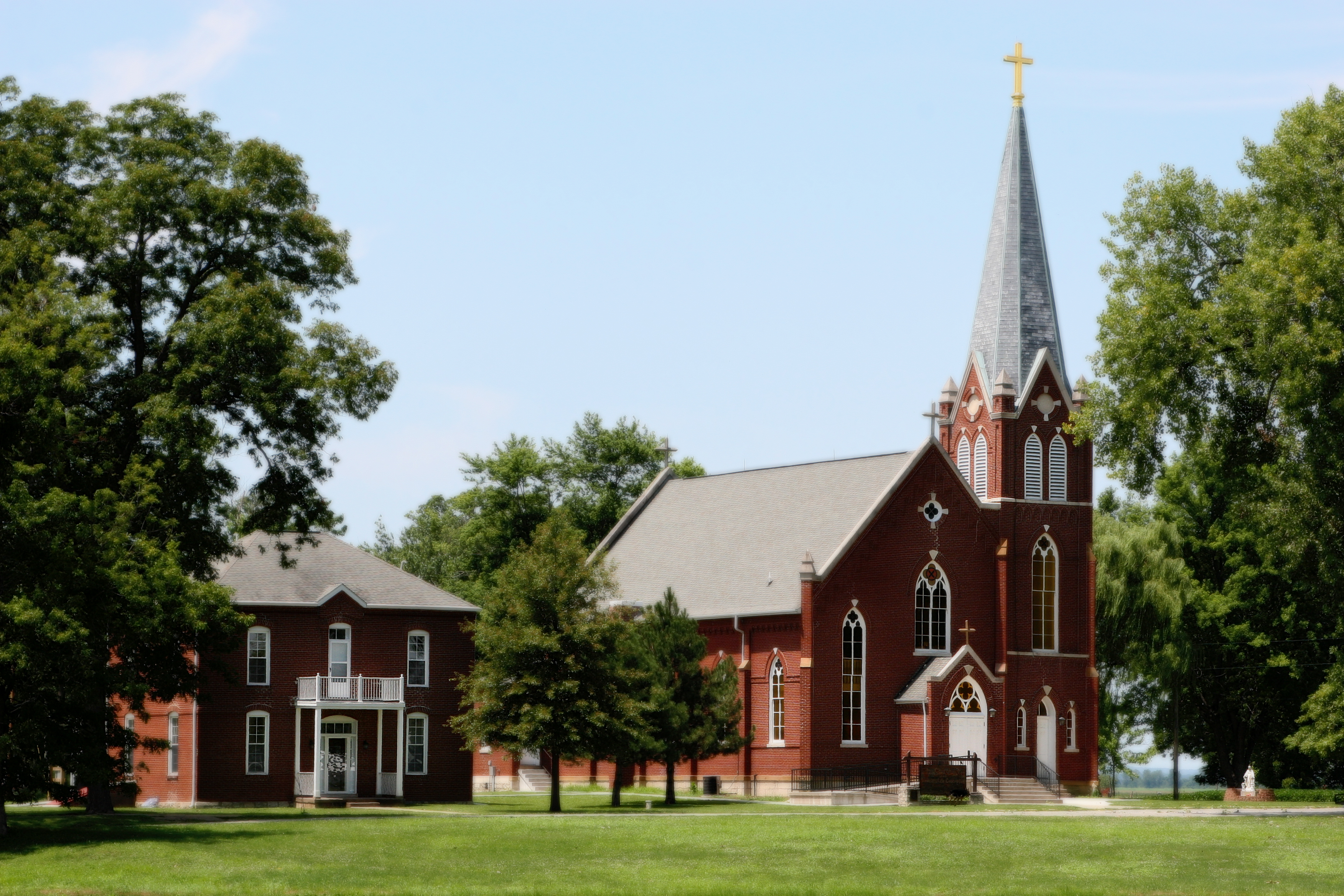
Kaskaskia, Illinois
Twenty-one people live in a place that once served as the capital of a state that no longer claims the ground beneath their feet. Kaskaskia, Illinois, sits west of the Mississippi River, physically attached to Missouri, reachable only by crossing through another state. Its residents carry Illinois area codes and Missouri ZIP codes. They vote in Illinois elections but their roads dead-end into Missouri farmland. It is the kind of place that cartographers argue about and postal workers dread -- a village that the river decided to rearrange, and that history mostly forgot.
Where the French Met the Frontier
Long before it became a state capital, Kaskaskia was a crossroads of empires. The Kaskaskia people, part of the Illinois Confederation, established a settlement here that swelled to some twenty thousand inhabitants by the 1680s as refugees from the Beaver Wars sought safety in numbers. French Jesuit missionaries and voyageurs arrived to find a thriving community, and the two cultures intertwined in ways that were unusual for the colonial frontier. By 1717, a visitor reported that the village consisted of 400 Illinois men, two Jesuit missionaries, and about twenty French voyageurs who had married Indian women. The births recorded in Kaskaskia's earliest church registers tell the story: of 21 children baptized before 1714, eighteen had Indigenous mothers and twenty had French fathers. The settlement grew into a critical supply hub for French Louisiana, shipping tons of wheat and corn downriver to New Orleans, where the Gulf climate could not support staple crops. King Louis XV sent a bell to the Kaskaskia church in 1741, a gift that would later earn a revolutionary nickname.
The Liberty Bell Rings West
On July 4, 1778, George Rogers Clark and 200 Virginia militiamen captured Kaskaskia from the British without firing a shot. The parish priest rang that French bell to celebrate the American victory, and it became known as the Liberty Bell of the West. Clark's Illinois Campaign secured the western frontier for the Revolution and set the stage for what would follow: Kaskaskia became part of the Northwest Territory in 1787, the capital of Illinois Territory in 1809, and the first capital of the new state of Illinois in 1818. Its first constitutional convention met here. The Illinois Herald, the state's first newspaper, rolled off a press here on June 24, 1814. At its peak, Kaskaskia boasted a population of around 7,000 and an outsized list of prominent citizens -- from Shadrach Bond, the first governor of Illinois, to John Willis Menard, the first African American elected to the United States Congress, to Nance Legins-Costley, the first enslaved person freed by Abraham Lincoln in 1841.
A River's Revenge
The very steamboats that brought prosperity to Mississippi River towns carried the seeds of Kaskaskia's destruction. Crews stripped the riverbanks of timber to fuel their boilers, destabilizing miles of shoreline. The banks eroded and collapsed. The river grew wider, shallower, and more unpredictable between St. Louis and the Ohio River confluence. The Great Flood of 1844 forced residents to relocate the town southward. Then, in April 1881, the Mississippi made its decisive move: it shifted eastward into the channel of the Kaskaskia River, passing east of the village instead of west. The original town site -- including the location of the first Illinois statehouse -- vanished beneath the current. The village that had once governed a state was now an island, then a peninsula, and finally a sliver of Illinois soil physically grafted onto the Missouri side of the river.
Stubbornly Illinois
The rebuilt village is a study in defiance. Residents moved the Church of the Immaculate Conception in 1893 and built a shrine nearby to house the Liberty Bell. A levee lines the eastern edge. A small bridge crosses a bayou to connect the village to the surrounding farmland. But the Mississippi is not done making its point. The Great Flood of 1993 submerged the entire island, forcing a full evacuation and covering the village in water more than several feet deep. The 2020 census counted 21 residents. There are five housing units. The median age is 48. By any measure of civic vitality, Kaskaskia is fading. Yet it remains, legally and stubbornly, a village in Randolph County, Illinois -- a place where the state boundary follows a river channel that no longer exists, and where a handful of people hold down the last scrap of a forgotten capital.
From the Air
Kaskaskia sits at 37.92N, 89.92W, on the west bank of the Mississippi River, physically attached to Missouri despite being legally in Illinois. From altitude, look for the distinctive bend in the Mississippi where the river shifted its channel east, with a small bridge crossing a bayou. The village is tiny and surrounded by floodplain farmland. Nearest major airport is St. Louis Lambert International (KSTL) about 60 nm to the northwest. Mid-America Airport (KBLV) at Scott AFB is roughly 30 nm north. Approach at 2,000-3,000 ft AGL to see the contrast between the river channel and the isolated village. The levee system along the eastern edge is visible from moderate altitude.