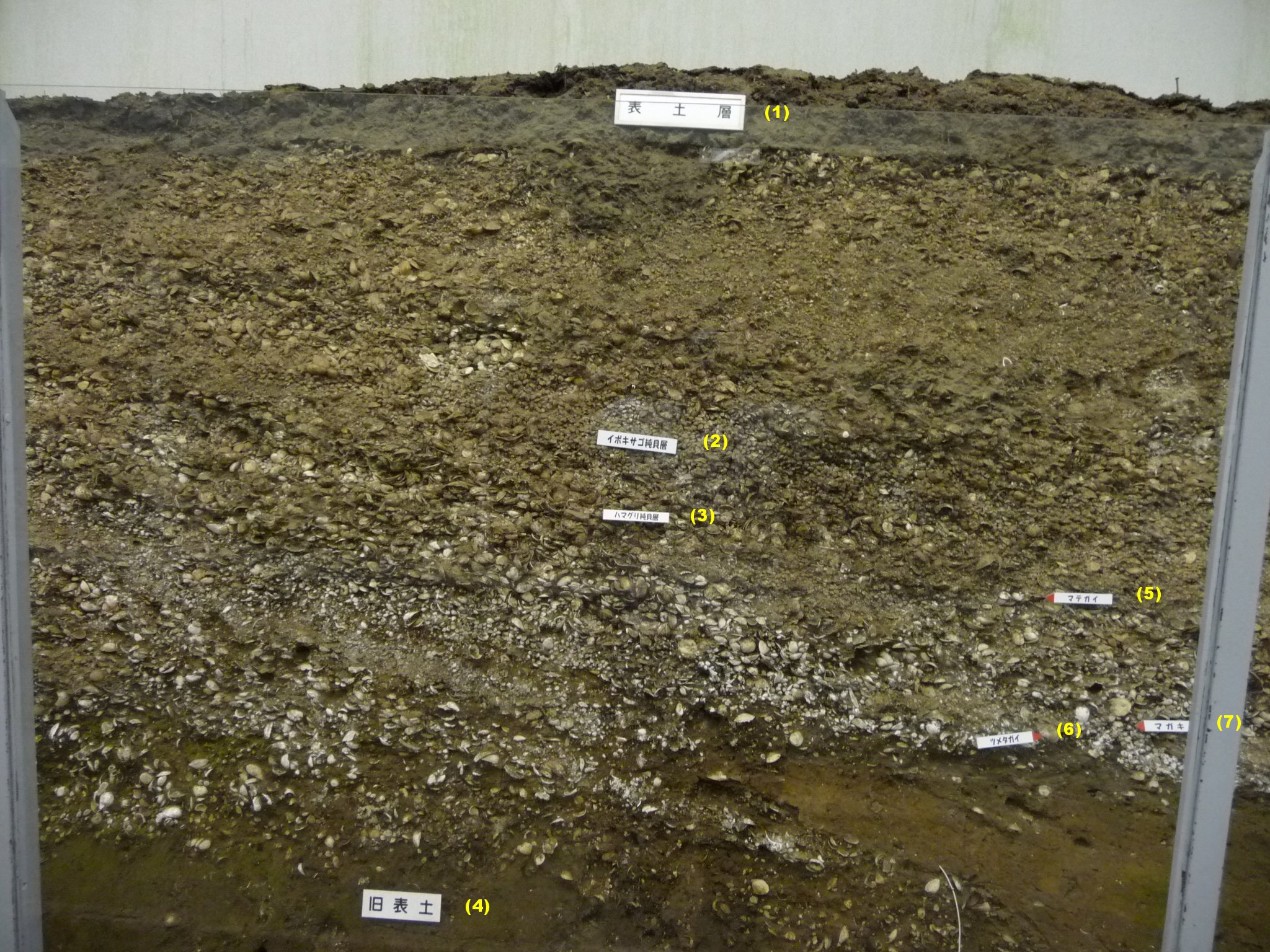
Kasori Shell Mound
Five thousand years ago, the sea reached further inland. Water levels stood five to six meters higher than today, temperatures ran two degrees Celsius warmer, and the coastline of what is now Chiba City pushed deep into the Kanto plain. On a tongue-shaped plateau above the Sakatsuki River, a community of Jomon people cracked open clams, shucked oysters, filleted black seabream, and tossed the remains over their shoulders. They did this for roughly two thousand years. The accumulation of all that discarded marine life -- shells upon shells upon shells, layered with fish bones, deer antlers, boar tusks, stone tools, and broken pottery -- grew into the largest shell midden in Japan and one of the largest in the world. The Kasori Shell Mounds are not ruins in the conventional sense. They are a garbage heap elevated to the status of a Special National Historic Site, and they have more to teach us about prehistoric Japan than most temples or castles ever will.
A Figure Eight in Shells
The site consists of two linked shell mounds that form, when viewed from above, a rough figure eight. The northern mound, Kasori Kita, dates from the middle Jomon period -- roughly 5,000 to 4,000 years ago -- and measures 130 meters in diameter. It accumulated over more than a millennium of continuous habitation. The southern mound, Kasori Minami, is younger, dating from the latter half of the Jomon period, about 4,000 to 3,000 years ago. It is also larger, a horseshoe shape with a long diameter of about 170 meters. Together the two mounds form what archaeologists call a double shell ring, connected at their narrowest point. The entire shell layer spreads across 300 meters east-to-west and 400 meters north-to-south along the eastern edge of the plateau. Within and around these mounds, excavators have found 110 pit dwellings, the largest with a diameter exceeding 19 meters -- a communal structure that speaks to organized, cooperative living on a scale unusual for hunter-gatherer societies.
What the Garbage Reveals
The contents of the Kasori middens read like an inventory of Jomon daily life. Clam and oyster shells dominate, the residue of a diet anchored to the sea. Fish bones from black seabream and sea bass confirm that the inhabitants were skilled fishermen who worked the rich waters of the ancient Tokyo Bay shoreline. Tree nuts -- Japanese chestnuts, walnuts, and acorns -- show that foraging in the surrounding forests supplemented the marine harvest. Fish hooks crafted from the bones and antlers of boar and deer demonstrate material ingenuity, turning hunting waste into fishing tools. The site also yielded 53 human burials spanning the middle to final Jomon periods, along with the bones of six dogs -- likely companions or working animals in the settlement. And then there is the pottery. When Tokyo Imperial University first excavated the site in 1924, the distinctive ceramics recovered here became the type specimen for "Kasori type earthenware," a classification still used in Jomon archaeology today.
The Ninety-Two Percent
Here is the remarkable fact about Kasori: after 37 separate excavations conducted at 14 locations across the site since its discovery in 1887, only about eight percent of the total area has been examined. The remaining 92 percent lies almost untouched beneath the plateau's surface. This is not neglect but strategy. Japanese archaeological practice increasingly favors preservation over excavation, recognizing that future technologies may extract information that current methods cannot. The site was designated a National Historic Site in 1971 for the northern mound, with the southern mound added in 1978. In 2017, the entire site was elevated to Special National Historic Site status -- the highest designation Japan grants to archaeological heritage. Since 1986, the area has been maintained as Kasori Kaizuka Park, where visitors can peer through viewing tunnels into cross-sections of the shell layers and walk among reconstructed pit houses.
An Ancient City in the Modern One
The Kasori Shell Mounds Museum sits within the park, displaying excavated Jomon pottery, stone tools, and artifacts while explaining the rhythms of daily life in a society that thrived here for millennia. The site is a 15-minute walk from Sakuragi Station on the Chiba Urban Monorail -- a journey that covers roughly 7,000 years of human history in the time it takes to stroll through a few residential blocks. Of the approximately 2,400 shell middens scattered across Japan, about 120 are concentrated in Chiba City alone, a density that reflects the area's ancient geography: when sea levels were higher, this region was a patchwork of inlets and estuaries ideal for coastal settlement. Kasori is the largest and most significant of them all, a monument built not by architects or emperors but by ordinary people eating dinner, night after night, for two thousand years.
From the Air
Located at 35.6233N, 140.1647E in Wakaba Ward, eastern Chiba City. The site sits on a plateau above the Sakatsuki River, a tributary of the Miyakogawa River. From altitude, look for the green expanse of Kasori Kaizuka Park in the eastern residential areas of Chiba, roughly 4km east-northeast of central Chiba Station. The plateau and park are distinguishable from surrounding dense residential neighborhoods. Nearest major airports: Narita International (RJAA), approximately 25nm east-northeast; Tokyo Haneda (RJTT), approximately 28nm west across Tokyo Bay. The Chiba Urban Monorail line provides a useful visual reference running through the area.