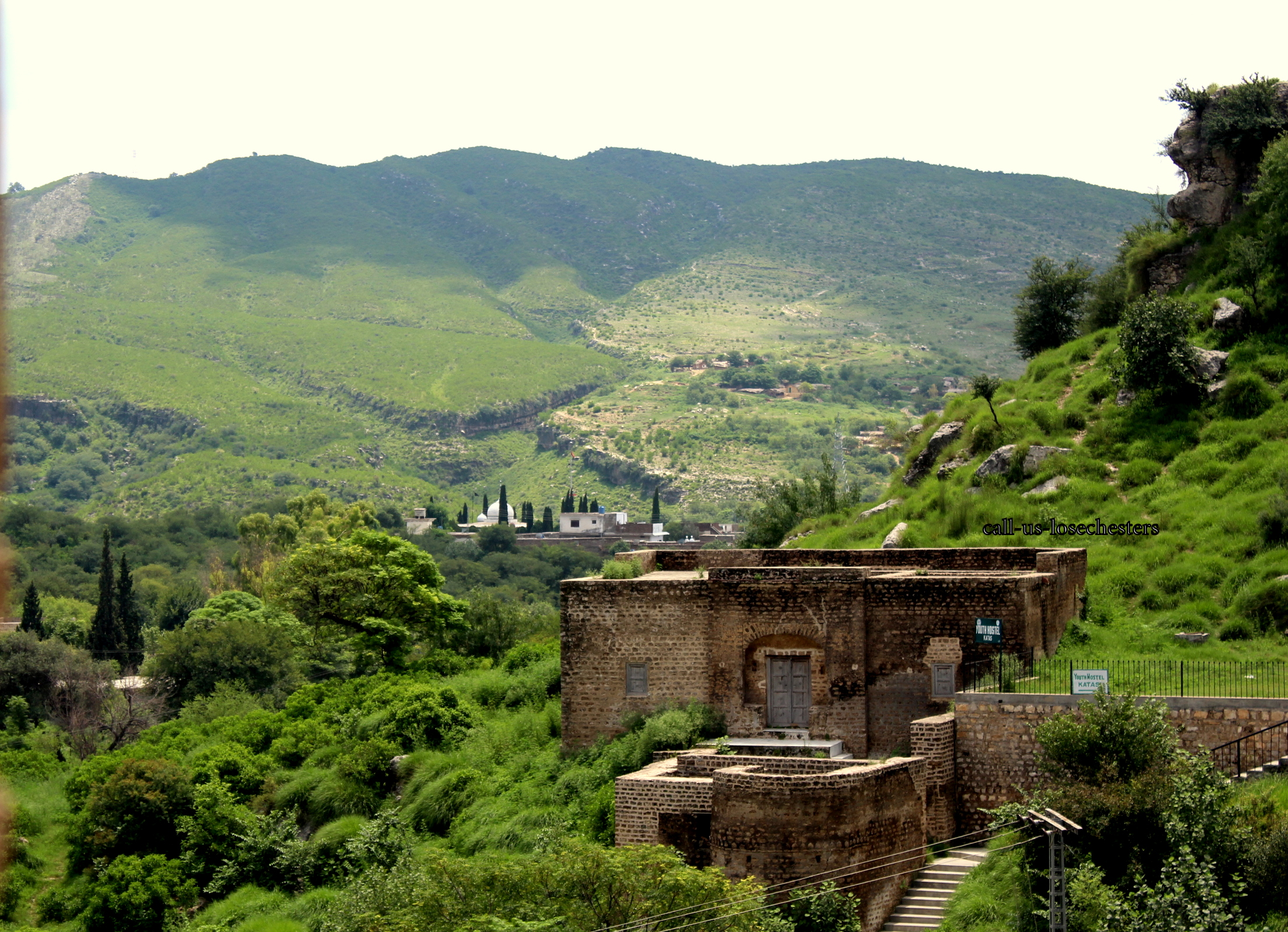
Katas Raj Temples
According to the Puranas, the god Shiva wept. His wife Sati had died, and he wandered the Earth inconsolable, his grief so vast that where his tears fell, pools of water formed. One of those pools -- or so the legend holds -- lies at the center of a temple complex on Pakistan's Potohar Plateau, ringed by stone shrines that have drawn pilgrims for over fifteen hundred years. The Katas Raj Temples, also known as Qila Katas, sit in the Chakwal District of Punjab province, a cluster of ancient Hindu sanctuaries connected by walkways and unified by the sacred pond they surround. In Urdu and Persian, this body of water is called Chashm-e-Alam -- the Eye of the World.
Tears Older Than Memory
Hindu tradition places the origins of Katas Raj in the era of the Mahabharata, claiming that the Pandava brothers spent a large portion of their exile here. Historical evidence is less mythic but no less impressive. Following the collapse of the Gandhara empire, Hinduism gained strength in the region under the Hindu Shahi dynasty, beginning around the 7th century CE. The seven original temples were built in an architectural style similar to Kashmiri temples: square platforms rising through a series of cornices with small rows of pillars, crowned by ribbed domes. A rectangular fort with four corner bastions encloses part of the complex, its walls standing approximately five metres tall, with a western entryway leading to an interior courtyard ringed by arched verandas. The site is considered the second most sacred in the historic Punjab region, after the temple at Jwalamukhi in modern Himachal Pradesh.
Emperors and Pilgrims
The temples accumulated reverence across religious boundaries. The Sikh emperor Ranjit Singh regularly performed pilgrimage here, visiting for the Vaisakhi festival in 1806 and returning in December 1818. Before the 1947 Partition of British India, large numbers of Hindu devotees traveled to Katas Raj for Maha Shivaratri, the great night of Shiva. Partition changed everything. As millions of Hindus and Muslims crossed the new border in opposite directions -- amid violence that claimed hundreds of thousands of lives -- the temple complex lost most of its community of worshippers. Pakistani Hindus continued to visit occasionally, but the expansive complex required more care than a diminished congregation could provide. Over the decades that followed, neglect set in. Walls crumbled, ceilings deteriorated, and the sacred pond began to shrink.
A Pond Under Siege
The most dramatic modern threat to Katas Raj came not from neglect but from industry. Cement factories operating near the complex drew so heavily on local groundwater that the sacred pond's water levels dropped alarmingly. In 2012, the crisis forced authorities to temporarily shut down the local cement factory to allow restoration. Water levels recovered, but the reprieve was short-lived -- by May 2017, the pond was falling again. The case reached Pakistan's Supreme Court, where judges expressed displeasure not only at the water extraction but at the absence of idols from the temples. In May 2018, the court ruled that Bestway and DG Khan cement factories must source water from elsewhere -- including alluvial sources like the Jhelum River -- and pay the Government of Punjab for any water drawn in the interim. Meanwhile, a water filtration system was installed to provide potable water for pilgrims, and a three-member archaeological team traveled to India, Sri Lanka, and Nepal to collect murtis of Hindu deities for the temples.
Renewal Across Borders
Despite the obstacles, Katas Raj has experienced a quiet resurgence. Restoration work funded at a cost of over 51 million Pakistani rupees has stabilized structures and rebuilt walkways. In February 2017, two hundred pilgrims from India traveled to the temple to participate in the Katas Raj Dham festival, and in 2018 Pakistan issued visas to 139 Indian Hindu pilgrims to visit the site. These cross-border pilgrimages carry weight far beyond their numbers -- each one a small act of faith that a sacred site can transcend the political boundaries drawn through it. In July 2025, monsoon floods damaged parts of the temple complex, adding another chapter to the site's long history of survival. But Shiva's pond endures, as it has through the rise and fall of empires, the trauma of Partition, and the thirst of modern industry. The tears, the legend says, have no end.
From the Air
Located at 32.72N, 72.95E on the Potohar Plateau in Chakwal District, Punjab, Pakistan. The temple complex is visible from the air as a cluster of stone structures surrounding a central pond, near the M2 Motorway. Nearest major airports are Islamabad International (OPIS) approximately 130 km to the northwest, and Lahore (OPLA) approximately 270 km to the southeast. Best viewed at 3,000-6,000 feet AGL. The terrain is rolling semi-arid plateau with scattered vegetation.